PUBLISHER: TrendForce | PRODUCT CODE: 1950748

PUBLISHER: TrendForce | PRODUCT CODE: 1950748
2026 Global LED Lighting Market Trend- Database and Player Strategies
According to the latest TrendForce report, 2026 Global LED Lighting Market Trend- Database and Player Strategies (1H26), the global LED lighting market, after undergoing macroeconomic volatility and demand corrections, is expected to enter a critical transition phase in 2026, shifting from contraction to stabilization. As channel inventories return to healthier levels, the annual decline is projected to narrow significantly, with overall demand gradually reverting to fundamental replacement-driven growth. More importantly, the competitive landscape is undergoing a structural transformation - from price-based competition toward application-driven value creation and system integration capabilities.
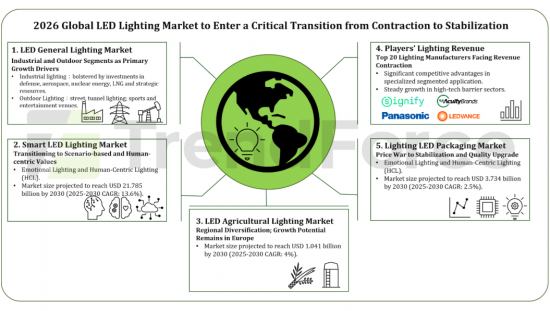
Below are 5 strategic observations for the global LED lighting market in 2026:
1. General Lighting Market: Industrial and Outdoor Segments as Primary Growth Drivers
Although general lighting remains in an adjustment phase in 2026, selected subsegments demonstrate resilient growth potential.
Industrial lighting is set to become the core growth engine in 2026, bolstered by investments in defense, aerospace, nuclear energy, liquefied natural gas (LNG), and strategic resources. Simultaneously, the accelerated construction of AI data centers is driving demand for infrastructure lighting tailored for liquid cooling systems and server racks. In the outdoor segment, the renewal of aging infrastructure and upgrades to tunnel lighting standards continue to fuel retrofit demand. Furthermore, lighting for sports and entertainment venues, alongside smart and energy-saving solutions, are providing significant incremental growth to the market.
By region, Europe still dominates the market, followed by the North America and Asia-Pacific regions. The European LED lighting market is projected to expand at a CAGR of 2.3% from 2025 to 2030. This growth is mainly supported by the accelerating enforced adoption of energy-saving lighting retrofit solutions to rein in the rising energy costs. The Asian-Pacific market keeps up its momentum on growth, especially in the Southeastern market, with a CAGR of 3.6% throughout the same forecast period.
2. Smart Lighting Market: Transitioning from Technical Spec Wars to Scenario-based and Human-centric Values
TrendForce indicates that in 2025, the global lighting industry entered a new phase centered on Emotional Lighting and Human-Centric Lighting (HCL). Competitive dynamics are shifting away from traditional performance metrics such as luminous efficacy and communication protocols toward value propositions focused on circadian rhythm regulation and experiential scenarios.
Enabled by AI-based dimming, full-spectrum control, and Software-Defined Lighting (SDL), lighting products evolve from static hardware devices into intelligent system nodes capable of perception and adaptive learning. According to TrendForce data, the smart lighting market is projected to reach USD 21.785 billion by 2030, representing a CAGR of 13.6% from 2025 to 2030. Growth will mostly come from value enhancement through AI enablement and system upgrades in three major application scenarios: residential, outdoor, and industrial lighting.
As AI, SDL, and IoT technologies converge, lighting is transitioning from basic illumination equipment to a critical sensing and interaction node within smart living environments, urban governance systems, and industrial digitalization frameworks. Suppliers with software-hardware integration capabilities, ecosystem collaboration and scenario-aware insights will be well-positioned to gain a competitive edge in the future smart lighting market.
3. Agricultural Lighting: Deepening Regional Differentiation with Upside Potential in Europe
Replacement cycles for specialty crops have not materialized as expected, while budget constraints have led to continued downward pressure on end-product pricing. Meanwhile, new greenhouse and vertical farm construction projects have been postponed globally in 2025.
However, Europe remains comparatively resilient, supported by energy-efficiency regulations and the adoption of high photosynthetic photon efficacy (PPF/W, PPE) solutions, effectively offsetting weakness in North America and other regions. In 2025, the global LED horticultural lighting market reached USD 1.365 billion (+4% YoY).
Looking ahead to 2026, with a specific focus on greenhouse applications, accelerated LED replacement of high-pressure sodium (HPS) systems in Europe will continue to drive demand. Meanwhile, North America, Asia, and the Middle East are entering a new expansion cycle, supported by food security policies and export-oriented agricultural investments. Demand for high-PPE, spectrum-tunable, and intelligent LED lighting systems is expected to increase. TrendForce projects the market to reach USD 1.041 billion by 2030, with a CAGR of 4% from 2025 to 2030.
In the LED packaging segment, 2026 is expected to mark accelerated adoption of multi-channel spectral technologies. Most newly registered products will feature dynamic dimming functionality and higher precision control requirements, driving demand for higher-quality solutions and increased LED shipment volumes. Following previous inventory adjustments and industry consolidation, agricultural lighting LED ASPs are expected to stabilize in 2026.
4. Manufacturer Revenue: Rising Share of Smart Lighting and Segmented Application Markets
According to TrendForce's latest statistics, total revenue of the global top 20 lighting companies is projected to decline 2% YoY to USD 23.355 billion in 2025. The top five players remain unchanged: Signify, Acuity Brands, Panasonic, LEDVANCE, and Zumtobel.
TrendForce observes that at specific segments, professional segmented lighting shows advantages in terms of economies of scale. While global general lighting leaders such as Signify and LEDVANCE face revenue contraction in 2025 due to sluggish real estate markets and price competition in the traditional residential and commercial general lighting markets. Conversely, companies focusing on high-tech niche areas show steady performance.
Warom, specializing in explosion-proof and industrial lighting, is expected to achieve a 5.8% revenue growth for 2025, as it has benefited from the recovery of global energy extraction activities and the rise in industrial safety demands. Similarly, Glamox Group, which focuses on marine and offshore energy lighting, is projected to maintain a steady growth rate of 3.2%, driven by the demand for ship lighting upgrades influenced by the EU's maritime carbon emission policies.
TrendForce believes that as the effect of economies of scale is diminishing in the general lighting market, high-tech niche segments have become the key for manufacturers to maintain profitability and growth.
5. LED Packaging Market: From Price War to Stabilization and Quality Upgrade
TrendForce analysis indicates that in 2025, the lighting LED market faced intensified price erosion and low order visibility due to aggressive cost optimization strategies by international brands from Europe and the USA and concentrated adoption of high cost-performance solutions.
After prolonged margin compression, the LED packaging market is expected to exit its downward cycle in 2026. With rising upstream material costs, LED packaging prices are likely to stabilize, marking a transition from continuous price decline to a volume contraction with price stabilization environment.
Supported by sustainability policies, carbon reduction targets, and strengthened green building standards, the industry structure is undergoing qualitative transformation. The LED lighting industry is expected to complete its cyclical bottoming phase in 2026 and begin recovery in 2027. TrendForce maintains a cautiously optimistic outlook, forecasting the global lighting LED market to reach USD 3.734 billion by 2030, representing a 2025-2030 CAGR of 2.5%.
TrendForce provides in-depth insights into global LED lighting industry trends, covering market size, pricing, and regional distribution across general, smart, and horticultural lighting segments, along with analysis of developments in the LED packaging sector. The report tracks revenue and strategies of the top 20 manufacturers, examines the competitive positioning of leading players such as Signify, Acuity, Panasonic, LEDVANCE, and Opple, and outlines trends and price movements in seven major luminaire categories, supported by monthly segmented markets analysis.
TABLE OF CONTENTS
PART 1 Introduction
- 1.1 Market Research Methodology
- 1.2 Global Economics (GDP)
- 1.3 Exchange Rates
PART 2 General Lighting Market Forecast (2026-2030)
- 2.1 General LED Lighting Market Scale-Demand Market Value & Volume & ASP-by Product
- 2.2 General LED Lighting Market Scale-Demand Market Value-by Category-Lamps & Luminaries
- 2.3 General LED Lighting Market Scale-Demand Market Value-by Region
- 2.4 General LED Lighting Market Scale-Demand Market Value & Volume-by Product & by Region
- 2.5 General LED Lighting Market Scale-Demand Market Value-by Application
- 2.6 General LED Lighting Penetration Rate (Installed Based Volume)
- 2.7 General Lighting LED Market-Value & Volume-by Application
- 2.8 General Lighting LED Market-Value & Volume & ASP-by Power
- 2.9 General Lighting LED Market-Value & Volume & ASP-by Package Type
- 2.10 General Lighting LED Market-Value-by CCT
- 2.11 General Lighting LED Market-Value & Volume-by CRI
- 2.12 General Lighting LED Price
PART 3 Smart Lighting Market Forecast (2026-2030)
- 3.1 Smart LED Lighting Market Scale-Demand Market Value-by Application
- 3.2 Smart LED Lighting Market Scale-Demand Market Value-by Region
PART 4 Agricultural Lighting Market Forecast (2026-2030)
- 4.1 Horticultural LED Lighting Market Scale-Demand Market Value-by Application
- 4.2 Horticultural LED Lighting Market Scale-Demand Market Value-by Region
- 4.3 Agricultural Lighting LED Market-Value & Volume-by Chip Type
- 4.4 Agricultural Lighting LED Market-Value & Volume-by Power
- 4.5 Agricultural Lighting LED Price
- 4.6 Horticultural Lighting LED Player Revenue Ranking (2023-2025E)
PART 5 Lighting Player Revenue Ranking and Estimated
- 5.1 Top 20 Lighting Player Revenue (2023-2025E)
- 5.2 Top 10 Lighting Player Revenue Ranking by Application (2023-2025E)
- 5.3 Lighting LED Player Revenue (2023-2025E)
PART 6 LED Lighting Product Specification and Price
- 6.1 Product & Price- Filament Lamp-by Region
- 6.2 Product & Price- Street Light-by Region
- 6.3 Product & Price- Panel Light-by Region
- 6.4 Product & Price- Troffer-by Region
- 6.5 Product & Price- High/Low Bay-by Region
- 6.6 Product & Price- Explosion Proof Light-by Region
- 6.7 Product & Price- Horticultural Light- by Application
(PDF)1. 2025 Global LED Lighting Market Trend- Player Strategies
Chapter 1 Global Smart LED Lighting Market Trend
- 2026-2030 Global Smart LED Lighting Market Size Analysis
- 2026-2030 Global Smart LED Lighting Market Size Analysis: Residential
- 2025-2026 Smart Residential Lighting Products
- 2026-2030 Global Smart LED Lighting Market Size Analysis: Outdoor
- 2026-2030 Global Smart LED Lighting Market Size Analysis: Industrial
- 2026-2030 Global Smart LED Lighting Market Size Analysis: by Region
- Smart Lighting Control Protocol- Bluetooth
- Smart Lighting Control Protocol- Zhaga
Chapter 2 Lighting Player Revenue and Market Strategies Analysis
- 2023-2025(E) Top 20 Lighting Player Revenue Ranking: Total Lighting
- 2023-2025(E) Top 20 Lighting Player Revenue Ranking: LED Lighting
- Lighting Player Revenue and Product Strategies
- Signify
- Zumtobel
- Fagerhult
- Acuity
- Current
- Panasonic
- Endo Lighting
- Chinese Lighting Player Revenue and Product Strategies
- LEDVANCE / MLS
- Opple Lighting
- NVC Lighting
- Foshan Lighting
- Yankon Group
(PDF)2. LED Lighting Market Monthly Report-Segment Application and Product Analysis
- Foreword
- TrendForce's Perspective
- Market Overview and Feature Analysis
- Product Types and Application Scenario Analysis
- Mainstream Product Specifications and LED Requirement Analysis
- Manufacturer Dynamics and Competitive Landscape Analysis

