PUBLISHER: Zhar Research | PRODUCT CODE: 1967351

PUBLISHER: Zhar Research | PRODUCT CODE: 1967351
Medical Materials that Heal Themselves: Markets, Technology: 2026-2046
Summary
Self-healing materials have the greatest potential in healthcare due to exceptionally strong needs and broad applicability. That spans implants, artificial skin, tissue engineering, drug delivery materials and much more, from instruments to healthcare vehicles and buildings. The new commercially-oriented Zhar Research report, "Medical Materials that Heal Themselves: Markets, Technology: 2026-2046" comprehensively covers all your opportunities. Self-healing materials and devices and their medical impact are the focus. Such materials will be a market of over $20 billion within 20 years.
Healing many types of damage
Types of damage to people and things that are addressed include microbial attack, chemical, mechanical, electrical and ageing. There is relevance to adjacent subjects such as fitness, wellness, veterinary and wearables. Uniquely comprehensive and up-to-date (continuous updating from 2026 onwards) it has 382 pages, six chapters, nine SWOT appraisals, roadmap and 17 forecast lines 2026-2046. Over 64 companies are covered. In particular, the strong research pipeline and company initiatives in 2025-6 are closely analysed to reveal winning materials, applications, issues and initiatives.
The self-healing megatrend
Dr Peter Harrop, CEO of analysts Zhar Research says, "Using self-healing materials enables both clinically-effective and cost-effective outcomes. Initially, they present opportunities for premium pricing, including where toxigen intermediaries are substituted. Then many will be a given, so practitioners and suppliers must correctly reflect these trends. Later, there is even wide potential for self-healing Engineered Living Materials extending patient longevity and quality of life."
Stand-alone summary and conclusions
The Executive Summary and Conclusions (54 pages) is sufficient in itself because it has the 34 key conclusions, SWOT appraisals, forecasts and roadmap 2026-2046 and many new graphics. The Introduction (31 pages) explains the definitions, choices, market drivers and options. See how components-in-a-box trend to self-healing, multifunctional materials, even structural electronics. Why the trend to long life, reliability, fit-and-forget and rejuvenation? Why has biomimetics got much further to go but we must overcome the soft material dilemma? In this chapter and the others, all is brought alive with analysed examples of research on self-healing materials in 2025-6.
Self-healing toolkit presents many opportunities
Chapter 3. "The Self-healing Technology Toolkit: General" is the longest chapter at 118 pages. It looks closely and intrinsic and extrinsic self-healing material mechanisms. Then it reveals your inanimate self-healing material opportunities - inorganic, organic and composite - explaining the flood of new research. What is winning and why? What problems are your opportunities? For example, it finds that self-healing in wet environments is very relevant but self-healing metals and building materials are more peripheral to the healthcare sector.
Chapter 4. "Self-healing Technology Toolkit: Engineered Living Materials ELM" is 36 pages. While nature-inspired non-living materials exhibit exceptional properties, they typically lack the dynamic functionalities of living systems, such as self-healing and environmental responsiveness. Here we see bacteria, algae and particularly funghi showing promise but the practical and regulatory challenges for healthcare application are formidable. First come novel structures and functionalities where the growth is killed before use. However, self-healing, living biobandages for wound healing are already a target.
Medical outcomes and paybacks
The report then swings from primarily discussing the self-healing toolkit to detailed examination of the applications emerging, with lessons from success and failure. Chapter 5. "Self-healing Material Applications in Healthcare 2026-2046" takes 102 pages to comprehensively appraise the dreams, prioritisation of applications and achievements including relevant research advances even into 2026. That includes your applications for self-healing subsystems such as membranes, e-skin and smart sensors, taking into consideration biocompatibility, sensory, electronic, anti-bacterial, anti-fouling and other aspects. Topics include tissue engineering, cell co-culture, organ replacement, artificial muscle, cartilage, prosthetics, soft robotics and drug delivery by self-healing microcapsules, hydrogels and other routes. To maximise your opportunities, the chapter ends with self-healing electronic and electrical components in healthcare including patches and even self-healing triboelectric nanogenerators for muscle motion monitoring and photothermal treatment.
Room for more suppliers
The report closes with 23 pages of Chapter 6 assessing actual and putative suppliers under, "Self-healing Company Profiles" with overview and value chain, comparison of 62 self-healing material manufacturers in eight columns and profiles of 14 companies involved. The report, "Medical Materials that Heal Themselves: Markets, Technology: 2026-2046" is your essential guide to this rapidly emerging market opportunity.
CAPTION: Healthcare self-healing research material priority analysis. Source Zhar Research report, "Medical Materials that Heal Themselves: Markets, Technology: 2026-2046".
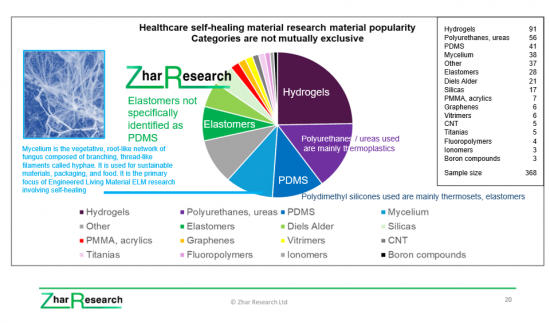
Table of Contents
1. Executive summary and conclusions
- 1.1 Purpose, methodology and background of this report
- 1.2 Definitions and focus with analysis of 368 healthcare self-healing materials researched
- 1.3 34 conclusions
- 1.3.1 Addressable markets: 10 general conclusions, 3 infograms and 2 SWOT appraisals
- 1.3.2 Emerging technologies and capabilities: 24 key conclusions, 6 infograms, compound prioritisation chart, 6 SWOT appraisals
- 1.3.3 Self-healing Engineered Living Materials ELM with infograms and SWOT
- 1.3.4 Market fundamentals in infograms, pie charts and commentary
- 1.4 Maturity curves of self-healing material technologies in healthcare 2026, 2036, 2046
- 1.5 Roadmap for self-healing materials in healthcare 2026-2046
- 1.6 Market forecasts 2026-2046 in 17 lines
- 1.6.1 Self-healing materials for all applications: value market 2026-2046
- 1.6.2 Self-healing materials for healthcare value market $ billion 2026-2046
- 1.6.3 Percentage share of self-healing healthcare value market by four regions 2026-2046
- 1.6.4 Percentage share of hydrogel value market by four regions 2026-2046
- 1.6.5 Global hydrogel value market by four business sectors 2026-2046
2. Introduction
- 2.1 Definition and choices
- 2.2 Market drivers and options
- 2.2.1 Trend to self-healing smart materials
- 2.2.2 Trend to long life, reliability, fit-and-forget, rejuvenation
- 2.2.3 Biomimetics - much further to go
- 2.2.4 Overcoming the soft material dilemma
- 2.2.5 Beyond biomimetics
- 2.2.6 Challenges of putting a value on the market
- 2.2.7 Stretching the logic to include minimal post treatment
- 2.3 Analysed examples of research on self-healing materials in 2025-6
3. The self-healing technology toolkit: general
- 3.1 Overview
- 3.2 Technology options top down - intrinsic and extrinsic mechanisms
- 3.3 Self-healing options: operational, physical, chemical, formulation, format
- 3.4 Autogeneous and autonomic self-healing advances in 2025-6: polymers and ceramics
- 3.5 Atomic and molecular toolkit for self-healing materials
- 3.6 Some of the important self-healing materials by application likely to be commercialised 2025-2045
- 3.7 The dilemma of metrics for self-healing efficacy
- 3.7.1 Quantifying healing time, maximum number of healing cycles enabled, degree of recovery
- 3.7.2 Efficiency and mobility over time
- 3.8 Self-healing polymer toolkit
- 3.8.1 Types of polymer damage to be healed
- 3.8.2 Healing options for polymers
- 3.8.3 Difficulty levels for self-healing commercialisation in polymer sectors
- 3.9 Toolkit for intrinsic self-healing materials
- 3.9.1 Overview, importance of nanomaterials
- 3.9.2 Hydrogels with SWOT appraisal, options for repairing structural damage, recovering original functions, mimicking natural healing, improvement 2025-2045
- 3.9.3 Wound healing, tissue engineering, and nerve regeneration with biocompatible self-healing hydrogels: surge in research advances in 2025-6
- 3.9.4 Sustained hydrogel delivery of decorin to prevent corneal scarring
- 3.9.5 Wound-healing and injectable self-healing hydrogels: tissue engineering and regenerative medicine in 2025-6
- 3.9.6 Ionogel self healing including 2025-6 research advances
- 3.9.7 Silica gel
- 3.9.8 Supramolecular gels and elastomers for implantable and smart patch energy storage in 2025-6
- 3.9.9 Diels Alder self-healing adhesives, coatings including SWOT and latest research appraisal
- 3.9.10 Self-healing ionomers for healthcare packaging and biomedical sensors
- 3.9.11 Vitrimers with examples researched in 2026
- 3.9.12 Self-healing proteins such as polypeptides
- 3.9.13 Self-healing metals
- 3.9.14 Self-healing under water
- 3.10 Extrinsic self-healing by microcapsules
- 3.10.1 SWOT appraisal
- 3.10.2 Design issues and examples
- 3.10.3 Self-healing microcapsule manufacturing options
- 3.11 Extrinsic self-healing by vascular systems
- 3.11.1 Vascular self-healing SWOT appraisal
- 3.11.2 Geometrical design and challenges
- 3.12 Vascular-like self-healing
- 3.13 Self-healing elastomers intrinsic and extrinsic
- 3.14 Shape memory assisted self-healing SMASH
- 3.14.1 Shape memory alloys and polymers and SMASH potential markets
- 3.14.2 Stress-Induced shape-shifting materials possessing autonomous self-healing and scratch-resistant ability
- 3.14.3 Hydrogel versions
- 3.14.4 Polyolefin and polyurethane versions
- 3.14.5 Close-then-heal and fiber dispersion options
4. Self-healing technology toolkit: Engineered Living Materials ELM
- 4.1 Overview
- 4.1.1 Definition and choice of hosts
- 4.1.2 Learning from nature
- 4.1.3 Allied topic: assisting human healing by application of biological materials that may or may not be self-healing themselves
- 4.1.4 Features of engineered living materials
- 4.1.5 Four stages of ELM creation and deployment
- 4.2 Self-healing Engineered Living Material SWOT appraisal
- 4.3 Obstacles and the way forward
- 4.4 Self-healing approaches with biological materials
- 4.5 Bio ELM vs hybrid ELM
- 4.6 Self-healing ELM hydrogels
- 4.7 Relevant ELM research in 2025-6
5. Self-healing material applications in healthcare 2026-2046
- 5.1 Overview: topics, biomaterials and vision of self-healing healthcare materials
- 5.2 SWOT appraisal of self-healing material applications in healthcare and examples of medical self-healing materials in action in 2026
- 5.3 Artificial human skin and muscle: self-healing materials and material that helps you to "self-heal"
- 5.3.1 Overview: progress 2025-6, technology trends including sensory, electronic, biocompatibility, anti-bacterial, anti-fouling aspects
- 5.3.2 Hydrogel approach
- 5.3.3 Polyimine approach
- 5.3.4 Fluoropolymer sensory robots
- 5.3.5 Silicone approach: e-skin, siloxanes
- 5.3.6 PVA, organometallic polymer and other approaches
- 5.4 Tissue engineering, cell co-culture, organ replacement
- 5.4.1 Objectives and progress in 2025-6
- 5.4.2 Tissue engineering adhesives
- 5.4.3 Tissue engineering films
- 5.4.4 Hydrogel approaches
- 5.5 Artificial muscle, cartilage, prosthetics and soft robotics
- 5.5.1 Overview
- 5.5.2 PDMS approach
- 5.5.3 Hydrogel approaches including as engineered living materials and SWOT appraisal
- 5.5.4 Self-healing soft robotics: US Army and others
- 5.6 Bone repair and replacement
- 5.7 Titanium and other implants
- 5.8 Membranes
- 5.8.1 Definitions
- 5.8.2 Fabricated membranes
- 5.8.3 Difficulty levels for self-healing membrane
- 5.9 Drug delivery by microcapsules and hydrogels
- 5.10 Electronics
- 5.10.1 Overview and health monitoring
- 5.10.2 Conductors
- 5.10.3 Transistors
- 5.10.4 Sensors
- 5.10.5 Optical and photonic materials
- 5.10.6 Self-healing implantable and smart patch batteries and battery parts including 2025-6 research advances
- 5.10.7 Self-healing triboelectric nanogenerators for muscle motion monitoring and photothermal treatment
6. Self-healing company profiles
- 6.1 Overview and value chain
- 6.2 Comparison of 62 self-healing material manufacturers in eight columns
- 6.3 Profiles of 14 companies involved

