
PUBLISHER: Aviation & Defense Market Reports (A&D) | PRODUCT CODE: 1930536

PUBLISHER: Aviation & Defense Market Reports (A&D) | PRODUCT CODE: 1930536
Global Armored Vehicle Market 2026-2036
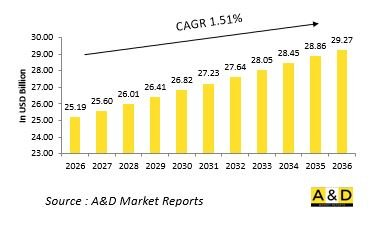
The Global Armored vehicles market is estimated at USD 25.19 billion in 2026, projected to grow to USD 29.27 billion by 2036 at a Compound Annual Growth Rate (CAGR) of 1.51% over the forecast period 2026-2036.
Introduction
Armored vehicles represent a cornerstone of modern ground warfare, providing protected mobility, fire support, and operational endurance across diverse combat scenarios. These platforms are designed to operate in high-threat environments where survivability and maneuverability are critical to mission success. Armored vehicles support a wide range of roles including frontline combat, reconnaissance, command operations, logistics support, and internal security missions. As modern conflicts increasingly involve hybrid threats and complex terrain, the operational value of armored vehicles continues to expand. Defense forces worldwide prioritize these platforms to ensure force protection while maintaining tactical flexibility. Modernization initiatives focus on improving mobility, protection, and integration with networked command systems. Armored vehicles remain essential for maintaining operational tempo and battlefield dominance, reflecting their enduring relevance within land force structures.
Technology Impact in Armored Vehicles
Technological innovation is transforming armored vehicles into more capable and adaptable platforms. Advances in armor materials enhance protection against diverse threats while reducing weight. Improved powertrains and suspension systems increase mobility across challenging terrain. Integration of advanced sensors and situational awareness systems improves threat detection and crew coordination. Digital command and control interfaces enable armored vehicles to operate as connected elements within network-centric operations. Active protection systems enhance survivability by countering incoming threats. Modular design allows rapid adaptation to different mission profiles. These technological developments improve combat effectiveness while extending platform service life.
Key Drivers in Armored Vehicles
The demand for armored vehicles is driven by evolving threat environments and force modernization priorities. Military organizations seek platforms that provide enhanced survivability and operational flexibility. Urban warfare and peacekeeping missions require protected mobility and adaptability. Defense procurement policies emphasize replacing aging fleets with modern solutions. Increased focus on joint operations and interoperability further supports demand. Indigenous production initiatives influence acquisition strategies. Training and logistics considerations also favor reliable and maintainable platforms. These drivers ensure sustained investment in armored vehicle capabilities.
Regional Trends in Armored Vehicles
Regional defense strategies shape armored vehicle development and deployment. North American forces focus on advanced protection and digital integration. European militaries emphasize interoperability and modularity for multinational operations. Asia-Pacific nations prioritize mobility and adaptability to varied terrain. Middle Eastern forces focus on robust protection for high-risk environments. African defense organizations seek cost-effective and durable solutions. Across regions, local manufacturing and technology partnerships are expanding. These trends reflect the global importance of armored vehicles in modern defense planning.
Key Armored vehicles Program:
Oshkosh Defense secured a $792 million U.S. Army contract modification in June 2025 for Family of Medium Tactical Vehicle A2 production, supporting a three-year extension of the program. The company also received a $95 million order for autonomy-ready heavy tactical vehicles in April 2025. These contracts sustain American production of protected mobility platforms featuring modular armor configurations, advanced suspension systems, and integration capabilities for remote weapon stations and electronic warfare suites.
Table of Contents
Armored Vehicle Market - Table of Contents
Armored Vehicle Market Report Definition
Armored Vehicle Market Segmentation
By Region
By Type
By Mobility
By Components
Armored Vehicle Market Analysis for next 10 Years
The 10-year armored vehicle market analysis would give a detailed overview of armored vehicle market growth, changing dynamics, technology adoption overviews and the overall market attractiveness is covered in this chapter.
Market Technologies of Armored Vehicle Market
This segment covers the top 10 technologies that is expected to impact this market and the possible implications these technologies would have on the overall market.
Global Armored Vehicle Market Forecast
The 10-year armored vehicle market forecast of this market is covered in detailed across the segments which are mentioned above.
Regional Armored Vehicle Market Trends & Forecast
The regional armored vehicle market trends, drivers, restraints and Challenges of this market, the Political, Economic, Social and Technology aspects are covered in this segment. The market forecast and scenario analysis across regions are also covered in detailed in this segment. The last part of the regional analysis includes profiling of the key companies, supplier landscape and company benchmarking. The current market size is estimated based on the normal scenario.
North America
Drivers, Restraints and Challenges
PEST
Market Forecast & Scenario Analysis
Key Companies
Supplier Tier Landscape
Company Benchmarking
Europe
Middle East
APAC
South America
Country Analysis of Armored Vehicle Market
This chapter deals with the key defense programs in this market, it also covers the latest news and patents which have been filed in this market. Country level 10 year market forecast and scenario analysis are also covered in this chapter.
US
Defense Programs
Latest News
Patents
Current levels of technology maturation in this market
Market Forecast & Scenario Analysis
Canada
Italy
France
Germany
Netherlands
Belgium
Spain
Sweden
Greece
Australia
South Africa
India
China
Russia
South Korea
Japan
Malaysia
Singapore
Brazil
Opportunity Matrix for Armored Vehicle Market
The opportunity matrix helps the readers understand the high opportunity segments in this market.
Expert Opinions on Armored Vehicle Market Report
Hear from our experts their opinion of the possible analysis for this market.
Conclusions
About Aviation and Defense Market Reports
List of Tables
- Table 1: 10 Year Market Outlook, 2026-2036
- Table 2: Drivers, Impact Analysis, North America
- Table 3: Restraints, Impact Analysis, North America
- Table 4: Challenges, Impact Analysis, North America
- Table 5: Drivers, Impact Analysis, Europe
- Table 6: Restraints, Impact Analysis, Europe
- Table 7: Challenges, Impact Analysis, Europe
- Table 8: Drivers, Impact Analysis, Middle East
- Table 9: Restraints, Impact Analysis, Middle East
- Table 10: Challenges, Impact Analysis, Middle East
- Table 11: Drivers, Impact Analysis, APAC
- Table 12: Restraints, Impact Analysis, APAC
- Table 13: Challenges, Impact Analysis, APAC
- Table 14: Drivers, Impact Analysis, South America
- Table 15: Restraints, Impact Analysis, South America
- Table 16: Challenges, Impact Analysis, South America
- Table 17: Scenario Analysis, Scenario 1, By Region, 2026-2036
- Table 18: Scenario Analysis, Scenario 1, By Type, 2026-2036
- Table 19: Scenario Analysis, Scenario 1, By Mobility, 2026-2036
- Table 20: Scenario Analysis, Scenario 1, By Components, 2026-2036
- Table 21: Scenario Analysis, Scenario 2, By Region, 2026-2036
- Table 22: Scenario Analysis, Scenario 2, By Type, 2026-2036
- Table 23: Scenario Analysis, Scenario 2, By Mobility, 2026-2036
- Table 24: Scenario Analysis, Scenario 2, By Components, 2026-2036
List of Figures
- Figure 1: Global Armored Vehicle Market Forecast, 2026-2036
- Figure 2: Global Armored Vehicle Market Forecast, By Region, 2026-2036
- Figure 3: Global Armored Vehicle Market Forecast, By Type, 2026-2036
- Figure 4: Global Armored Vehicle Market Forecast, By Mobility, 2026-2036
- Figure 5: Global Armored Vehicle Market Forecast, By Components, 2026-2036
- Figure 6: North America, Armored Vehicle Market, Market Forecast, 2026-2036
- Figure 7: Europe, Armored Vehicle Market, Market Forecast, 2026-2036
- Figure 8: Middle East, Armored Vehicle Market, Market Forecast, 2026-2036
- Figure 9: APAC, Armored Vehicle Market, Market Forecast, 2026-2036
- Figure 10: South America, Armored Vehicle Market, Market Forecast, 2026-2036
- Figure 11: United States, Armored Vehicle Market, Technology Maturation, 2026-2036
- Figure 12: United States, Armored Vehicle Market, Market Forecast, 2026-2036
- Figure 13: Canada, Armored Vehicle Market, Technology Maturation, 2026-2036
- Figure 14: Canada, Armored Vehicle Market, Market Forecast, 2026-2036
- Figure 15: Italy, Armored Vehicle Market, Technology Maturation, 2026-2036
- Figure 16: Italy, Armored Vehicle Market, Market Forecast, 2026-2036
- Figure 17: France, Armored Vehicle Market, Technology Maturation, 2026-2036
- Figure 18: France, Armored Vehicle Market, Market Forecast, 2026-2036
- Figure 19: Germany, Armored Vehicle Market, Technology Maturation, 2026-2036
- Figure 20: Germany, Armored Vehicle Market, Market Forecast, 2026-2036
- Figure 21: Netherlands, Armored Vehicle Market, Technology Maturation, 2026-2036
- Figure 22: Netherlands, Armored Vehicle Market, Market Forecast, 2026-2036
- Figure 23: Belgium, Armored Vehicle Market, Technology Maturation, 2026-2036
- Figure 24: Belgium, Armored Vehicle Market, Market Forecast, 2026-2036
- Figure 25: Spain, Armored Vehicle Market, Technology Maturation, 2026-2036
- Figure 26: Spain, Armored Vehicle Market, Market Forecast, 2026-2036
- Figure 27: Sweden, Armored Vehicle Market, Technology Maturation, 2026-2036
- Figure 28: Sweden, Armored Vehicle Market, Market Forecast, 2026-2036
- Figure 29: Brazil, Armored Vehicle Market, Technology Maturation, 2026-2036
- Figure 30: Brazil, Armored Vehicle Market, Market Forecast, 2026-2036
- Figure 31: Australia, Armored Vehicle Market, Technology Maturation, 2026-2036
- Figure 32: Australia, Armored Vehicle Market, Market Forecast, 2026-2036
- Figure 33: India, Armored Vehicle Market, Technology Maturation, 2026-2036
- Figure 34: India, Armored Vehicle Market, Market Forecast, 2026-2036
- Figure 35: China, Armored Vehicle Market, Technology Maturation, 2026-2036
- Figure 36: China, Armored Vehicle Market, Market Forecast, 2026-2036
- Figure 37: Saudi Arabia, Armored Vehicle Market, Technology Maturation, 2026-2036
- Figure 38: Saudi Arabia, Armored Vehicle Market, Market Forecast, 2026-2036
- Figure 39: South Korea, Armored Vehicle Market, Technology Maturation, 2026-2036
- Figure 40: South Korea, Armored Vehicle Market, Market Forecast, 2026-2036
- Figure 41: Japan, Armored Vehicle Market, Technology Maturation, 2026-2036
- Figure 42: Japan, Armored Vehicle Market, Market Forecast, 2026-2036
- Figure 43: Malaysia, Armored Vehicle Market, Technology Maturation, 2026-2036
- Figure 44: Malaysia, Armored Vehicle Market, Market Forecast, 2026-2036
- Figure 45: Singapore, Armored Vehicle Market, Technology Maturation, 2026-2036
- Figure 46: Singapore, Armored Vehicle Market, Market Forecast, 2026-2036
- Figure 47: United Kingdom, Armored Vehicle Market, Technology Maturation, 2026-2036
- Figure 48: United Kingdom, Armored Vehicle Market, Market Forecast, 2026-2036
- Figure 49: Opportunity Analysis, Armored Vehicle Market, By Region (Cumulative Market), 2026-2036
- Figure 50: Opportunity Analysis, Armored Vehicle Market, By Region (CAGR), 2026-2036
- Figure 51: Opportunity Analysis, Armored Vehicle Market, By Type (Cumulative Market), 2026-2036
- Figure 52: Opportunity Analysis, Armored Vehicle Market, By Type (CAGR), 2026-2036
- Figure 53: Opportunity Analysis, Armored Vehicle Market, By Mobility (Cumulative Market), 2026-2036
- Figure 54: Opportunity Analysis, Armored Vehicle Market, By Mobility (CAGR), 2026-2036
- Figure 55: Opportunity Analysis, Armored Vehicle Market, By Components (Cumulative Market), 2026-2036
- Figure 56: Opportunity Analysis, Armored Vehicle Market, By Components (CAGR), 2026-2036
- Figure 57: Scenario Analysis, Armored Vehicle Market, Cumulative Market, 2026-2036
- Figure 58: Scenario Analysis, Armored Vehicle Market, Global Market, 2026-2036
- Figure 59: Scenario 1, Armored Vehicle Market, Total Market, 2026-2036
- Figure 60: Scenario 1, Armored Vehicle Market, By Region, 2026-2036
- Figure 61: Scenario 1, Armored Vehicle Market, By Type, 2026-2036
- Figure 62: Scenario 1, Armored Vehicle Market, By Mobility, 2026-2036
- Figure 63: Scenario 1, Armored Vehicle Market, By Components, 2026-2036
- Figure 64: Company Benchmark, Armored Vehicle Market, 2026-2036

