
PUBLISHER: Aviation & Defense Market Reports (A&D) | PRODUCT CODE: 1936056

PUBLISHER: Aviation & Defense Market Reports (A&D) | PRODUCT CODE: 1936056
Global Defense Ignition Exciters Market 2026-2036
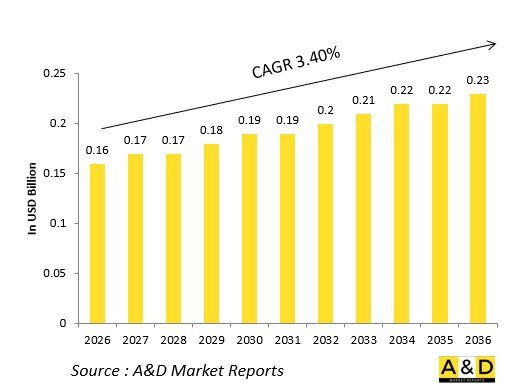
The Global Defense Ignition Exciters Market is estimated at USD 0.16 billion in 2026, projected to grow to USD 0.23 billion by 2036 at a Compound Annual Growth Rate (CAGR) of 3.40% over the forecast period 2026-2036.
Introduction:
The global Defense Ignition Exciters market generates precise capacitive discharges to arc igniter plugs, initiating combustion in turbine cores during startup, relight, or afterburner transitions. Dual-redundant channels store energy in high-voltage capacitors, triggered by FADEC commands through transformer-isolators.
Market evolution tracks sixth-generation engines requiring continuous relight capability for unmanned deep-strike missions. Core technologies include silicon avalanche diodes, energy management circuits, and health monitoring feeding prognostic data links. Modular exciters enable line-replaceable swaps during forward deployments.
Geopolitical demands for scramble readiness drive development, prioritizing systems tolerant of electromagnetic pulses and synthetic fuels. Open architectures support integration across engine families. Supply chains focus on radiation-hardened semiconductors and ceramic insulators. Competition features Honeywell, Collins Aerospace, and TransDigm pioneering laser-based variants.
Technology Impact in Defense Ignition Exciters
Solid-state capacitor discharge replaces exploding bridge wires, delivering consistent kV pulses without consumables degradation. Silicon carbide rectifiers handle sustained afterburner relights, doubling service intervals versus legacy selenium stacks.
FADEC-integrated health monitoring analyzes discharge waveforms, detecting insulator tracking before arc-through. Laser plasma igniters focus kilowatt beams through fiber optics, striking multiple plug tips simultaneously for uniform flame kernels. Embedded current transformers validate arc formation within microseconds.
Digital twins optimize pulse timing against fuel spray patterns at altitude. Radiation-hardened gallium nitride switches survive nuclear environments. Dual-frequency exciters support dry turbine starts and wet afterburner lighting through selectable waveforms.
Predictive algorithms cue igniter swaps from voltage-rise signatures. Compact exciters integrate directly into fan cases, eliminating harness runs. Variable energy circuits adjust spark strength for hydrogenated synthetics. These innovations ensure light-off from cold-and-dark states.
Key Drivers in Defense Ignition Exciters
Adaptive cycle engines demand continuous relight during variable bypass transitions. Unmanned platforms require autonomous ignition without ground carts.
Sustainment prioritizes prognostic exciters eliminating scheduled removals. Export programs need electromagnetic pulse hardening across coalitions. Arctic cold soaks mandate sub-zero light-off reliability.
Budget favors commercial derivatives with mil-spec qualification. Supply resilience counters semiconductor shortages via domestic fabs. Interoperability enables common interfaces across engine families.
Directed-energy power extraction requires high-reliability ignition sequencing. These position exciters as combustion enablers.
Regional Trends in Defense Ignition Exciters
North America dominates F-35 sustainment, pioneering laser plasma for STOVL relights.
Europe upgrades Rafale/Typhoon exciters for dispersed basing with synthetic fuels.
Asia-Pacific surges with indigenous programs-India's Kaveri, China's WS-15-prioritizing high-altitude starts.
Middle East adapts circuits for desert overtemps.
Russia hardens systems for Su-57 nuclear missions.
South Korea integrates KF-21 with radiation-tolerant designs.
Trends favor solid-state; Asia-Pacific captures growth.
Key Defense Ignition Exciters Programs
F135 exciters power STOVL transitions and afterburner relights across variants.
NGAD laser plasma enables variable cycle combustion stability.
EJ200 upgrades deliver supercruise dry starts via optimized capacitors.
Kaveri equips Tejas with indigenous silicon avalanche circuits.
F119 systems sustain stealth missions with EMP-hardened stacks.
Rafale M88 integrates carrier catapult ignition surges.
Su-57 AL-41F1 supports 3D thrust vectoring light-offs.
T-50 FADEC-controlled dual-frequency prevents flameout cascades.
Table of Contents
Defense Ignition Exciters Market - Table of Contents
Defense Ignition Exciters Market Report Definition
Defense Ignition Exciters Market Segmentation
By Platform
By Energy Output
By Ignition Type
Defense Ignition Exciters Market Analysis for next 10 Years
The 10-year Defense Ignition Exciters market analysis would give a detailed overview of Defense Ignition Exciters market growth, changing dynamics, technology adoption overviews and the overall market attractiveness is covered in this chapter.
Market Technologies of Defense Ignition Exciters Market
This segment covers the top 10 technologies that is expected to impact this market and the possible implications these technologies would have on the overall market.
Global Defense Ignition Exciters Market Forecast
The 10-year Defense Ignition Exciters market forecast of this market is covered in detailed across the segments which are mentioned above.
Regional Defense Ignition Exciters Market Trends & Forecast
The regional counter drone market trends, drivers, restraints and Challenges of this market, the Political, Economic, Social and Technology aspects are covered in this segment. The market forecast and scenario analysis across regions are also covered in detailed in this segment. The last part of the regional analysis includes profiling of the key companies, supplier landscape and company benchmarking. The current market size is estimated based on the normal scenario.
North America
Drivers, Restraints and Challenges
PEST
Market Forecast & Scenario Analysis
Key Companies
Supplier Tier Landscape
Company Benchmarking
Europe
Middle East
APAC
South America
Country Analysis of Defense Ignition Exciters Market
This chapter deals with the key defense programs in this market, it also covers the latest news and patents which have been filed in this market. Country level 10 year market forecast and scenario analysis are also covered in this chapter.
US
Defense Programs
Latest News
Patents
Current levels of technology maturation in this market
Market Forecast & Scenario Analysis
Canada
Italy
France
Germany
Netherlands
Belgium
Spain
Sweden
Greece
Australia
South Africa
India
China
Russia
South Korea
Japan
Malaysia
Singapore
Brazil
Opportunity Matrix for Defense Ignition Exciters Market
The opportunity matrix helps the readers understand the high opportunity segments in this market.
Expert Opinions on Defense Ignition Exciters Market Report
Hear from our experts their opinion of the possible analysis for this market.
Conclusions
About Aviation and Defense Market Reports
List of Tables
- Table 1: 10 Year Market Outlook, 2026-2036
- Table 2: Drivers, Impact Analysis, North America
- Table 3: Restraints, Impact Analysis, North America
- Table 4: Challenges, Impact Analysis, North America
- Table 5: Drivers, Impact Analysis, Europe
- Table 6: Restraints, Impact Analysis, Europe
- Table 7: Challenges, Impact Analysis, Europe
- Table 8: Drivers, Impact Analysis, Middle East
- Table 9: Restraints, Impact Analysis, Middle East
- Table 10: Challenges, Impact Analysis, Middle East
- Table 11: Drivers, Impact Analysis, APAC
- Table 12: Restraints, Impact Analysis, APAC
- Table 13: Challenges, Impact Analysis, APAC
- Table 14: Drivers, Impact Analysis, South America
- Table 15: Restraints, Impact Analysis, South America
- Table 16: Challenges, Impact Analysis, South America
- Table 17: Scenario Analysis, Scenario 1, By Energy Output, 2026-2036
- Table 18: Scenario Analysis, Scenario 1, By Platform, 2026-2036
- Table 19: Scenario Analysis, Scenario 1, By Region, 2026-2036
- Table 20: Scenario Analysis, Scenario 2, By Energy Output, 2026-2036
- Table 21: Scenario Analysis, Scenario 2, By Platform, 2026-2036
- Table 22: Scenario Analysis, Scenario 2, By Region, 2026-2036
List of Figures
- Figure 1: Global Defense Ignition Exciters Market Forecast, 2026-2036
- Figure 2: Global Defense Ignition Exciters Market Forecast, By Energy Output, 2026-2036
- Figure 3: Global Defense Ignition Exciters Market Forecast, By Platform, 2026-2036
- Figure 4: Global Defense Ignition Exciters Market Forecast, By Region, 2026-2036
- Figure 5: North America, Defense Ignition Exciters Market , Forecast, 2026-2036
- Figure 6: Europe, Defense Ignition Exciters Market , Forecast, 2026-2036
- Figure 7: Middle East, Defense Ignition Exciters Market , Forecast, 2026-2036
- Figure 8: APAC, Defense Ignition Exciters Market , Forecast, 2026-2036
- Figure 9: South America, Defense Ignition Exciters Market , Forecast, 2026-2036
- Figure 10: United States, Defense Ignition Exciters Market , Technology Maturation, 2026-2036
- Figure 11: United States, Defense Ignition Exciters Market , Forecast, 2026-2036
- Figure 12: Canada, Defense Ignition Exciters Market , Technology Maturation, 2026-2036
- Figure 13: Canada, Defense Ignition Exciters Market , Forecast, 2026-2036
- Figure 14: Italy, Defense Ignition Exciters Market , Technology Maturation, 2026-2036
- Figure 15: Italy, Defense Ignition Exciters Market , Market Forecast, 2026-2036
- Figure 16: France, Defense Ignition Exciters Market , Technology Maturation, 2026-2036
- Figure 17: France, Defense Ignition Exciters Market , Market Forecast, 2026-2036
- Figure 18: Germany, Defense Ignition Exciters Market , Technology Maturation, 2026-2036
- Figure 19: Germany, Defense Ignition Exciters Market , Market Forecast, 2026-2036
- Figure 20: Netherlands, Defense Ignition Exciters Market , Technology Maturation, 2026-2036
- Figure 21: Netherlands, Defense Ignition Exciters Market , Market Forecast, 2026-2036
- Figure 22: Belgium, Defense Ignition Exciters Market , Technology Maturation, 2026-2036
- Figure 23: Belgium, Defense Ignition Exciters Market , Market Forecast, 2026-2036
- Figure 24: Spain, Defense Ignition Exciters Market , Technology Maturation, 2026-2036
- Figure 25: Spain, Defense Ignition Exciters Market , Market Forecast, 2026-2036
- Figure 26: Sweden, Defense Ignition Exciters Market , Technology Maturation, 2026-2036
- Figure 27: Sweden, , Market Forecast, 2026-2036
- Figure 28: Brazil, Defense Ignition Exciters Market , Technology Maturation, 2026-2036
- Figure 29: Brazil, Defense Ignition Exciters Market , Market Forecast, 2026-2036
- Figure 30: Australia, Defense Ignition Exciters Market , Technology Maturation, 2026-2036
- Figure 31: Australia, Defense Ignition Exciters Market , Market Forecast, 2026-2036
- Figure 32: India, Defense Ignition Exciters Market , Technology Maturation, 2026-2036
- Figure 33: India, Defense Ignition Exciters Market , Market Forecast, 2026-2036
- Figure 34: China, Defense Ignition Exciters Market , Technology Maturation, 2026-2036
- Figure 35: China, Defense Ignition Exciters Market , Market Forecast, 2026-2036
- Figure 36: Saudi Arabia, Defense Ignition Exciters Market , Technology Maturation, 2026-2036
- Figure 37: Saudi Arabia, Defense Ignition Exciters Market , Market Forecast, 2026-2036
- Figure 38: South Korea, Defense Ignition Exciters Market , Technology Maturation, 2026-2036
- Figure 39: South Korea, Defense Ignition Exciters Market , Market Forecast, 2026-2036
- Figure 40: Japan, Defense Ignition Exciters Market , Technology Maturation, 2026-2036
- Figure 41: Japan, Defense Ignition Exciters Market , Market Forecast, 2026-2036
- Figure 42: Malaysia, Defense Ignition Exciters Market , Technology Maturation, 2026-2036
- Figure 43: Malaysia, Defense Ignition Exciters Market , Market Forecast, 2026-2036
- Figure 44: Singapore, Defense Ignition Exciters Market , Technology Maturation, 2026-2036
- Figure 45: Singapore, Defense Ignition Exciters Market , Market Forecast, 2026-2036
- Figure 46: United Kingdom, Defense Ignition Exciters Market , Technology Maturation, 2026-2036
- Figure 47: United Kingdom, Defense Ignition Exciters Market , Market Forecast, 2026-2036
- Figure 48: Opportunity Analysis, Defense Ignition Exciters Market , By Energy Output (Cumulative Market), 2026-2036
- Figure 49: Opportunity Analysis, Defense Ignition Exciters Market , By Energy Output (CAGR), 2026-2036
- Figure 50: Opportunity Analysis, Defense Ignition Exciters Market , By (Cumulative Market), 2026-2036
- Figure 51: Opportunity Analysis, Defense Ignition Exciters Market , By Platform(CAGR), 2026-2036
- Figure 52: Opportunity Analysis, Defense Ignition Exciters Market , By Region (Cumulative Market), 2026-2036
- Figure 53: Opportunity Analysis, Defense Ignition Exciters Market , By Region (CAGR), 2026-2036
- Figure 54: Scenario Analysis, Defense Ignition Exciters Market , Cumulative Market, 2026-2036
- Figure 55: Scenario Analysis, Defense Ignition Exciters Market , Global Market, 2026-2036
- Figure 56: Scenario 1, Defense Ignition Exciters Market , Total Market, 2026-2036
- Figure 57: Scenario 1, Defense Ignition Exciters Market , By Energy Output, 2026-2036
- Figure 58: Scenario 1, Defense Ignition Exciters Market , By Platform, 2026-2036
- Figure 59: Scenario 1, Defense Ignition Exciters Market , By Region, 2026-2036
- Figure 60: Scenario 2, Defense Ignition Exciters Market , Total Market, 2026-2036
- Figure 61: Scenario 2, Defense Ignition Exciters Market , By Energy Output, 2026-2036
- Figure 62: Scenario 2, Defense Ignition Exciters Market , By Platform, 2026-2036
- Figure 63: Scenario 2, Defense Ignition Exciters Market , By Region, 2026-2036
- Figure 64: Company Benchmark, Defense Ignition Exciters Market , 2026-2036

