PUBLISHER: Aviation & Defense Market Reports (A&D) | PRODUCT CODE: 1951139

PUBLISHER: Aviation & Defense Market Reports (A&D) | PRODUCT CODE: 1951139
Global Defense Gyro Compasses Market 2026-2036
The Global defense gyro compasses market is estimated at USD 0.31 billion in 2026, projected to grow to USD 0.44 billion by 2036 at a Compound Annual Growth Rate (CAGR) of 3.60% over the forecast period 2026-2036.
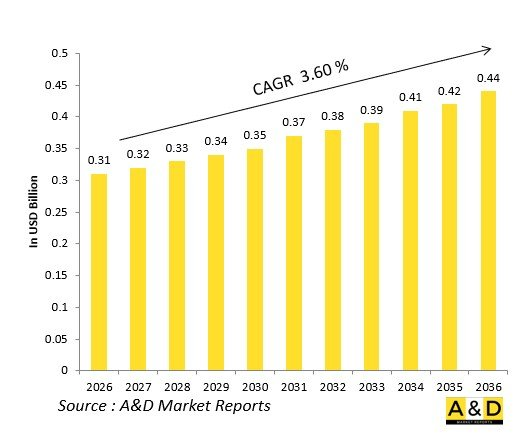
Introduction:
The Global defense gyro compasses market supplies self-contained heading references for warships, submarines, and aircraft, immune to magnetic distortions and GPS outages. These electromechanical or fiber-optic systems align to true north via gyroscope precession, feeding stabilized azimuth to fire control, radar, and autopilot. As electronic warfare proliferates, demand grows for resilient gyros ensuring precise targeting and station-keeping in jammed environments. Naval surface fleets lead, followed by submersibles needing silent operation. Innovations merge gyros with inertial units for hybrid navigation. Rugged designs endure shock, vibration, and temperature swings. The market supports power projection, providing the unjammable directional backbone for multi-axis warfare across oceans and poles.
Technology Impact in Defense Gyro Compasses
Technological evolutions redefine defense gyro compasses, blending precision with compactness. Fiber-optic gyros (FOG) eliminate moving parts, slashing maintenance via interferometric sensing. Ring laser gyros (RLG) deliver drift-free stability for long-endurance missions. MEMS variants miniaturize for UAVs and missiles. AI drift compensation self-aligns amid accelerations. Digital outputs interface seamlessly with combat networks. Strapdown architectures ditch gimbals for solid-state reliability. Quantum sensors explore enhanced sensitivity. Fusion with stellar trackers verifies headings under stars. Hemispherical resonator gyros resist sabotage. These advances cut SWaP, extend MTBF, and enable conformal installs, fortifying navigation against spoofing and denial.
Key Drivers in Defense Gyro Compasses
Essential drivers propel the defense gyro compasses market. GNSS jamming threats mandate independent true-north references. Submarine stealth requires non-emitting heading sources. Littoral magnetic anomalies demand gyro accuracy. Platform modernizations swap magnetic needles for digital gyros. Interoperability links headings to allied datalinks. Arctic ops need pole-convergent alignments. Unmanned fleets crave low-drift autonomy. Cybersecurity shields gyro buses from hacks. Anti-vibration tech suits rotary platforms. Supply diversification counters precision optic shortages. Budgets embrace COTS hybrids for affordability. Collectively, these ensure gyros as the trusted core of degraded navigation.
Regional Trends in Defense Gyro Compasses
Regional demands tailor defense gyro compasses strategies. North America upgrades carriers with FOG for Pacific transits. Europe prioritizes RLG for North Atlantic convoys. Asia-Pacific integrates MEMS for corvette swarms in chokepoints. Indo-Pacific navies fuse gyros with INS for island ops. Middle East adapts for Gulf magnetic hotspots. Africa deploys rugged units on patrol craft. South America links to riverine helos. Collaborative standards unify outputs in coalitions. Trends spotlight quantum prototypes and AI calibration, echoing polar routes and contested seas.
Key Defense Gyro Compasses Programs
Prominent programs highlight defense gyro compasses applications. Destroyer refits embed strapdown FOG in stabilized platforms. Submarines test silent RLG for periscope masts. Frigates validate gyro-stellar hybrids in EW drills. Allied navies standardize digital interfaces for task forces. Drone carriers outfit UAVs with MEMS clusters. Milestones include shock-basin survivability and polar alignments. Amphibious ships sync gyros to landing radars. Developmental quantum gyros pioneer next-gen drift. These efforts deliver resilient, networked heading solutions, anchoring fleets in chaos.
Table of Contents
Defense Gyro Compasses Market - Table of Contents
Defense Gyro Compasses Market Report Definition
Defense Gyro Compasses Market Segmentation
By Region
By Platform
By Type
By Accuracy
Defense Gyro Compasses Market Analysis for next 10 Years
The 10-year Defense Gyro Compasses Market analysis would give a detailed overview of Defense Gyro Compasses Market growth, changing dynamics, technology adoption overviews and the overall market attractiveness is covered in this chapter.
Market Technologies of Defense Gyro Compasses Market
This segment covers the top 10 technologies that is expected to impact this market and the possible implications these technologies would have on the overall market.
Global Defense Gyro Compasses Market Forecast
The 10-year Defense Gyro Compasses Market forecast of this market is covered in detailed across the segments which are mentioned above.
Regional Defense Gyro Compasses Market Trends & Forecast
The regional counter drone market trends, drivers, restraints and Challenges of this market, the Political, Economic, Social and Technology aspects are covered in this segment. The market forecast and scenario analysis across regions are also covered in detailed in this segment. The last part of the regional analysis includes profiling of the key companies, supplier landscape and company benchmarking. The current market size is estimated based on the normal scenario.
North America
Drivers, Restraints and Challenges
PEST
Market Forecast & Scenario Analysis
Key Companies
Supplier Tier Landscape
Company Benchmarking
Europe
Middle East
APAC
South America
Country Analysis of Defense Gyro Compasses Market
This chapter deals with the key defense programs in this market, it also covers the latest news and patents which have been filed in this market. Country level 10 year market forecast and scenario analysis are also covered in this chapter.
US
Defense Programs
Latest News
Patents
Current levels of technology maturation in this market
Market Forecast & Scenario Analysis
Canada
Italy
France
Germany
Netherlands
Belgium
Spain
Sweden
Greece
Australia
South Africa
India
China
Russia
South Korea
Japan
Malaysia
Singapore
Brazil
Opportunity Matrix for Defense Gyro Compasses Market
The opportunity matrix helps the readers understand the high opportunity segments in this market.
Expert Opinions on Defense Gyro Compasses Market Report
Hear from our experts their opinion of the possible analysis for this market.
Conclusions
About Aviation and Defense Market Reports
List of Tables
- Table 1: 10 Year Market Outlook, 2026-2036
- Table 2: Drivers, Impact Analysis, North America
- Table 3: Restraints, Impact Analysis, North America
- Table 4: Challenges, Impact Analysis, North America
- Table 5: Drivers, Impact Analysis, Europe
- Table 6: Restraints, Impact Analysis, Europe
- Table 7: Challenges, Impact Analysis, Europe
- Table 8: Drivers, Impact Analysis, Middle East
- Table 9: Restraints, Impact Analysis, Middle East
- Table 10: Challenges, Impact Analysis, Middle East
- Table 11: Drivers, Impact Analysis, APAC
- Table 12: Restraints, Impact Analysis, APAC
- Table 13: Challenges, Impact Analysis, APAC
- Table 14: Drivers, Impact Analysis, South America
- Table 15: Restraints, Impact Analysis, South America
- Table 16: Challenges, Impact Analysis, South America
- Table 17: Scenario Analysis, Scenario 1, By Type, 2026-2036
- Table 18: Scenario Analysis, Scenario 1, By Platform, 2026-2036
- Table 19: Scenario Analysis, Scenario 1, By Region, 2026-2036
- Table 20: Scenario Analysis, Scenario 2, By Type, 2026-2036
- Table 21: Scenario Analysis, Scenario 2, By Platform, 2026-2036
- Table 22: Scenario Analysis, Scenario 2, By Region, 2026-2036
List of Figures
- Figure 1: Global Defense Gyro Compasses Market Forecast, 2026-2036
- Figure 2: Global Defense Gyro Compasses Market Forecast, By Type, 2026-2036
- Figure 3: Global Defense Gyro Compasses Market Forecast, By Platform, 2026-2036
- Figure 4: Global Defense Gyro Compasses Market Forecast, By Region, 2026-2036
- Figure 5: North America, Defense Gyro Compasses Market, Forecast, 2026-2036
- Figure 6: Europe, Defense Gyro Compasses Market, Forecast, 2026-2036
- Figure 7: Middle East, Defense Gyro Compasses Market, Forecast, 2026-2036
- Figure 8: APAC, Defense Gyro Compasses Market, Forecast, 2026-2036
- Figure 9: South America, Defense Gyro Compasses Market, Forecast, 2026-2036
- Figure 10: United States, Defense Gyro Compasses Market, Technology Maturation, 2026-2036
- Figure 11: United States, Defense Gyro Compasses Market, Forecast, 2026-2036
- Figure 12: Canada, Defense Gyro Compasses Market, Technology Maturation, 2026-2036
- Figure 13: Canada, Defense Gyro Compasses Market, Forecast, 2026-2036
- Figure 14: Italy, Defense Gyro Compasses Market, Technology Maturation, 2026-2036
- Figure 15: Italy, Defense Gyro Compasses Market, Market Forecast, 2026-2036
- Figure 16: France, Defense Gyro Compasses Market, Technology Maturation, 2026-2036
- Figure 17: France, Defense Gyro Compasses Market, Market Forecast, 2026-2036
- Figure 18: Germany, Defense Gyro Compasses Market, Technology Maturation, 2026-2036
- Figure 19: Germany, Defense Gyro Compasses Market, Market Forecast, 2026-2036
- Figure 20: Netherlands, Defense Gyro Compasses Market, Technology Maturation, 2026-2036
- Figure 21: Netherlands, Defense Gyro Compasses Market, Market Forecast, 2026-2036
- Figure 22: Belgium, Defense Gyro Compasses Market, Technology Maturation, 2026-2036
- Figure 23: Belgium, Defense Gyro Compasses Market, Market Forecast, 2026-2036
- Figure 24: Spain, Defense Gyro Compasses Market, Technology Maturation, 2026-2036
- Figure 25: Spain, Defense Gyro Compasses Market, Market Forecast, 2026-2036
- Figure 26: Sweden, Defense Gyro Compasses Market, Technology Maturation, 2026-2036
- Figure 27: Sweden, Defense Gyro Compasses Market, Forecast, 2026-2036
- Figure 28: Brazil, Defense Gyro Compasses Market, Technology Maturation, 2026-2036
- Figure 29: Brazil, Defense Gyro Compasses Market, Market Forecast, 2026-2036
- Figure 30: Australia, Defense Gyro Compasses Market, Technology Maturation, 2026-2036
- Figure 31: Australia, Defense Gyro Compasses Market, Market Forecast, 2026-2036
- Figure 32: India, Defense Gyro Compasses Market, Technology Maturation, 2026-2036
- Figure 33: India, Defense Gyro Compasses Market, Market Forecast, 2026-2036
- Figure 34: China, Defense Gyro Compasses Market, Technology Maturation, 2026-2036
- Figure 35: China, Defense Gyro Compasses Market, Market Forecast, 2026-2036
- Figure 36: Saudi Arabia, Defense Gyro Compasses Market, Technology Maturation, 2026-2036
- Figure 37: Saudi Arabia, Defense Gyro Compasses Market, Market Forecast, 2026-2036
- Figure 38: South Korea, Defense Gyro Compasses Market, Technology Maturation, 2026-2036
- Figure 39: South Korea, Defense Gyro Compasses Market, Market Forecast, 2026-2036
- Figure 40: Japan, Defense Gyro Compasses Market, Technology Maturation, 2026-2036
- Figure 41: Japan, Defense Gyro Compasses Market, Market Forecast, 2026-2036
- Figure 42: Malaysia, Defense Gyro Compasses Market, Technology Maturation, 2026-2036
- Figure 43: Malaysia, Defense Gyro Compasses Market, Market Forecast, 2026-2036
- Figure 44: Singapore, Defense Gyro Compasses Market, Technology Maturation, 2026-2036
- Figure 45: Singapore, Defense Gyro Compasses Market, Market Forecast, 2026-2036
- Figure 46: United Kingdom, Defense Gyro Compasses Market, Technology Maturation, 2026-2036
- Figure 47: United Kingdom, Defense Gyro Compasses Market, Market Forecast, 2026-2036
- Figure 48: Opportunity Analysis, Defense Gyro Compasses Market, By Type(Cumulative Market), 2026-2036
- Figure 49: Opportunity Analysis, Defense Gyro Compasses Market, By Type(CAGR), 2026-2036
- Figure 50: Opportunity Analysis, Defense Gyro Compasses Market, By (Cumulative Market), 2026-2036
- Figure 51: Opportunity Analysis, Defense Gyro Compasses Market, By Platform(CAGR), 2026-2036
- Figure 52: Opportunity Analysis, Defense Gyro Compasses Market, By Region (Cumulative Market), 2026-2036
- Figure 53: Opportunity Analysis, Defense Gyro Compasses Market, By Region (CAGR), 2026-2036
- Figure 54: Scenario Analysis, Defense Gyro Compasses Market, Cumulative Market, 2026-2036
- Figure 55: Scenario Analysis, Defense Gyro Compasses Market, Global Market, 2026-2036
- Figure 56: Scenario 1, Defense Gyro Compasses Market, Total Market, 2026-2036
- Figure 57: Scenario 1, Defense Gyro Compasses Market, By Type, 2026-2036
- Figure 58: Scenario 1, Defense Gyro Compasses Market, By Platform, 2026-2036
- Figure 59: Scenario 1, Defense Gyro Compasses Market, By Region, 2026-2036
- Figure 60: Scenario 2, Defense Gyro Compasses Market, Total Market, 2026-2036
- Figure 61: Scenario 2, Defense Gyro Compasses Market, By Type, 2026-2036
- Figure 62: Scenario 2, Defense Gyro Compasses Market, By Platform, 2026-2036
- Figure 63: Scenario 2, Defense Gyro Compasses Market, By Region, 2026-2036
- Figure 64: Company Benchmark, Defense Gyro Compasses Market, 2026-2036

