PUBLISHER: Mordor Intelligence | PRODUCT CODE: 2120727

PUBLISHER: Mordor Intelligence | PRODUCT CODE: 2120727
Gyroscopes - Market Share Analysis, Industry Trends & Statistics, Growth Forecasts (2026 - 2031)
According to Mordor Intelligence, the gyroscopes market size is expected to increase from USD 4.32 billion in 2025 to USD 4.56 billion in 2026 and reach USD 6.13 billion by 2031, growing at a CAGR of 6.10% over 2026-2031.
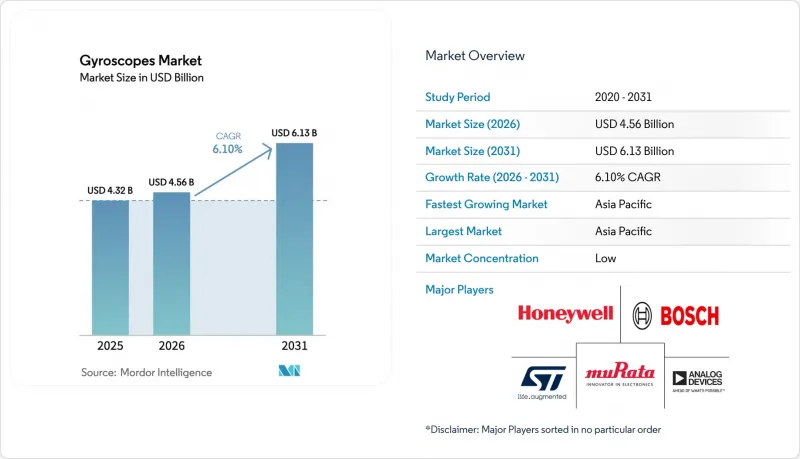
This report is Segmented by Technology (MEMS Gyroscope, Fiber Optic Gyroscope, Ring Laser Gyroscope, and More), Axis (1-Axis, 2-Axis, and 3-Axis), End-User Vertical (Consumer Electronics, Automotive, Aerospace and Defense, and More), Application (Navigation Systems, Stabilization Platforms, Gaming and Virtual Reality, and More), and Geography. The Market Forecasts are Provided in Terms of Value (USD).
Global Gyroscopes Market Trends and Insights
Proliferation of MEMS Sensors in Smartphones and Wearables
Six-axis MEMS hybrids are now shipping in flagship handsets and premium wearables, delivering sub-degree accuracy and a 40% reduction in footprint, which helps device makers maintain slim form factors without sacrificing motion fidelity. Closed-loop digital architectures reduce power draw while maintaining bias drift below 1°/h, enabling consumer suppliers to approach tactical-grade thresholds. Medical wearables add a new revenue tier that values low drift for FDA-approved patient monitoring. The result is a steady funnel of high-volume orders that anchors base demand, even as premium applications set loftier performance bars.
Automotive ADAS and Autonomous Driving Demand
Level 3 and Level 4 autonomy requires multi-sensor redundancy; thus, modern inertial modules must reach bias stability better than 10°/h, angular random walk below 0.1°-√h, and functional-safety diagnostics per ISO 26262. Electric vehicles further lean on precise rate feedback to optimize regenerative braking. Over-the-air calibration and self-test capabilities have become must-haves, giving suppliers that bundle MEMS gyros with on-board processors a competitive edge.
High Manufacturing Complexity for High-Accuracy Gyroscopes
Fiber-optic builds require optical fibers with a loss of <= 0.5 dB/m, while ring-laser cavities demand nanometer-grade machining, resulting in steep capital outlays and slow throughput. MEMS designs that aim for navigation-grade stability require vacuum wafer-level packaging and multi-point temperature compensation, lengthening production cycles and payback periods. Extended burn-in testing, which can sometimes last weeks, caps monthly volume and increases unit cost.
Other drivers and restraints analyzed in the detailed report include:
- Defense Modernization Programs in Emerging Economies
- Rapid Expansion of Commercial Drone Applications
- Supply-Chain Volatility in Specialty Optical Fibers and ICs
For complete list of drivers and restraints, kindly check the Table Of Contents.
Segment Analysis
MEMS devices accounted for 43.53% of the gyroscopes market share in 2025, a lead built on low cost and seamless SoC integration for phones, wearables, and cars. Fiber-optic designs, though pricier, are growing at a 7.85% CAGR as defense and aerospace buyers seek bias instability below 0.01°/h, a tolerance MEMS still rarely meet. Ring-laser and hemispherical resonator models protect smaller niches, such as high-g munitions and long-life satellites, where single-restart reliability outweighs bill-of-materials savings. Photonic integrated circuit prototypes have now logged less than 1°/h drift on footprints under 5 cm2, hinting that chip-scale optics could soon bridge MEMS and fiber cost-to-precision gaps. MEMS engineers answer with cobweb-style disk resonators and multi-bit sigma-delta readouts, which have pushed bias noise toward navigation thresholds.
As hybrid stacks emerge, vendors that master both piezoelectric and photonic steps will control the most defensible intellectual property. Licensing paths are opening in the Asia-Pacific region, where fabs can co-package CMOS and optical waveguides, promising lower entry barriers for regional brands. Overall, the technology choice is shifting from a binary MEMS-versus-optics argument to a continuum of precision tiers that enable integrators to match cost, size, and environmental limits without switching suppliers mid-program.
Three-axis chips captured 55.53% of 2025 revenue because phones, VR headsets, and full IMUs demand complete pitch-roll-yaw telemetry in a single die. Two-axis units nevertheless achieve the fastest 7.92% CAGR because automakers require only pitch and roll for electronic stability control and are cost-sensitive regarding yaw redundancy. Single-axis parts, once mainstream, now linger in high-speed spindles or scientific rigs where cross-axis coupling is unacceptable. Packaging advances enable a 3-axis MEMS to occupy the same board area as an older single-axis device, yet each axis still reacts differently to temperature. Therefore, vendors embed EEPROM calibration curves and on-die heaters to maintain drift parity. ISO 26262 diagnostics now monitor each axis separately, forcing firmware to flag latent faults before they trigger unstable vehicle dynamics.
In gaming, matched-axis latency tightens user comfort thresholds, pushing makers to align bandwidth and phase to the millisecond. Industrial buyers add vibration-hardening epoxy fill or ceramic carriers to stop resonance peaks that would otherwise amplify z-axis noise. As sensor-fusion processors mature, design wins increasingly hinge on how predictably each channel maintains linearity throughout the product's life, rather than on the number of axes.
Complete Report Scope:
- By Technology
- MEMS Gyroscope
- Fiber Optic Gyroscope (FOG)
- Ring Laser Gyroscope (RLG)
- Hemispherical Resonating Gyroscope (HRG)
- Dynamically Tuned Gyroscope (DTG)
- Other Technologies
- By Axis
- 1-Axis
- 2-Axis
- 3-Axis
- By End-User Vertical
- Consumer Electronics
- Automotive
- Aerospace and Defense
- Industrial
- Marine
- Other End-User Verticals
- By Application
- Navigation Systems
- Stabilization Platforms
- Gaming and Virtual Reality
- Robotics and Automation
- Other Applications
- By Geography
- North America
- United States
- Canada
- Mexico
- South America
- Brazil
- Argentina
- Chile
- Rest of South America
- Europe
- United Kingdom
- Germany
- France
- Italy
- Spain
- Rest of Europe
- Asia-Pacific
- China
- Japan
- India
- South Korea
- Australia and New Zealand
- Rest of Asia-Pacific
- Middle East and Africa
- Middle East
- United Arab Emirates
- Saudi Arabia
- Turkey
- Rest of Middle East
- Africa
- South Africa
- Kenya
- Nigeria
- Rest of Africa
- Middle East
- North America
Geography Analysis
The Asia-Pacific region controlled 40.42% of the 2025 turnover, driven by semiconductor clustering in China, Japan, and South Korea, as well as India's push for localized defense electronics. The region also posts the fastest 8.45% CAGR, a testament to domestic ecosystems that cover foundry services, packaging, and downstream system integration. Factory expansions in Taiwan and Malaysia promise additional MEMS capacity, but the same projects also increase local demand for high-purity precursor gases and lithography tooling, thereby gradually deepening the supply chain.
North America remains influential through its defense budgets, autonomous vehicle pilots, and a concentration of photonics start-ups. The Federal Aviation Administration's TSO compliance templates elevate barrier costs, indirectly steering procurement toward incumbents familiar with paperwork. Parallel reshoring programs in New York and Arizona aim to rebuild the critical MEMS supply chain but face labor and utility-rate headwinds that may limit near-term throughput.
Europe emphasizes automotive ADAS and industrial cobots, benefitting from cohesive ISO and UNECE regulations that harmonize sensor testing. The Middle East and Africa, although small in volume, channel oil revenues into defense modernization and smart infrastructure projects that require precise inertial references for drones inspecting pipelines or bridges. Latin America, led by Brazil, eyes indigenous production in line with offsets tied to fighter and satellite contracts, spreading the gyroscopes market into fresh jurisdictions.
- Honeywell International Inc.
- Northrop Grumman Corporation
- Safran SA
- Robert Bosch GmbH
- STMicroelectronics N.V.
- Analog Devices Inc.
- Murata Manufacturing Co. Ltd.
- TDK Corporation
- EMCORE Corporation
- KVH Industries Inc.
- iXblue SAS
- Optolink LLC
- InnaLabs Ltd.
- Silicon Sensing Systems Ltd.
- MEMSIC Inc.
- VectorNav Technologies LLC
- Kearfott Corporation
- L3Harris Technologies Inc.
- Seiko Epson Corporation
- Fizoptika Corp.
Additional Benefits:
- The market estimate (ME) sheet in Excel format
- 3 months of analyst support
TABLE OF CONTENTS
1 INTRODUCTION
- 1.1 Study Assumptions and Market Definition
- 1.2 Scope of the Study
2 RESEARCH METHODOLOGY
3 EXECUTIVE SUMMARY
4 MARKET LANDSCAPE
- 4.1 Market Overview
- 4.2 Market Drivers
- 4.2.1 Proliferation of MEMS Sensors in Smartphones and Wearables
- 4.2.2 Automotive ADAS and Autonomous Driving Demand
- 4.2.3 Defense Modernization Programs in Emerging Economies
- 4.2.4 Rapid Expansion of Commercial Drone Applications
- 4.2.5 Cost Decline in Fiber-Optic and Ring-Laser Gyroscopes
- 4.2.6 Emergence of Quantum-Enhanced Inertial Navigation
- 4.3 Market Restraints
- 4.3.1 High Manufacturing Complexity for High-Accuracy Gyroscopes
- 4.3.2 Supply-Chain Volatility in Specialty Optical Fibers and ICs
- 4.3.3 Certification Barriers in Aviation and Medical Markets
- 4.3.4 Competition from Vision and GNSS-INS Hybrid Solutions
- 4.4 Industry Value Chain Analysis
- 4.5 Regulatory Landscape
- 4.6 Impact of Macroeconomic Factors on the Market
- 4.7 Porter's Five Forces Analysis
- 4.7.1 Threat of New Entrants
- 4.7.2 Bargaining Power of Buyers
- 4.7.3 Bargaining Power of Suppliers
- 4.7.4 Threat of Substitute Products
- 4.7.5 Intensity of Competitive Rivalry
5 MARKET SIZE AND GROWTH FORECASTS (VALUE)
- 5.1 By Technology
- 5.1.1 MEMS Gyroscope
- 5.1.2 Fiber Optic Gyroscope (FOG)
- 5.1.3 Ring Laser Gyroscope (RLG)
- 5.1.4 Hemispherical Resonating Gyroscope (HRG)
- 5.1.5 Dynamically Tuned Gyroscope (DTG)
- 5.1.6 Other Technologies
- 5.2 By Axis
- 5.2.1 1-Axis
- 5.2.2 2-Axis
- 5.2.3 3-Axis
- 5.3 By End-User Vertical
- 5.3.1 Consumer Electronics
- 5.3.2 Automotive
- 5.3.3 Aerospace and Defense
- 5.3.4 Industrial
- 5.3.5 Marine
- 5.3.6 Other End-User Verticals
- 5.4 By Application
- 5.4.1 Navigation Systems
- 5.4.2 Stabilization Platforms
- 5.4.3 Gaming and Virtual Reality
- 5.4.4 Robotics and Automation
- 5.4.5 Other Applications
- 5.5 By Geography
- 5.5.1 North America
- 5.5.1.1 United States
- 5.5.1.2 Canada
- 5.5.1.3 Mexico
- 5.5.2 South America
- 5.5.2.1 Brazil
- 5.5.2.2 Argentina
- 5.5.2.3 Chile
- 5.5.2.4 Rest of South America
- 5.5.3 Europe
- 5.5.3.1 United Kingdom
- 5.5.3.2 Germany
- 5.5.3.3 France
- 5.5.3.4 Italy
- 5.5.3.5 Spain
- 5.5.3.6 Rest of Europe
- 5.5.4 Asia-Pacific
- 5.5.4.1 China
- 5.5.4.2 Japan
- 5.5.4.3 India
- 5.5.4.4 South Korea
- 5.5.4.5 Australia and New Zealand
- 5.5.4.6 Rest of Asia-Pacific
- 5.5.5 Middle East and Africa
- 5.5.5.1 Middle East
- 5.5.5.1.1 United Arab Emirates
- 5.5.5.1.2 Saudi Arabia
- 5.5.5.1.3 Turkey
- 5.5.5.1.4 Rest of Middle East
- 5.5.5.2 Africa
- 5.5.5.2.1 South Africa
- 5.5.5.2.2 Kenya
- 5.5.5.2.3 Nigeria
- 5.5.5.2.4 Rest of Africa
- 5.5.5.1 Middle East
- 5.5.1 North America
6 COMPETITIVE LANDSCAPE
- 6.1 Market Concentration
- 6.2 Strategic Moves
- 6.3 Market Share Analysis
- 6.4 Company Profiles (Includes Global Level Overview, Market Level Overview, Core Segments, Financials as Available, Strategic Information, Market Rank/Share, Products and Services, and Recent Developments)
- 6.4.1 Honeywell International Inc.
- 6.4.2 Northrop Grumman Corporation
- 6.4.3 Safran SA
- 6.4.4 Robert Bosch GmbH
- 6.4.5 STMicroelectronics N.V.
- 6.4.6 Analog Devices Inc.
- 6.4.7 Murata Manufacturing Co. Ltd.
- 6.4.8 TDK Corporation
- 6.4.9 EMCORE Corporation
- 6.4.10 KVH Industries Inc.
- 6.4.11 iXblue SAS
- 6.4.12 Optolink LLC
- 6.4.13 InnaLabs Ltd.
- 6.4.14 Silicon Sensing Systems Ltd.
- 6.4.15 MEMSIC Inc.
- 6.4.16 VectorNav Technologies LLC
- 6.4.17 Kearfott Corporation
- 6.4.18 L3Harris Technologies Inc.
- 6.4.19 Seiko Epson Corporation
- 6.4.20 Fizoptika Corp.
7 MARKET OPPORTUNITIES AND FUTURE OUTLOOK
- 7.1 White-Space and Unmet-Need Assessment

