PUBLISHER: Global Market Insights Inc. | PRODUCT CODE: 2109324

PUBLISHER: Global Market Insights Inc. | PRODUCT CODE: 2109324
Portable Hydrogen Generator Market Opportunity, Growth Drivers, Industry Trend Analysis, and Forecast 2026 - 2035
The Global Portable Hydrogen Generator Market was valued at USD 176.7 million in 2025 and is estimated to grow at a CAGR of 8.3% to reach USD 389.3 million in 2035.
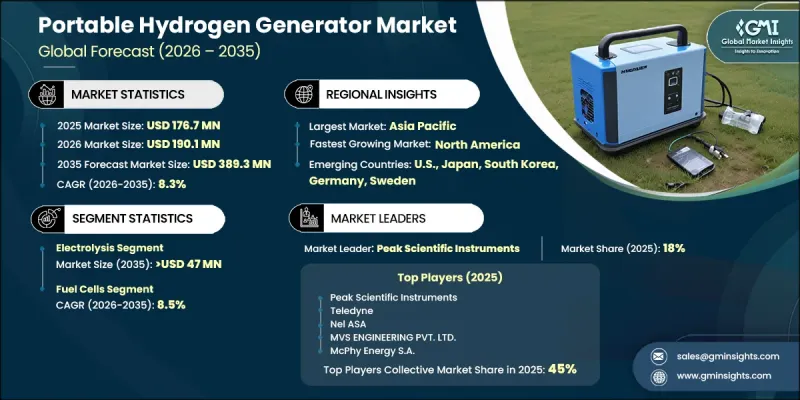
The market is witnessing steady growth as industries and end users increasingly seek clean, flexible, and low-emission power generation alternatives. Rising demand for zero-emission backup power solutions and temporary energy systems is encouraging the adoption of hydrogen-based portable generators to support carbon reduction goals and meet evolving environmental requirements. These generators provide a cleaner alternative to conventional power sources while supporting the transition toward sustainable off-grid energy solutions. The growing emphasis on renewable energy integration, energy security, and decentralized power generation is strengthening the role of portable hydrogen generators across multiple applications. Increasing investments in green hydrogen production and improvements in hydrogen supply infrastructure are creating favorable conditions for market expansion. As organizations focus on reducing emissions while maintaining reliable power availability, portable hydrogen generators are becoming an important technology for remote, mobile, and emergency power requirements.
| Market Scope | |
|---|---|
| Start Year | 2025 |
| Forecast Year | 2026-2035 |
| Start Value | $176.7 Million |
| Forecast Value | $389.3 Million |
| CAGR | 8.3% |
Greater availability of renewable hydrogen is supporting long-term industry development, as scalable green hydrogen production enables sectors to move toward cleaner energy systems. Better integration with renewable energy value chains is improving the environmental advantages of hydrogen-powered mobile solutions and contributing to market growth. Advancements in portable generator technology are allowing systems to store excess renewable electricity and provide backup power during grid disruptions. Industries operating in mobile and remote environments are increasingly adopting portable hydrogen generators to operate machinery and equipment efficiently without interruptions. These applications value the mobility, adaptability, and environmentally friendly performance offered by hydrogen-based power systems. Demand for portable hydrogen generators is also increasing in emergency response and backup energy applications, where dependable electricity supply is essential during power failures.
The electrolysis segment is projected to reach USD 47 million by 2035. Electrolysis technology is gaining importance in the portable hydrogen generator market because it enables clean hydrogen production through compact electrolyzer systems. These systems provide greater independence for remote operations and emergency applications while avoiding the emissions and noise challenges associated with traditional generators. Continuous improvements in electrolyzer design are leading to the development of lightweight, modular, and highly efficient units capable of producing hydrogen closer to the point of use. This advancement reduces reliance on external fuel transportation and improves operational flexibility.
The fuel cells segment is expected to grow at a CAGR of 8.5% by 2035. Improvements in fuel cell materials, system design, and integration technologies are enhancing efficiency, durability, and overall performance, accelerating adoption across various applications. Leading companies are focusing on developing compact, modular, and affordable fuel cell systems to expand their use in transportation, commercial power solutions, backup energy systems, and distributed power networks. These technological developments improve reliability, lower lifecycle expenses, and strengthen the position of fuel cells as efficient alternatives to conventional power generation methods. Continued adoption of advanced fuel cell solutions is expected to support strong market growth through established and emerging applications.
U.S. Portable Hydrogen Generator Market is projected to reach USD 88 million by 2035. Rising demand for clean energy technologies and the growing requirement for portable power solutions are supporting market expansion. Remote and off-grid locations are increasingly adopting hydrogen generators where traditional electricity sources are limited or unreliable, creating growth opportunities across emergency services, defense applications, and industrial operations. Growing interest in portable hydrogen systems among recreational users and outdoor applications is also contributing to market development and improving the overall business outlook.
Key players operating in the global portable hydrogen generator industry are Air Liquide, RIX Industries, Kanadevia Corporation, Airco, McPhy Energy S.A., Toshiba Corporation, Nel ASA, Hydrovert, Air Products & Chemicals, Inc., Daigas Group, EPOCH Energy Technology Corp, Teledyne Technologies Incorporated, Mahler AGS GmbH, SENZA, MVS ENGINEERING PVT. LTD., Peak Scientific Instruments, Idroenergy, Gastek Engineering, Ningbo Vet Energy Technology Co., Ltd., and Praxair Technology, Inc. Companies operating in the portable hydrogen generator market are adopting several strategies to strengthen their market position. Key players are investing in research and development activities to improve hydrogen generation efficiency, system portability, and cost competitiveness. Manufacturers are focusing on developing compact and modular solutions that can serve diverse applications, including backup power, mobility, and remote energy needs. Strategic collaborations, technology partnerships, and expansion of production capabilities are helping companies improve their supply networks and reach new customer segments. Businesses are also emphasizing renewable hydrogen integration, advanced fuel cell technologies, and product customization to differentiate their offerings.
Table of Contents
Chapter 1 Methodology & Scope
- 1.1 Research design
- 1.2 Quality commitment
- 1.2.1 GMI AI policy & data integrity commitment
- 1.2.1.1 Source consistency protocol
- 1.2.1 GMI AI policy & data integrity commitment
- 1.3 Research trail & confidence scoring
- 1.3.1 Research trail components
- 1.3.2 Scoring components
- 1.4 Data collection
- 1.4.1 Partial list of primary sources
- 1.5 Data mining sources
- 1.5.1 Paid sources
- 1.5.1.1 Sources, by region
- 1.5.1 Paid sources
- 1.6 Base estimates and calculations
- 1.6.1 Base year calculation for any one approach
- 1.7 Forecast model
- 1.8 Research transparency addendum
- 1.8.1 Source attribution framework
- 1.8.2 Quality assurance metrics
- 1.8.3 Our commitment to trust
- 1.9 Market definitions
Chapter 2 Executive Summary
- 2.1 Industry synopsis, 2022 - 2035
- 2.2 Business trends
- 2.3 Process trends
- 2.4 Capacity trends
- 2.5 Application trends
- 2.6 Regional trends
Chapter 3 Industry Insights
- 3.1 Industry ecosystem
- 3.1.1 Raw material availability & sourcing analysis
- 3.1.2 Manufacturing capacity assessment
- 3.1.3 Supply chain resilience & risk factors
- 3.1.4 Distribution network analysis
- 3.2 Regulatory landscape
- 3.3 Industry impact forces
- 3.3.1 Growth drivers
- 3.3.2 Industry pitfalls & challenges
- 3.4 Growth potential analysis
- 3.5 Porter's analysis
- 3.5.1 Bargaining power of suppliers
- 3.5.2 Bargaining power of buyers
- 3.5.3 Threat of new entrants
- 3.5.4 Threat of substitutes
- 3.6 PESTEL analysis
- 3.6.1 Political factors
- 3.6.2 Economic factors
- 3.6.3 Social factors
- 3.6.4 Technological factors
- 3.6.5 Legal factors
- 3.6.6 Environmental factors
- 3.7 Cost structure analysis
- 3.8 Impact of AI & generative AI on the market (Driven by Primary Research)
- 3.8.1 Predictive maintenance & fault detection
- 3.8.2 Grid optimization & load forecasting
- 3.8.3 Digital twin simulation & testing
- 3.8.4 Risks, limitations & regulatory considerations
- 3.9 Emerging opportunities & trends
- 3.10 Digitalization & IoT integration
- 3.11 Investment analysis and future outlook
Chapter 4 Competitive landscape, 2026
- 4.1 Introduction
- 4.2 Company market share analysis, by region, 2025
- 4.2.1 North America
- 4.2.2 Europe
- 4.2.3 Asia Pacific
- 4.2.4 Middle East & Africa
- 4.2.5 Latin America
- 4.3 Competitive analysis of major market players
- 4.4 Competitive positioning matrix
- 4.5 Key developments
- 4.5.1 Mergers & acquisitions
- 4.5.2 Partnerships & collaborations
- 4.5.3 New product launches
- 4.5.4 Expansion plans & funding
- 4.6 Company tier benchmarking
- 4.6.1 Tier classification criteria & qualifying thresholds
- 4.6.2 Tier positioning matrix by revenue, geography & innovation
Chapter 5 Market Size and Forecast, By Process, 2022 - 2035 (USD Million)
- 5.1 Key trends
- 5.2 Steam reforming
- 5.3 Electrolysis
- 5.4 Others
Chapter 6 Market Size and Forecast, By Application, 2022 - 2035 (USD Million)
- 6.1 Key trends
- 6.2 Chemical processing
- 6.3 Petroleum recovery
- 6.4 Fuel cells
- 6.5 Refinery
- 6.6 Others
Chapter 7 Market Size and Forecast, By Capacity, 2022 - 2035 (USD Million)
- 7.1 Key trends
- 7.2 <100 Nm3/h
- 7.3 100-2,000 Nm3/h
- 7.4 >2,000 Nm3/h
Chapter 8 Market Size and Forecast, By Region, 2022 - 2035 (USD Million)
- 8.1 Key trends
- 8.2 North America
- 8.2.1 U.S.
- 8.2.2 Canada
- 8.3 Europe
- 8.3.1 Germany
- 8.3.2 UK
- 8.3.3 France
- 8.3.4 Sweden
- 8.3.5 Italy
- 8.3.6 Netherlands
- 8.4 Asia Pacific
- 8.4.1 China
- 8.4.2 Japan
- 8.4.3 South Korea
- 8.4.4 India
- 8.5 Middle East & Africa
- 8.6 Latin America
- 8.6.1 Brazil
Chapter 9 Company Profiles
- 9.1 Airco
- 9.2 Air Liquide
- 9.3 Air Products & Chemicals
- 9.4 EPOCH Energy Technology Corp
- 9.5 Hydrovert
- 9.6 Idroenergy
- 9.7 MVS Engineering
- 9.8 McPhy Energy S.A.
- 9.9 Mahler AGS
- 9.10 Nel ASA
- 9.11 RIX Industries
- 9.12 Praxair Technology
- 9.13 Teledyne Technologies Incorporated
- 9.14 SENZA
- 9.15 Ningbo Vet Energy Technology
- 9.16 Toshiba Corporation
- 9.17 Peak Scientific Instruments
- 9.18 Gastek Engineering
- 9.19 Kanadevia Corporation
- 9.20 Daigas Group

