
PUBLISHER: Global Market Insights Inc. | PRODUCT CODE: 1871324

PUBLISHER: Global Market Insights Inc. | PRODUCT CODE: 1871324
Porcelain Tableware Market Opportunity, Growth Drivers, Industry Trend Analysis, and Forecast 2025 - 2034
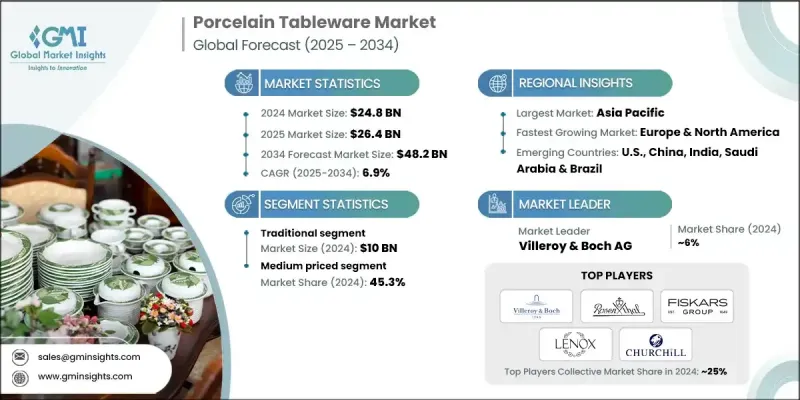
The Global Porcelain Tableware Market was valued at USD 24.8 billion in 2024 and is estimated to grow at a CAGR of 6.9% to reach USD 48.2 billion by 2034.
One of the key drivers fueling this growth is the rising trend of premiumization, especially among affluent urban consumers who regard porcelain dinnerware as a sophisticated choice for special occasions and a favored premium gift for celebrations and corporate events. Additionally, the surge in curated home dining experiences, amplified by social media platforms, has significantly boosted demand for luxurious and aesthetically pleasing tableware. Consumers are increasingly willing to invest in products that blend practicality with artistic and innovative designs, aligning with modern lifestyle trends. Cultural and ceremonial values also contribute notably, particularly across Asia and the Middle East, where porcelain plays a vital role in traditional family gatherings, religious rituals, and festivities. Furthermore, the market is witnessing a growing emphasis on customization, personalization, sustainability, and minimalist aesthetics. Manufacturers who innovate by integrating eco-friendly materials and unique designs are positioned to lead the future of this evolving market.
| Market Scope | |
|---|---|
| Start Year | 2024 |
| Forecast Year | 2025-2034 |
| Start Value | $24.8 billion |
| Forecast Value | $48.2 billion |
| CAGR | 6.9% |
The traditional porcelain designs segment generated USD 10 billion in 2024 and is expected to grow at a CAGR of 7.5% from 2025 to 2034. These designs typically feature elaborate patterns, floral motifs, and classic color schemes such as blue and white. They resonate with consumers who appreciate timeless elegance and cultural heritage. In many parts of Asia, Europe, and the Middle East, traditional porcelain remains closely linked to religious ceremonies, formal dining, and festive occasions, maintaining its strong appeal for special events like weddings and cultural celebrations.
The medium-priced segment held 45.3% share and is anticipated to grow at a CAGR of 6.9% through 2034. This segment appeals to a wide demographic, including middle-income families, casual dining establishments, and boutique hotels that seek durable yet stylish tableware without the high-end price. These products often marry traditional craftsmanship with contemporary designs, making them suitable for both everyday use and formal occasions. Advances in manufacturing have allowed producers to offer sophisticated finishes, intricate patterns, and enhanced durability at affordable prices, boosting this segment's attractiveness.
United States Porcelain Tableware Market generated USD 4.6 billion in 2024 and is forecasted to grow at a CAGR of 6.8% from 2025 to 2034. American consumers value high-quality and thoughtfully designed homeware, viewing porcelain tableware as a symbol of elegance and lifestyle refinement. The increasing popularity of home entertaining, inspired by social media and lifestyle trends, has further amplified demand for elegant and functional dinnerware. The presence of numerous upscale restaurants, boutique hotels, and catering services in the U.S. also fuels consistent investment in premium tableware to enhance guest experience and brand identity.
Leading companies in the Global Porcelain Tableware Market include Herend Porcelain Manufactory, Noritake Co., Limited, Rosenthal GmbH, BHS Tabletop AG, Villeroy & Boch AG, Fiskars Group, Bernardaud, Lenox Corporation, Meissen Porcelain, Raynaud Limoges, Churchill China plc, Vista Alegre Atlantis, Royal Copenhagen, and Degrenne Paris. To fortify their position in the Porcelain Tableware Market, companies are focusing on several strategic initiatives. They invest substantially in research and development to introduce innovative designs that merge traditional artistry with modern aesthetics. Emphasis is placed on sustainability, with many manufacturers adopting eco-friendly materials and production processes to appeal to environmentally conscious consumers. Customization and personalization services are being expanded to meet growing consumer demand for unique and meaningful products. Firms are also enhancing their distribution networks through partnerships with high-end retailers, e-commerce platforms, and hospitality sectors to broaden market reach.
Table of Contents
Chapter 1 Methodology & Scope
- 1.1 Market scope and definition
- 1.2 Research design
- 1.2.1 Research approach
- 1.2.2 Data collection methods
- 1.3 Data mining sources
- 1.3.1 Global
- 1.3.2 Regional/Country
- 1.4 Base estimates and calculations
- 1.4.1 Base year calculation
- 1.4.2 Key trends for market estimation
- 1.5 Primary research and validation
- 1.5.1 Primary sources
- 1.6 Forecast model
- 1.7 Research assumptions and limitations
Chapter 2 Executive Summary
- 2.1 Industry 360° synopsis
- 2.2 Key market trends
- 2.2.1 Regional
- 2.2.2 Product type
- 2.2.3 Design and style
- 2.2.4 Shape
- 2.2.5 Price
- 2.2.6 Application
- 2.2.7 Distribution channel
- 2.3 CXO perspectives: Strategic imperatives
- 2.3.1 Key decision points for industry executives
- 2.3.2 Critical success factors for market players
- 2.4 Future outlook and strategic recommendations
Chapter 3 Industry Insights
- 3.1 Industry ecosystem analysis
- 3.1.1 Supplier landscape
- 3.1.2 Profit margin
- 3.1.3 Value addition at each stage
- 3.1.4 Factor affecting the value chain
- 3.2 Industry impact forces
- 3.2.1 Growth drivers
- 3.2.1.1 Increasing demand for corrosion-resistant materials
- 3.2.1.2 Growth in oil & gas industry
- 3.2.1.3 Rising investment in water and wastewater management
- 3.2.2 Industry pitfalls & challenges
- 3.2.2.1 Limited awareness and technological perception
- 3.2.2.2 Vulnerability to extreme temperatures and UV exposure
- 3.2.1 Growth drivers
- 3.3 Growth potential analysis
- 3.4 Future market trends
- 3.5 Technology and innovation landscape
- 3.5.1 Current technological trends
- 3.5.2 Emerging technologies
- 3.6 Price trends
- 3.6.1 By region
- 3.6.2 By product type
- 3.7 Regulatory landscape
- 3.7.1 Standards and compliance requirements
- 3.7.2 Regional regulatory frameworks
- 3.7.3 Certification standards
- 3.8 Trade statistics
- 3.8.1 Major importing countries
- 3.8.2 Major exporting countries
- 3.9 Porter's analysis
- 3.10 PESTEL analysis
- 3.11 Consumer behavior analysis
- 3.11.1 Purchasing patterns
- 3.11.2 Preference analysis
- 3.11.3 Regional variations in consumer behavior
- 3.11.4 Impact of e-commerce on buying decisions
Chapter 4 Competitive Landscape, 2024
- 4.1 Introduction
- 4.2 Company market share analysis
- 4.2.1 By Region
- 4.2.1.1 North America
- 4.2.1.2 Europe
- 4.2.1.3 Asia Pacific
- 4.2.1.4 Latin America
- 4.2.1.5 Middle East & Africa
- 4.2.1 By Region
- 4.3 Company matrix analysis
- 4.4 Competitive analysis of major market players
- 4.5 Competitive positioning matrix
- 4.6 Key developments
- 4.6.1 Mergers & acquisitions
- 4.6.2 Partnerships & collaborations
- 4.6.3 New product launches
- 4.6.4 Expansion plans
Chapter 5 Market Estimates & Forecast, By Product Type, 2021 - 2034, (USD Billion) (Million Units)
- 5.1 Key trends
- 5.2 Plates
- 5.3 Bowls
- 5.4 Cups and saucers
- 5.5 Mugs
- 5.6 Serving dishes
- 5.7 Others
Chapter 6 Market Estimates & Forecast, By Design and Style, 2021 - 2034, (USD Billion) (Million Units)
- 6.1 Key trends
- 6.2 Traditional
- 6.3 Contemporary
- 6.4 Modern
- 6.5 Vintage
- 6.6 Artistic/decorative
- 6.7 Custom/personalized
Chapter 7 Market Estimates & Forecast, By Shape, 2021 - 2034, (USD Billion) (Million Units)
- 7.1 Key trends
- 7.2 Round
- 7.3 Square
- 7.4 Rectangular
Chapter 8 Market Estimates & Forecast, By Price, 2021 - 2034, (USD Billion) (Million Units)
- 8.1 Key trends
- 8.2 Low
- 8.3 Medium
- 8.4 High
Chapter 9 Market Estimates & Forecast, By Application, 2021 - 2034, (USD Billion) (Million Units)
- 9.1 Key trends
- 9.2 Household
- 9.3 Commercial
- 9.3.1 Hotels
- 9.3.2 Restaurants
- 9.3.3 Catering services
- 9.3.4 Cafes
Chapter 10 Market Estimates & Forecast, By Distribution Channel, 2021 - 2034, (USD Billion) (Million Units)
- 10.1 Key trends
- 10.2 Online
- 10.2.1 E-commerce website
- 10.2.2 Company website
- 10.3 Offline
- 10.3.1 Supermarkets / hypermarkets
- 10.3.2 Specialty stores
- 10.3.3 Brick-and-mortar retailers
- 10.3.4 Others (e.g., direct-to-consumer, pop-up shops)
Chapter 11 Market Estimates & Forecast, By Region, 2021 - 2034, (USD Billion) (Million Units)
- 11.1 Key trends
- 11.2 North America
- 11.2.1 U.S.
- 11.2.2 Canada
- 11.3 Europe
- 11.3.1 Germany
- 11.3.2 UK
- 11.3.3 France
- 11.3.4 Italy
- 11.3.5 Spain
- 11.4 Asia Pacific
- 11.4.1 China
- 11.4.2 India
- 11.4.3 Japan
- 11.4.4 South Korea
- 11.4.5 Australia
- 11.4.6 Indonesia
- 11.4.7 Malaysia
- 11.5 Latin America
- 11.5.1 Brazil
- 11.5.2 Mexico
- 11.5.3 Argentina
- 11.6 MEA
- 11.6.1 Saudi Arabia
- 11.6.2 UAE
- 11.6.3 South Africa
Chapter 12 Company Profiles
- 12.1 Bernardaud
- 12.2 BHS Tabletop AG
- 12.3 Churchill China plc
- 12.4 Degrenne Paris
- 12.5 Fiskars Group
- 12.6 Haviland & Cie
- 12.7 Herend Porcelain Manufactory
- 12.8 Lenox Corporation
- 12.9 Meissen Porcelain
- 12.10 Noritake Co., Limited
- 12.11 Raynaud Limoges
- 12.12 Rosenthal GmbH
- 12.13 Royal Copenhagen
- 12.14 Villeroy & Boch AG
- 12.15 Vista Alegre Atlantis

