
PUBLISHER: Global Market Insights Inc. | PRODUCT CODE: 1876543

PUBLISHER: Global Market Insights Inc. | PRODUCT CODE: 1876543
Metabolomics-based Nutritional Products Market Opportunity, Growth Drivers, Industry Trend Analysis, and Forecast 2025 - 2034
The Global Metabolomics-based Nutritional Products Market was valued at USD 2.8 billion in 2024 and is estimated to grow at a CAGR of 23.3% to reach USD 27.2 billion by 2034.
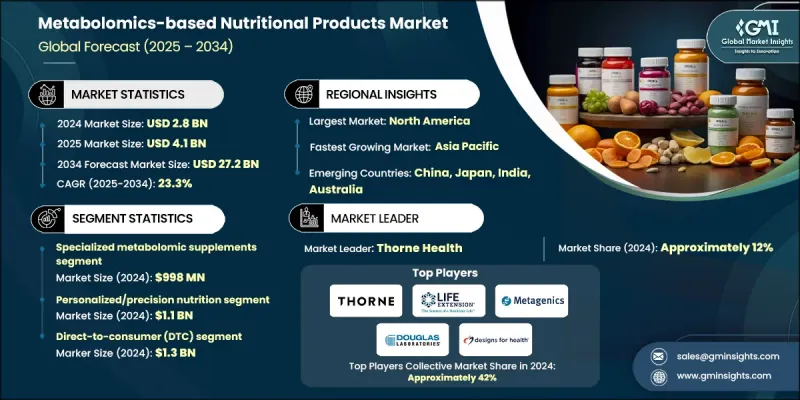
The market growth is primarily driven by increasing demand for specialized metabolomic supplements and condition-specific formulations, alongside the broader adoption of vitamin- and amino acid-based products in precision nutrition applications. Advances in metabolomic profiling enable more personalized nutrition strategies, while clinical research continues to validate targeted health interventions. Regulatory guidance from the FDA and growing adoption of personalized nutrition in healthcare, biotechnology, and wellness sectors further reinforce market expansion. Next-generation metabolomic products integrate seamlessly into therapeutic development, delivering scalable, safe, and effective bioactive compounds. These innovations are creating commercial-scale opportunities in precision nutrition, expanding applications for specialized supplements, multi-biomarker technologies, and biomarker-driven formulations, while enabling wider acceptance of metabolomics-based approaches in specialty nutrition and wellness initiatives.
| Market Scope | |
|---|---|
| Start Year | 2024 |
| Forecast Year | 2025-2034 |
| Start Value | $2.8 Billion |
| Forecast Value | $27.2 Billion |
| CAGR | 23.3% |
The specialized metabolomic supplements segment was valued at USD 998 million in 2024 and is projected to grow at a CAGR of 25.7% through 2034, accounting for a 35% share of the market. The segment's growth is fueled by innovations in supplement design, its versatility across precision nutrition applications, and robust biomarker validation frameworks. These supplements allow scalable molecular profiling and bioactive component optimization, establishing steady demand across research, pilot, and commercial production environments.
The personalized and precision nutrition segment generated USD 1.1 billion in 2024 and is anticipated to grow at a CAGR of 27.1% through 2034. Its growth is supported by advancements in individualized nutritional profiling, versatility in health optimization, and validated metabolomic standards. Scalable profiling enables precise identification of metabolic responses to interventions, supporting consistent demand across clinical, research, and commercial wellness environments.
U.S. Metabolomics-based Nutritional Products Market was valued at USD 1 billion in 2024, accounting for an 80% share. This dominance is supported by government initiatives promoting precision nutrition research, advanced metabolomics infrastructure, and the presence of leading industry players. The market is shaped by FDA dietary supplement guidelines, personalized nutrition regulations, and innovations in metabolomic profiling technologies. Procurement and supplier standards are aligned with clinical trial frameworks and biomarker validation protocols, sustaining downstream demand for advanced metabolomics-based products in both personalized wellness and precision nutrition applications.
Key players in the Global Metabolomics-based Nutritional Products Market include Life Extension, Thorne Health, Metagenics, Designs for Health, Pure Encapsulations, Douglas Laboratories, Jarrow Formulas, Cambridge Isotope Laboratories, Sigma-Aldrich (Merck), NOW Foods, Integrative Therapeutics, XYMOGEN, Ortho Molecular Products, Allergy Research Group, SFI Health (Klaire Labs), Nutricology, Biotics Research, Vital Nutrients, Protocol for Life Balance, Researched Nutritionals, Apex Energetics, Bioclinic Naturals, Quicksilver Scientific, and Seeking Health. Companies in the Metabolomics-based Nutritional Products Market are pursuing several strategies to strengthen their market position. They are heavily investing in research and development to enhance metabolomic profiling capabilities, optimize bioactive component identification, and develop multi-biomarker formulations. Strategic collaborations and partnerships allow firms to expand product portfolios and access new markets. Companies are prioritizing clinical validation and regulatory compliance to reinforce product credibility.
Table of Contents
Chapter 1 Methodology & Scope
- 1.1 Market scope and definition
- 1.2 Research design
- 1.2.1 Research approach
- 1.2.2 Data collection methods
- 1.3 Data mining sources
- 1.3.1 Global
- 1.3.2 Regional/Country
- 1.4 Base estimates and calculations
- 1.4.1 Base year calculation
- 1.4.2 Key trends for market estimation
- 1.5 Primary research and validation
- 1.5.1 Primary sources
- 1.6 Forecast model
- 1.7 Research assumptions and limitations
Chapter 2 Executive Summary
- 2.1 Industry 3600 synopsis
- 2.2 Key market trends
- 2.2.1 Product type trends
- 2.2.2 Application trends
- 2.2.3 Distribution channel trends
- 2.2.4 Regional trends
- 2.3 TAM Analysis, 2025-2034
- 2.4 CXO perspectives: Strategic imperatives
- 2.4.1 Executive decision points
- 2.4.2 Critical success factors
- 2.5 Future Outlook and Strategic Recommendations
Chapter 3 Industry Insights
- 3.1 Industry ecosystem analysis
- 3.1.1 Supplier landscape
- 3.1.2 Profit margin
- 3.1.3 Value addition at each stage
- 3.1.4 Factor affecting the value chain
- 3.1.5 Disruptions
- 3.2 Industry impact forces
- 3.2.1 Drivers
- 3.2.2 Pitfalls & Challenges
- 3.2.3 Opportunities
- 3.3 Growth potential analysis
- 3.4 Regulatory landscape
- 3.4.1 North America
- 3.4.2 Europe
- 3.4.3 Asia Pacific
- 3.4.4 Latin America
- 3.4.5 Middle East & Africa
- 3.5 Porter's analysis
- 3.6 PESTEL analysis
- 3.7 Price trends
- 3.7.1 By region
- 3.7.2 By product type
- 3.8 Future market trends
- 3.9 Technology and Innovation landscape
- 3.9.1 Current technological trends
- 3.9.2 Emerging technologies
- 3.10 Patent Landscape
- 3.11 Trade statistics (HS code) (Note: the trade statistics will be provided for key countries only)
- 3.11.1 Major importing countries
- 3.11.2 Major exporting countries
- 3.12 Sustainability and environmental aspects
- 3.12.1 Sustainable practices
- 3.12.2 Waste reduction strategies
- 3.12.3 Energy efficiency in production
- 3.12.4 Eco-friendly initiatives
- 3.13 Carbon footprint consideration
Chapter 4 Competitive Landscape, 2024
- 4.1 Introduction
- 4.2 Company market share analysis
- 4.2.1 By region
- 4.2.1.1 North America
- 4.2.1.2 Europe
- 4.2.1.3 Asia Pacific
- 4.2.1.4 LATAM
- 4.2.1.5 MEA
- 4.2.1 By region
- 4.3 Company matrix analysis
- 4.4 Competitive analysis of major market players
- 4.5 Competitive positioning matrix
- 4.6 Key developments
- 4.6.1 Mergers & acquisitions
- 4.6.2 Partnerships & collaborations
- 4.6.3 New Product Launches
- 4.6.4 Expansion Plans
Chapter 5 Market Estimates and Forecast, By Product Type, 2021-2034 (USD Million & Units)
- 5.1 Key trends
- 5.2 Vitamin and vitamin-related supplements
- 5.2.1 Fat-soluble vitamins
- 5.2.1.1 Vitamin A (retinol/Beta-carotene)
- 5.2.1.2 Vitamin D3 (cholecalciferol)
- 5.2.1.3 Vitamin E (tocopherols/tocotrienols)
- 5.2.1.4 Vitamin K2 (menaquinone)
- 5.2.2 Water-soluble vitamins
- 5.2.2.1 Folate/Folic Acid (B9)
- 5.2.2.2 Vitamin B12 (cobalamin/methylcobalamin)
- 5.2.2.3 Vitamin B6 (pyridoxine/pyridoxal-5-phosphate)
- 5.2.2.4 Other B vitamins (B1, B2, B3, B5, B7)
- 5.2.1 Fat-soluble vitamins
- 5.3 Mineral and trace element supplements
- 5.3.1 Essential minerals
- 5.3.2 Trace elements
- 5.4 Amino acid and protein-related supplements
- 5.4.1 Branched-chain amino acids (BCAAs)
- 5.4.2 Essential amino acids
- 5.4.3 Non-essential amino acids
- 5.4.4 Amino acid derivatives
- 5.5 Fatty acid supplements
- 5.5.1 Omega-3 polyunsaturated fatty acids
- 5.5.2 Other fatty acids
- 5.6 Antioxidant and phytochemical supplements
- 5.6.1 Polyphenol-rich extracts
- 5.6.2 Carotenoids
- 5.6.3 Specialized antioxidants
- 5.7 Prebiotic and probiotic supplements
- 5.7.1 Prebiotic fibers
- 5.7.2 Probiotic strains
- 5.8 Specialized metabolomic supplements
- 5.8.1 Mitochondrial support
- 5.8.2 Methylation support
- 5.8.3 Neurotransmitter precursors
- 5.9 Condition-specific formulations
- 5.9.1 Metabolic syndrome support
- 5.9.2 Cardiovascular health
- 5.9.3 Liver health
Chapter 6 Market Estimates and Forecast, By Application, 2021-2034 (USD Million & Units)
- 6.1 Key trends
- 6.2 Personalized/precision nutrition
- 6.3 Clinical and health applications
- 6.4 Functional food and nutraceutical development
- 6.5 Microbiome-targeted applications
Chapter 7 Market Estimates and Forecast, By Distribution Channel, 2021-2034 (USD Million & Units)
- 7.1 Key trends
- 7.1.1 Direct-to-consumer (DTC)
- 7.1.2 E-commerce websites
- 7.1.3 Mobile applications
- 7.1.4 At-home collection kits
- 7.1.5 Others
- 7.2 Healthcare and clinical channels
- 7.2.1 Physicians and clinicians
- 7.2.2 Registered dietitians
- 7.2.3 Functional medicine practitioners
- 7.2.4 Hospital-based labs
- 7.2.5 Others
- 7.3 Retail and pharmacy channels
- 7.3.1 Health food stores
- 7.3.2 Pharmacies
- 7.3.3 Supermarkets & hypermarkets
- 7.3.4 Others
- 7.4 Professional and b2b channels
- 7.4.1 Universities and research centers
- 7.4.2 Government research facilities
- 7.4.3 Nutraceutical manufacturers
- 7.4.4 Contract manufacturing organizations
- 7.4.5 Others
- 7.5 Digital and technology-enabled channels
- 7.5.1 Bioinformatics services
- 7.5.2 Ai-powered platforms
- 7.5.3 Multi-omics platforms
- 7.5.4 Others
Chapter 8 Market Estimates and Forecast, By Region, 2021-2034 (USD Million & Units)
- 8.1 Key trends
- 8.2 North America
- 8.2.1 U.S.
- 8.2.2 Canada
- 8.3 Europe
- 8.3.1 Germany
- 8.3.2 UK
- 8.3.3 France
- 8.3.4 Spain
- 8.3.5 Italy
- 8.3.6 Rest of Europe
- 8.4 Asia Pacific
- 8.4.1 China
- 8.4.2 India
- 8.4.3 Japan
- 8.4.4 Australia
- 8.4.5 South Korea
- 8.4.6 Rest of Asia Pacific
- 8.5 Latin America
- 8.5.1 Brazil
- 8.5.2 Mexico
- 8.5.3 Argentina
- 8.5.4 Rest of Latin America
- 8.6 Middle East and Africa
- 8.6.1 Saudi Arabia
- 8.6.2 South Africa
- 8.6.3 UAE
- 8.6.4 Rest of Middle East and Africa
Chapter 9 Company Profiles
- 9.1 Thorne Health
- 9.2 Life Extension
- 9.3 Metagenics
- 9.4 Douglas Laboratories
- 9.5 Designs for Health
- 9.6 Pure Encapsulations
- 9.7 Jarrow Formulas
- 9.8 Cambridge Isotope Laboratories
- 9.9 Sigma-Aldrich (Merck)
- 9.10 NOW Foods
- 9.11 Cayman Chemical
- 9.12 Integrative Therapeutics
- 9.13 XYMOGEN
- 9.14 Ortho Molecular Products
- 9.15 Allergy Research Group
- 9.16 SFI Health (Klaire Labs)
- 9.17 Nutricology
- 9.18 Biotics Research
- 9.19 Vital Nutrients
- 9.20 Protocol for Life Balance
- 9.21 Researched Nutritionals
- 9.22 Apex Energetics
- 9.23 Bioclinic Naturals
- 9.24 Quicksilver Scientific
- 9.25 Seeking Health

