
PUBLISHER: Global Market Insights Inc. | PRODUCT CODE: 1876582

PUBLISHER: Global Market Insights Inc. | PRODUCT CODE: 1876582
Liquid Air Energy Storage Market Opportunity, Growth Drivers, Industry Trend Analysis, and Forecast 2025 - 2034
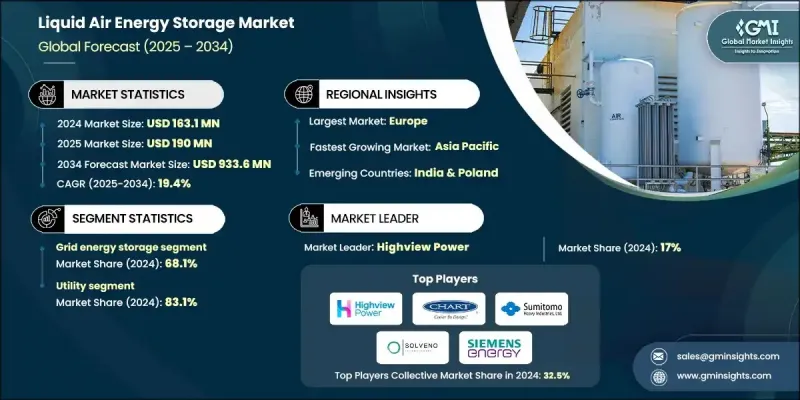
The Global Liquid Air Energy Storage Market was valued at USD 163.1 million in 2024 and is estimated to grow at a CAGR of 19.4% to reach USD 933.6 million by 2034.
LAES technology utilizes readily available and non-toxic materials such as air and steel, making it an eco-friendly and recyclable alternative to lithium-ion batteries. Its operational life span of 20-30 years with minimal performance degradation reduces lifecycle costs and environmental impacts associated with conventional energy storage systems. The global transition toward clean energy, particularly wind and solar, is fueling the demand for long-duration storage technologies like LAES. Unlike lithium-ion batteries suited for short-term applications, LAES systems can store power for several hours or even days, providing essential grid stability and flexibility. The technology's ability to separate power and energy capacity offers utilities a customizable design, ensuring a consistent power supply during periods of renewable intermittency or high energy demand. Moreover, continuous advancements in cryogenic engineering, energy recovery, and integration are improving system efficiency, with round-trip efficiency levels approaching 70%, further accelerating adoption across regions.
| Market Scope | |
|---|---|
| Start Year | 2024 |
| Forecast Year | 2025-2034 |
| Start Value | $163.1 Million |
| Forecast Value | $933.6 Million |
| CAGR | 19.4% |
In 2024, the grid energy storage segment held a 68.1% share and is forecasted to grow at a CAGR of 19% through 2034. The rising integration of wind and solar power across energy grids is increasing the necessity for dependable, long-duration storage systems. LAES provides a sustainable, emission-free solution capable of storing surplus renewable energy and discharging it during demand peaks, thereby enhancing grid reliability. The use of ambient air and the absence of scarce materials make it a cost-effective and environmentally responsible choice for large-scale storage deployment.
The utility segment held 83.1% share, and is expected to grow at a CAGR of 19.2% between 2025 and 2034. Utilities are increasingly turning to LAES technology to handle the growing fluctuations in energy production and consumption resulting from renewable energy integration. Its scalability, long-duration storage capabilities, and zero-emission operation make it an attractive alternative for meeting sustainability goals and ensuring energy security. Government initiatives supporting clean energy transition further encourage the adoption of this technology, paving the way for significant market expansion throughout the forecast period.
United States Liquid Air Energy Storage Market held a 96.7% share in 2024 and is projected to reach USD 88 million by 2034. Increasing investments in renewable infrastructure and stricter environmental regulations are pushing utilities and industries to adopt LAES systems. Their ability to stabilize the grid by storing excess solar and wind energy and releasing it during demand surges positions them as an essential component of the nation's sustainable energy portfolio. Furthermore, LAES technology offers superior safety, zero-emission performance, and compatibility with existing grid systems, enhancing its appeal for long-term energy planning.
Key companies operating in the Global Liquid Air Energy Storage Market include Chart Industries, Everllence, Huge Energy, Siemens Energy, Phelas, Solveno Technologies, Sumitomo Heavy Industries, Ltd, Highview Power, Innovatium, and ENERGY DOME. To strengthen their foothold, these companies are focusing on several strategic initiatives. Many are investing heavily in research and development to enhance the energy efficiency and cost performance of LAES systems. Collaborations with utilities and renewable energy developers are expanding their deployment opportunities globally. Strategic partnerships and joint ventures are being used to accelerate commercialization and scale up production capacity. Companies are also emphasizing regional expansion through pilot projects and demonstration plants to attract investments and build trust in LAES technology. Additionally, firms are prioritizing sustainable engineering practices and digital integration to improve system optimization, reduce operational costs, and meet evolving energy storage demands worldwide.
Table of Contents
Chapter 1 Methodology & Scope
- 1.1 Research design
- 1.1.1 Research approach
- 1.1.2 Data collection methods
- 1.1.3 Base estimates and calculations
- 1.1.4 Base year calculation
- 1.1.5 Key trends for market estimates
- 1.2 Forecast model
- 1.3 Primary research & validation
- 1.3.1 Primary sources
- 1.4 Data mining sources
- 1.5 Market definitions
Chapter 2 Executive Summary
- 2.1 Industry synopsis, 2021 - 2034
- 2.2 Business trends
- 2.3 Application trends
- 2.4 End use trends
- 2.5 Regional trends
Chapter 3 Industry Insights
- 3.1 Industry ecosystem
- 3.2 Regulatory landscape
- 3.3 Industry impact forces
- 3.3.1 Growth drivers
- 3.3.2 Industry pitfalls & challenges
- 3.4 Growth potential analysis
- 3.5 Cost structure analysis
- 3.6 Porter's analysis
- 3.6.1 Bargaining power of suppliers
- 3.6.2 Bargaining power of buyers
- 3.6.3 Threat of new entrants
- 3.6.4 Threat of substitutes
- 3.7 PESTEL analysis
- 3.7.1 Political factors
- 3.7.2 Economic factors
- 3.7.3 Social factors
- 3.7.4 Technological factors
- 3.7.5 Legal factors
- 3.7.6 Environmental factors
- 3.8 Emerging opportunities & trends
- 3.8.1 Digitalization & IoT integration
- 3.8.2 Emerging market penetration
- 3.9 Investment analysis and future outlook
Chapter 4 Competitive landscape, 2025
- 4.1 Introduction
- 4.2 Company market share analysis, by region, 2024
- 4.2.1 North America
- 4.2.2 Europe
- 4.2.3 Asia Pacific
- 4.2.4 Rest of World
- 4.3 Strategic dashboard
- 4.4 Strategic initiatives
- 4.5 Company benchmarking
- 4.6 Innovation & technology landscape
Chapter 5 Market Size and Forecast, By Application, 2021 - 2034 (USD Million)
- 5.1 Key trends
- 5.2 Grid energy storage
- 5.3 Renewable energy integration
- 5.4 Backup power
- 5.5 Others
Chapter 6 Market Size and Forecast, By End Use, 2021 - 2034 (USD Million)
- 6.1 Key trends
- 6.2 Utility
- 6.3 Commercial & industrial
- 6.4 Residential
Chapter 7 Market Size and Forecast, By Region, 2021 - 2034 (USD Million)
- 7.1 Key trends
- 7.2 North America
- 7.2.1 U.S.
- 7.2.2 Canada
- 7.3 Europe
- 7.3.1 UK
- 7.3.2 Germany
- 7.3.3 Poland
- 7.3.4 Spain
- 7.4 Asia Pacific
- 7.4.1 China
- 7.4.2 Japan
- 7.4.3 India
- 7.5 Rest of World
Chapter 8 Company Profiles
- 8.1 Chart Industries
- 8.2 ENERGY DOME
- 8.3 Everllence
- 8.4 Highview Power
- 8.5 Huge Energy
- 8.6 Innovatium
- 8.7 Phelas
- 8.8 Siemens Energy
- 8.9 Solveno Technologies
- 8.10 Sumitomo Heavy Industries Ltd

