
PUBLISHER: Global Market Insights Inc. | PRODUCT CODE: 1885796

PUBLISHER: Global Market Insights Inc. | PRODUCT CODE: 1885796
Textile to Textile Recycling Market Opportunity, Growth Drivers, Industry Trend Analysis, and Forecast 2025 - 2034
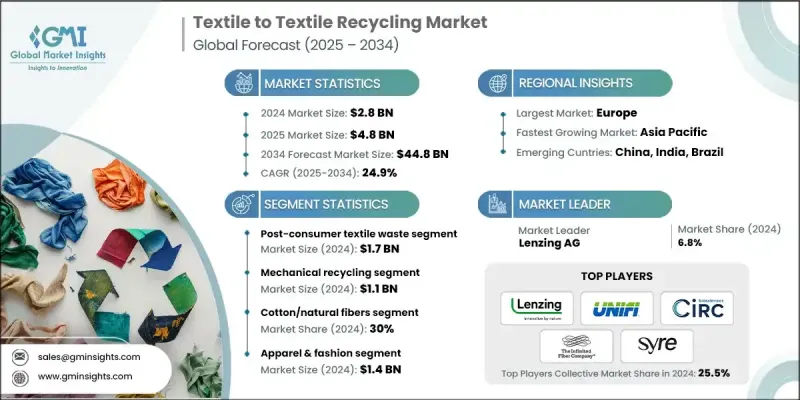
The Global Textile to Textile Recycling Market was valued at USD 2.8 billion in 2024 and is estimated to grow at a CAGR of 24.9% to reach USD 44.8 billion by 2034.
Market acceleration is driven by the rapid integration of blockchain-enabled digital product passports and embedded fiber identification technologies that enhance traceability and enable more accurate sorting. These digital systems allow recyclers to validate fiber type, track material origins, and monitor lifecycle data with high precision, supporting real-time decision-making in some instances. Their adoption improves the quality of recovered materials, reduces contamination, and ensures alignment with evolving circular textile regulations in Europe. As sustainability expectations grow, global brands are increasingly adopting these technologies to improve supply-chain accountability and meet regulatory expectations. At the same time, chemical and enzymatic recycling processes are achieving greater commercial maturity, offering the ability to break down complex textile blends into fiber components suitable for high-quality regenerated materials. These innovations are now transitioning from pilot stages into industrial-scale operations as companies secure partnerships with major apparel manufacturers and expand production capacity.
| Market Scope | |
|---|---|
| Start Year | 2024 |
| Forecast Year | 2025-2034 |
| Start Value | $2.8 Billion |
| Forecast Value | $44.8 Billion |
| CAGR | 24.9% |
The post-consumer textile waste segment accounted for USD 1.7 billion in 2024, representing roughly 60% of the total feedstock in textile-to-textile recycling. This dominant share is influenced by increased volumes of discarded garments, broader collection channels, and policy-driven initiatives supporting circular fashion systems.
The apparel and fashion segment reached USD 1.4 billion in 2024, benefiting from strong sustainability commitments among global clothing brands and rising incorporation of recycled fibers into mainstream and specialty apparel categories across the industry.
North America Textile to Textile Recycling Market generated USD 741 million in 2024, contributing 26% share. Policy developments encouraging extended producer responsibility programs, along with increased collaboration between retailers and recycling firms, are supporting stronger collection, sorting, and recovery infrastructure throughout the region.
Key companies participating in the Textile to Textile Recycling Market include Ambercycle Inc., Boer Group Recycling Solutions BV, Circ Inc., Ecotex Germany GmbH, Evrnu SPC, FABSCRAP Inc., Grasim Industries Limited (Birla Cellulose), Infinited Fiber Company Oy, Lenzing AG, Martex Fiber Southern Corporation, Procotex Corporation SA, RE&UP (SANKO Group), SYRE AB, Textile Recycling International Ltd, and Unifi Inc. Leading companies are strengthening their presence by investing heavily in advanced recycling technologies capable of processing blended and hard-to-recycle materials into high-quality regenerated fibers. Many firms are scaling production by transitioning from pilot operations to full industrial facilities through joint ventures and long-term collaborations with global apparel manufacturers. Businesses are further integrating digital tracking tools, such as embedded fiber markers and blockchain-enabled data systems, to enhance traceability and meet compliance demands.
Table of Contents
Chapter 1 Methodology & Scope
- 1.1 Market scope and definition
- 1.2 Research design
- 1.2.1 Research approach
- 1.2.2 Data collection methods
- 1.3 Data mining sources
- 1.3.1 Global
- 1.3.2 Regional/Country
- 1.4 Base estimates and calculations
- 1.4.1 Base year calculation
- 1.4.2 Key trends for market estimation
- 1.5 Primary research and validation
- 1.5.1 Primary sources
- 1.6 Forecast model
- 1.7 Research assumptions and limitations
Chapter 2 Executive Summary
- 2.1 Industry 360° synopsis
- 2.2 Key market trends
- 2.2.1 Regional
- 2.2.2 Feedstock source
- 2.2.3 Technology type
- 2.2.4 Fiber type
- 2.2.5 Application
- 2.3 TAM Analysis, 2025-2034
- 2.4 CXO perspectives: Strategic imperatives
- 2.4.1 Executive decision points
- 2.4.2 Critical success factors
- 2.5 Future Outlook and Strategic Recommendations
Chapter 3 Industry Insights
- 3.1 Industry ecosystem analysis
- 3.1.1 Supplier landscape
- 3.1.2 Profit margin
- 3.1.3 Value addition at each stage
- 3.1.4 Factor affecting the value chain
- 3.1.5 Disruptions
- 3.2 Industry impact forces
- 3.2.1 Growth drivers
- 3.2.2 Industry pitfalls and challenges
- 3.2.3 Market opportunities
- 3.3 Growth potential analysis
- 3.4 Regulatory landscape
- 3.4.1 North America
- 3.4.2 Europe
- 3.4.3 Asia Pacific
- 3.4.4 Latin America
- 3.4.5 Middle East & Africa (MEA)
- 3.5 Porter's analysis
- 3.6 PESTEL analysis
- 3.7 Price trends
- 3.7.1 By region
- 3.7.2 By feedstock source
- 3.8 Future market trends
- 3.9 Technology and innovation landscape
- 3.9.1 Current technological trends
- 3.9.2 Emerging technologies
- 3.10 Patent landscape
- 3.11 Trade statistics (HS code)
- 3.11.1 Major importing countries
- 3.11.2 Major exporting countries
- 3.12 Sustainability and environmental aspects
- 3.12.1 Sustainable practices
- 3.12.2 Waste reduction strategies
- 3.12.3 Energy efficiency in production
- 3.12.4 Eco-friendly initiatives
- 3.13 Carbon footprint consideration
Chapter 4 Competitive Landscape, 2024
- 4.1 Introduction
- 4.2 Company market share analysis
- 4.2.1 By region
- 4.2.1.1 North America
- 4.2.1.2 Europe
- 4.2.1.3 Asia Pacific
- 4.2.1.4 LATAM
- 4.2.1.5 MEA
- 4.2.1 By region
- 4.3 Company matrix analysis
- 4.4 Competitive analysis of major market players
- 4.5 Competitive positioning matrix
- 4.6 Key developments
- 4.6.1 Mergers & acquisitions
- 4.6.2 Partnerships & collaborations
- 4.6.3 New product launches
- 4.6.4 Expansion plans
Chapter 5 Market Estimates and Forecast, By Feedstock Source, 2021-2034 (USD Billion & Tons)
- 5.1 Key trends
- 5.2 Post-consumer textile waste
- 5.3 Pre-consumer industrial waste
- 5.4 Mixed textile waste streams
Chapter 6 Market Estimates and Forecast, By Technology Type, 2021-2034 (USD Billion & Tons)
- 6.1 Key trends
- 6.2 Mechanical recycling
- 6.3 Chemical recycling
- 6.4 Biological/enzymatic recycling
- 6.5 Hybrid/combined technologies
Chapter 7 Market Estimates and Forecast, By Fiber Type, 2021-2034 (USD Billion & Tons)
- 7.1 Key trends
- 7.2 Polyester/synthetic fibers
- 7.3 Cotton/natural fibers
- 7.4 Blended textiles
- 7.5 Specialty fibers
Chapter 8 Market Estimates and Forecast, By Application, 2021-2034 (USD Billion & Tons)
- 8.1 Key trends
- 8.2 Apparel & fashion
- 8.3 Industrial textiles
- 8.4 Home textiles
- 8.5 Automotive textiles
- 8.6 Non-woven applications
Chapter 9 Market Estimates and Forecast, By Region, 2021-2034 (USD Billion & Tons)
- 9.1 Key trends
- 9.2 North America
- 9.2.1 U.S.
- 9.2.2 Canada
- 9.3 Europe
- 9.3.1 Germany
- 9.3.2 UK
- 9.3.3 France
- 9.3.4 Spain
- 9.3.5 Italy
- 9.3.6 Rest of Europe
- 9.4 Asia Pacific
- 9.4.1 China
- 9.4.2 India
- 9.4.3 Japan
- 9.4.4 Australia
- 9.4.5 South Korea
- 9.4.6 Rest of Asia Pacific
- 9.5 Latin America
- 9.5.1 Brazil
- 9.5.2 Mexico
- 9.5.3 Argentina
- 9.5.4 Rest of Latin America
- 9.6 Middle East and Africa
- 9.6.1 Saudi Arabia
- 9.6.2 South Africa
- 9.6.3 UAE
- 9.6.4 Rest of Middle East and Africa
Chapter 10 Company Profiles
- 10.1 Ambercycle Inc
- 10.2 Boer Group Recycling Solutions BV
- 10.3 Circ Inc
- 10.4 Ecotex Germany GmbH
- 10.5 Evrnu SPC
- 10.6 FABSCRAP Inc
- 10.7 Grasim Industries Limited (Birla Cellulose)
- 10.8 Infinited Fiber Company Oy
- 10.9 Lenzing AG
- 10.10 Martex Fiber Southern Corporation
- 10.11 Procotex Corporation SA
- 10.12 RE&UP (SANKO Group)
- 10.13 SYRE AB
- 10.14 Textile Recycling International Ltd
- 10.15 Unifi Inc

