
PUBLISHER: Global Market Insights Inc. | PRODUCT CODE: 1885799

PUBLISHER: Global Market Insights Inc. | PRODUCT CODE: 1885799
Microbiome Modulators Market Opportunity, Growth Drivers, Industry Trend Analysis, and Forecast 2025 - 2034
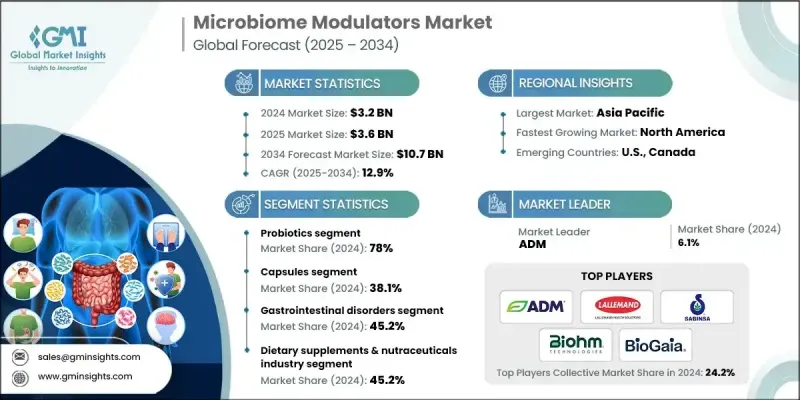
The Global Microbiome Modulators Market was valued at USD 3.2 billion in 2024 and is estimated to grow at a CAGR of 12.9% to reach USD 10.7 billion by 2034.
The market continues to expand as scientific and commercial interest in the human microbiome strengthens, highlighting the essential role of microbial balance in maintaining long-term health. Microbiome modulators such as probiotics, prebiotics, synbiotics, and postbiotics are designed to support and restore microbial harmony that may be disrupted by lifestyle factors, stress, antibiotic exposure, or poor dietary patterns. These products are increasingly associated with digestive comfort, immune reinforcement, lowered inflammation, and improved metabolic outcomes linked to conditions such as diabetes and obesity. As consumers gravitate toward natural, preventive solutions and personalized nutrition, demand for microbiome-focused products is accelerating across supplements, functional foods, and wellness formulations. Ongoing advancements in microbiome science, combined with rising health consciousness, continue to broaden product innovation and segment diversity, ensuring sustained market progression.
| Market Scope | |
|---|---|
| Start Year | 2024 |
| Forecast Year | 2025-2034 |
| Start Value | $3.2 Billion |
| Forecast Value | $10.7 Billion |
| CAGR | 12.9% |
The probiotics segment held a 78% share and is set to grow at a CAGR of 12.9% through 2034. Continuous strain development and specialized formulations are reinforcing their use in immune support, digestive regulation, and overall wellness. Their integration into dietary supplements, functional beverages, and fortified foods is expanding as consumer interest rises.
The capsules segment accounted for a 38.1% share in 2024 and is forecast to grow at a CAGR of 13% from 2025 to 2034. Capsules remain a preferred delivery mode due to convenience, ease of ingestion, and their protective barrier that improves the stability of sensitive organisms. This format supports targeted release, making it highly suitable for both supplement and pharmaceutical applications.
North America Microbiome Modulators Market captured 30.2% share in 2024, backed by growing awareness about gut health and its influence on overall wellness. Consumers across the region are increasingly purchasing probiotic and prebiotic-enriched products, driving reinforced demand across supplements, foods, and beverages.
Key players active in the Microbiome Modulators Market include AB-Biotics, SA, Ritual, 4D Pharma Plc, BioGaia, DSM-Firmenich, Sabinsa Corporation, ADM, Biohm Technologies, Modulate Biosystems, Second Genome, Inc., Ferring, Lallemand Health Solutions, and TCI Co., Ltd. To strengthen their position, companies in the Microbiome Modulators Market are adopting strategies centered on scientific validation, diversified product launches, and expanded distribution networks. Many firms are investing in advanced strain research and clinical studies to substantiate health claims and enhance credibility. Partnerships with food, beverage, and supplement manufacturers are helping broaden application possibilities, while personalized formulations are being developed to meet the rising demand for targeted wellness solutions. Companies are also expanding their global reach by strengthening e-commerce channels, optimizing supply chains, and engaging in strategic collaborations to accelerate innovation and regulatory compliance.
Table of Contents
Chapter 1 Methodology & Scope
- 1.1 Market scope and definition
- 1.2 Research design
- 1.2.1 Research approach
- 1.2.2 Data collection methods
- 1.3 Data mining sources
- 1.3.1 Global
- 1.3.2 Regional/Country
- 1.4 Base estimates and calculations
- 1.4.1 Base year calculation
- 1.4.2 Key trends for market estimation
- 1.5 Primary research and validation
- 1.5.1 Primary sources
- 1.6 Forecast model
- 1.7 Research assumptions and limitations
Chapter 2 Executive Summary
- 2.1 Industry 360° synopsis
- 2.2 Key market trends
- 2.2.1 Regional
- 2.2.2 Product
- 2.2.3 Form
- 2.2.4 Application
- 2.2.5 End Use industry
- 2.3 TAM Analysis, 2025-2034
- 2.4 CXO perspectives: Strategic imperatives
- 2.4.1 Executive decision points
- 2.4.2 Critical success factors
- 2.5 Future Outlook and Strategic Recommendations
Chapter 3 Industry Insights
- 3.1 Industry ecosystem analysis
- 3.1.1 Supplier landscape
- 3.1.2 Profit margin
- 3.1.3 Value addition at each stage
- 3.1.4 Factor affecting the value chain
- 3.1.5 Disruptions
- 3.2 Industry impact forces
- 3.2.1 Growth drivers
- 3.2.2 Industry pitfalls and challenges
- 3.2.3 Market opportunities
- 3.3 Growth potential analysis
- 3.4 Regulatory landscape
- 3.4.1 North America
- 3.4.2 Europe
- 3.4.3 Asia Pacific
- 3.4.4 Latin America
- 3.4.5 Middle East & Africa
- 3.5 Porter's analysis
- 3.6 PESTEL analysis
- 3.7 Price trends
- 3.7.1 By region
- 3.7.2 By Product type
- 3.8 Future market trends
- 3.9 Technology and Innovation landscape
- 3.9.1 Current technological trends
- 3.9.2 Emerging technologies
- 3.10 Patent Landscape
- 3.11 Trade statistics (HS code) ( Note: the trade statistics will be provided for key countries only)
- 3.11.1 Major importing countries
- 3.11.2 Major exporting countries
- 3.12 Sustainability and environmental aspects
- 3.12.1 Sustainable practices
- 3.12.2 Waste reduction strategies
- 3.12.3 Energy efficiency in production
- 3.12.4 Eco-friendly initiatives
- 3.13 Carbon footprint consideration
Chapter 4 Competitive Landscape, 2024
- 4.1 Introduction
- 4.2 Company market share analysis
- 4.2.1 By region
- 4.2.1.1 North America
- 4.2.1.2 Europe
- 4.2.1.3 Asia Pacific
- 4.2.1.4 LATAM
- 4.2.1.5 MEA
- 4.2.1 By region
- 4.3 Company matrix analysis
- 4.4 Competitive analysis of major market players
- 4.5 Competitive positioning matrix
- 4.6 Key developments
- 4.6.1 Mergers & acquisitions
- 4.6.2 Partnerships & collaborations
- 4.6.3 New Product Launches
- 4.6.4 Expansion Plans
Chapter 5 Market Estimates and Forecast, By Product, 2021-2034 (USD Million) (Kilo Tons)
- 5.1 Key trends
- 5.2 Probiotics
- 5.3 Prebiotics
- 5.4 Synbiotics
- 5.5 Postbiotics
- 5.6 Live biotherapeutic products (LBPs)
- 5.7 Bacteriophage therapies
Chapter 6 Market Estimates and Forecast, By Form, 2021-2034 (USD Million) (Kilo Tons)
- 6.1 Key trends
- 6.2 Capsules
- 6.3 Tablets
- 6.4 Powders
- 6.5 Liquids
- 6.6 Others
Chapter 7 Market Estimates and Forecast, By Application, 2021-2034 (USD Million) (Kilo Tons)
- 7.1 Key trends
- 7.2 Infectious diseases
- 7.3 Gastrointestinal disorders
- 7.4 Immune system disorders
- 7.5 Cancer therapy
- 7.6 Metabolic diseases
- 7.7 Dermatological conditions
Chapter 8 Market Estimates and Forecast, By End Use Industry, 2021-2034 (USD Million) (Kilo Tons)
- 8.1 Key trends
- 8.2 Pharmaceutical & biotechnology
- 8.3 Dietary supplements & nutraceuticals
- 8.4 Food & beverage
- 8.5 Animal feed & nutrition
- 8.6 Others
Chapter 9 Market Estimates and Forecast, By Region, 2021-2034 (USD Million) (Kilo Tons)
- 9.1 Key trends
- 9.2 North America
- 9.2.1 U.S.
- 9.2.2 Canada
- 9.3 Europe
- 9.3.1 Germany
- 9.3.2 UK
- 9.3.3 France
- 9.3.4 Spain
- 9.3.5 Italy
- 9.3.6 Rest of Europe
- 9.4 Asia Pacific
- 9.4.1 China
- 9.4.2 India
- 9.4.3 Japan
- 9.4.4 Australia
- 9.4.5 South Korea
- 9.4.6 Rest of Asia Pacific
- 9.5 Latin America
- 9.5.1 Brazil
- 9.5.2 Mexico
- 9.5.3 Argentina
- 9.5.4 Rest of Latin America
- 9.6 Middle East and Africa
- 9.6.1 Saudi Arabia
- 9.6.2 South Africa
- 9.6.3 UAE
- 9.6.4 Rest of Middle East and Africa
Chapter 10 Company Profiles
- 10.1 AB-Biotics, SA
- 10.2 ADM
- 10.3 BioGaia
- 10.4 Biohm Technologies
- 10.5 DSM-Firmenich
- 10.6 Ferring
- 10.7 Lallemand Health Solutions
- 10.8 Modulate Biosystems
- 10.9 Ritual
- 10.10 Sabinsa Corporation
- 10.11 Second Genome, Inc.
- 10.12 TCI Co., Ltd.
- 10.13 4D Pharma Plc

