PUBLISHER: Global Market Insights Inc. | PRODUCT CODE: 1885817

PUBLISHER: Global Market Insights Inc. | PRODUCT CODE: 1885817
Green Building Market Opportunity, Growth Drivers, Industry Trend Analysis, and Forecast 2025 - 2034
The Global Green Building Market was valued at USD 530.2 billion in 2024 and is estimated to grow at a CAGR of 10.2% to reach USD 1.39 trillion by 2034.
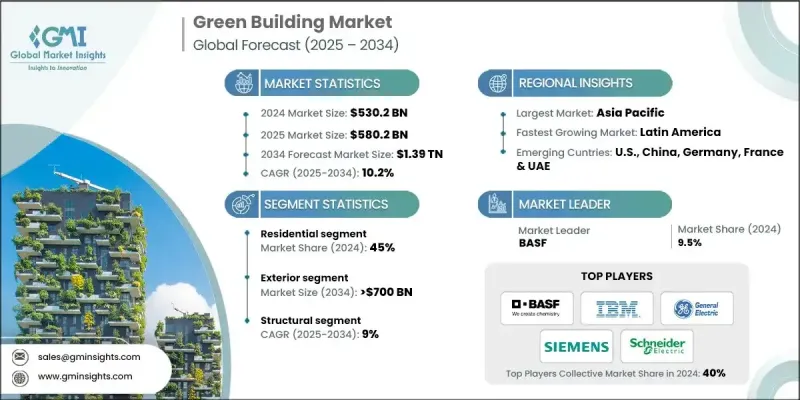
The industry is expanding as sustainability, energy efficiency, and environmental responsibility become core priorities for governments, consumers, and real estate developers. Accelerating urbanization, combined with stricter building regulations and heightened awareness of climate impacts, continues to drive market growth. Modern construction increasingly incorporates energy-efficient materials, advanced HVAC solutions, and on-site renewable systems, fundamentally reshaping how buildings are designed and operated. Green building practices reduce resource consumption, improve indoor environmental quality, and support long-term cost savings across residential, commercial, and industrial applications. Demand is further reinforced by global certification frameworks, corporate sustainability goals, and rising public expectations for environmentally conscious development. Organizations across multiple sectors are upgrading facilities to meet ambitious emissions targets, optimize operational performance, and align with global environmental standards.
| Market Scope | |
|---|---|
| Start Year | 2024 |
| Forecast Year | 2025-2034 |
| Start Value | $530.2 Billion |
| Forecast Value | $1.39 Trillion |
| CAGR | 10.2% |
The residential segment held a 45% share in 2024 and is projected to grow at a CAGR of 9.5% through 2034. Homeowners increasingly value lower operating costs, improved indoor air quality, and eco-friendly design features. Adoption is fueled by sustainability-driven materials, smart home technologies, and construction methods that minimize carbon output. Government incentives and updated building regulations support widespread integration, establishing residential green buildings as a key component of future urban development.
The interior green building segment reached USD 188.8 billion in 2024, reflecting growing interest in healthier indoor spaces that incorporate environmentally responsible materials and systems. Demand is rising for recycled and low-emission products, enhanced natural light, advanced ventilation, and smart controls that optimize comfort and energy performance. Strengthening ESG commitments and wellness-oriented design standards are accelerating the shift toward sustainable interior environments.
North America Green Building Market is expected to reach USD 400 billion by 2034. Strong environmental regulations and heightened sustainability expectations are encouraging developers to deploy eco-efficient designs, resource-saving materials, and intelligent building technologies. Supportive policies, expanding certification programs, and increased emphasis on healthy indoor spaces continue to drive long-term adoption across the region.
Key companies active in the Green Building Market include CertainTeed, DuPont, Binderholz, Johnson Controls, Alumasc Building Products, General Electric Company, BSW GROUP, Kingspan Group, Signify Holding, CEMEX, HOLCIM, Forbo, Bosch Sicherheitssysteme, Owens Corning, Daikin, Bauder, Interface, ABB, Alleguard, Schneider Electric, RedBuilt, Siemens, BASF, and IBM. Companies competing in the Green Building Market are employing a range of strategies to strengthen their market position and expand global reach. Many firms are investing in advanced sustainable materials, energy-efficient building systems, and low-carbon manufacturing processes to meet growing regulatory and consumer expectations. Partnerships with construction firms, technology providers, and certification bodies help accelerate innovation and create integrated solutions tailored to modern green standards. Companies are also expanding product portfolios to address diverse applications, from residential retrofits to large-scale commercial projects.
Table of Contents
Chapter 1 Methodology & Scope
- 1.1 Research design
- 1.1.1 Research approach
- 1.1.2 Data collection methods
- 1.2 Base estimates and calculations
- 1.2.1 Base year calculation
- 1.2.2 Market estimates & forecast parameters
- 1.3 Forecast model
- 1.3.1 Key trends for market estimates
- 1.3.2 Quantified market impact analysis
- 1.3.2.1 Mathematical impact of growth parameters on forecast
- 1.3.3 Scenario analysis framework
- 1.4 Primary research and validation
- 1.4.1 Some of the primary sources (but not limited to)
- 1.5 Data mining sources
- 1.5.1 Paid Sources
- 1.5.2 Sources, by region
- 1.6 Research trail & scoring components
- 1.6.1 Research trail components
- 1.6.2 Scoring components
- 1.7 Research transparency addendum
- 1.7.1 Source attribution framework
- 1.7.2 Quality assurance metrics
- 1.7.3 Our commitment to trust
- 1.8 Market definitions
Chapter 2 Executive Summary
- 2.1 Industry synopsis, 2021 - 2034
- 2.1.1 Business trends
- 2.1.2 End use trends
- 2.1.3 Project type trends
- 2.1.4 Product trends
- 2.1.5 Material type trends
- 2.1.6 Sales channel trends
- 2.1.7 Regional trends
Chapter 3 Industry Insights
- 3.1 Industry ecosystem analysis
- 3.1.1 Raw material availability & sourcing analysis
- 3.1.2 Manufacturing capacity assessment
- 3.1.3 Supply chain resilience & risk factors
- 3.1.4 Distribution network analysis
- 3.2 Regulatory landscape
- 3.3 Industry impact forces
- 3.3.1 Growth drivers
- 3.3.2 Industry pitfalls & challenges
- 3.4 Growth potential analysis
- 3.5 Porter's analysis
- 3.5.1 Bargaining power of suppliers
- 3.5.2 Bargaining power of buyers
- 3.5.3 Threat of new entrants
- 3.5.4 Threat of substitutes
- 3.6 PESTEL analysis
- 3.6.1 Political factors
- 3.6.2 Economic factors
- 3.6.3 Social factors
- 3.6.4 Technological factors
- 3.6.5 Legal factors
- 3.6.6 Environmental factors
- 3.7 Cost structure analysis of green buildings
- 3.8 Emerging growth opportunities
- 3.9 Key trends shaping sustainable construction
- 3.10 Investment landscape & long-term prospects
- 3.11 Digital transformation & industry 4.0 integration
- 3.12 Sustainability initiatives & standards
Chapter 4 Competitive Landscape, 2025
- 4.1 Introduction
- 4.2 Company market share analysis, by region, 2024
- 4.2.1 North America
- 4.2.2 Europe
- 4.2.3 Asia Pacific
- 4.2.4 Middle East & Africa
- 4.2.5 Latin America
- 4.3 Strategic dashboard
- 4.4 Strategic initiatives
- 4.4.1 Key partnerships & collaborations
- 4.4.2 Major M&A activities
- 4.4.3 Product innovations & launches
- 4.4.4 Market expansion strategies
- 4.5 Competitive benchmarking
- 4.6 Innovation & sustainability landscape
Chapter 5 Market Size and Forecast, By End Use, 2021 - 2034 (USD Million)
- 5.1 Key trends
- 5.2 Residential
- 5.3 Commercial
- 5.4 Industrial
Chapter 6 Market Size and Forecast, By Project Type, 2021 - 2034 (USD Million)
- 6.1 Key trends
- 6.2 New
- 6.3 Retrofit
Chapter 7 Market Size and Forecast, By Product, 2021 - 2034 (USD Million)
- 7.1 Key trends
- 7.2 Interior
- 7.3 Exterior
- 7.4 Others
Chapter 8 Market Size and Forecast, By Material Type, 2021 - 2034 (USD Million)
- 8.1 Key trends
- 8.2 Structural
- 8.3 Insulation
- 8.4 Finishing
- 8.5 Glass & glazing
Chapter 9 Market Size and Forecast, By Sales Channel, 2021 - 2034 (USD Million)
- 9.1 Key trends
- 9.2 Online
- 9.3 Offline
Chapter 10 Market Size and Forecast, By Region, 2021 - 2034 (USD Million)
- 10.1 Key trends
- 10.2 North America
- 10.2.1 U.S.
- 10.2.2 Canada
- 10.2.3 Mexico
- 10.3 Europe
- 10.3.1 Germany
- 10.3.2 UK
- 10.3.3 France
- 10.3.4 Netherlands
- 10.3.5 Sweden
- 10.3.6 Italy
- 10.3.7 Spain
- 10.3.8 Denmark
- 10.3.9 Norway
- 10.4 Asia Pacific
- 10.4.1 China
- 10.4.2 Japan
- 10.4.3 India
- 10.4.4 South Korea
- 10.4.5 Australia
- 10.4.6 Singapore
- 10.4.7 Indonesia
- 10.4.8 Malaysia
- 10.5 Middle East & Africa
- 10.5.1 UAE
- 10.5.2 Saudi Arabia
- 10.5.3 South Africa
- 10.5.4 Qatar
- 10.5.5 Kuwait
- 10.5.6 Egypt
- 10.5.7 Kenya
- 10.5.8 Morocco
- 10.6 Latin America
- 10.6.1 Brazil
- 10.6.2 Chile
- 10.6.3 Argentina
Chapter 11 Company Profiles
- 11.1 ABB
- 11.2 Alleguard
- 11.3 Alumasc Building Products
- 11.4 BASF
- 11.5 Bauder Ltd.
- 11.6 Binderholz GmbH
- 11.7 Bosch Sicherheitssysteme GmbH
- 11.8 BSW GROUP
- 11.9 CEMEX
- 11.10 CertainTeed, LLC
- 11.11 Daikin
- 11.12 DuPont
- 11.13 Forbo
- 11.14 General Electric Company
- 11.15 HOLCIM
- 11.16 IBM
- 11.17 Interface, Inc.
- 11.18 Johnson Controls
- 11.19 Kingspan Group
- 11.20 Owens Corning
- 11.21 RedBuilt
- 11.22 Schneider Electric
- 11.23 Siemens
- 11.24 Signify Holding

