
PUBLISHER: Global Market Insights Inc. | PRODUCT CODE: 1885835

PUBLISHER: Global Market Insights Inc. | PRODUCT CODE: 1885835
Middle East and Africa Automatic Door Market Opportunity, Growth Drivers, Industry Trend Analysis, and Forecast 2025 - 2034
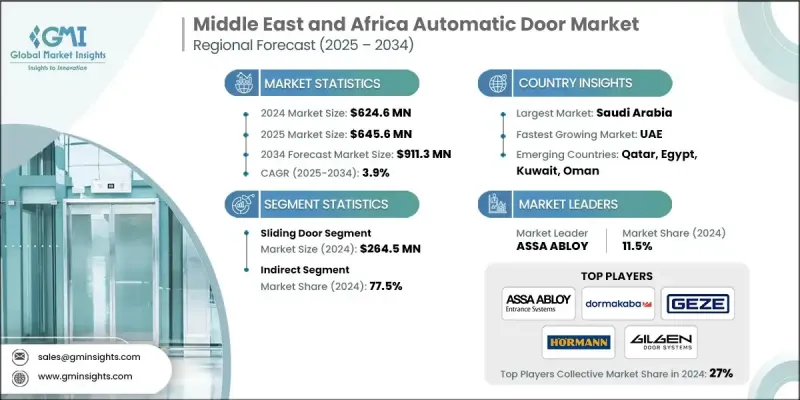
Middle East and Africa Automatic Door Market was valued at USD 624.6 million in 2024 and is estimated to grow at a CAGR of 3.9% to reach USD 911.3 million by 2034.
Growth in the region is driven by accessibility regulations and initiatives promoting disability inclusion, which encourage the adoption of automatic doors in commercial, public, and residential buildings. As governments implement standards to ensure compliance and inclusivity, demand for reliable and technologically advanced automatic doors rises. The shift toward smart infrastructure, modernization of urban projects, and investment in high-quality building solutions further fuels the market. Manufacturers are responding with products that combine safety, design, and energy efficiency while meeting regional codes and international standards. Increasing construction activities, particularly in high-end residential, commercial, and hospitality segments, are creating significant opportunities for automatic door providers, making them essential for both new developments and retrofitting projects across the MEA region.
| Market Scope | |
|---|---|
| Start Year | 2024 |
| Forecast Year | 2025-2034 |
| Start Value | $624.6 Million |
| Forecast Value | $911.3 Million |
| CAGR | 3.9% |
The sliding door segment generated USD 264.5 million in 2024. Its popularity stems from its space-saving design, aesthetic appeal, and convenience, making it a preferred choice for upscale residential and commercial properties. As urban development accelerates in the region, sliding doors are being increasingly integrated into high-end apartments and villas, providing both functionality and modern design value.
The indirect sales segment held a 77.5% share in 2024. The MEA market comprises diverse regulatory frameworks, including standards in the GCC, South Africa, and Nigeria, which can be challenging for manufacturers to navigate. Indirect distribution channels facilitate market entry, ensuring compliance while providing post-sale servicing such as sensor calibration and diagnostic checks.
Saudi Arabia Automatic Door Market generated USD 157.8 million in 2024. The country's rapid infrastructure development, urbanization, and government initiatives are driving the adoption of advanced automatic doors. Companies are leveraging new technologies to enhance product quality, functionality, and durability while meeting growing demand in commercial, residential, and public infrastructure projects.
Key players operating in the Middle East and Africa Automatic Door Market include Al Adel Automatic Doors, Al Arabia Automatic Doors, ASSA ABLOY Group, Boon Edam, Deper, DNG (Dongbang Automatic Door Co., Ltd.), DormaKaba Holding AG, FAAC Group, GEZE GmbH, Gilgen Door Systems AG, Hormann Group, Ningbo Ownic Automatic Door Co., Ltd., Record Group, Stanley Access Technologies, and TORMAX. Companies in the Middle East and Africa Automatic Door Market are focusing on technological innovation, including smart sensors, IoT-enabled monitoring, and energy-efficient automation to enhance product functionality and meet regional standards. Firms are forming strategic partnerships with construction companies, distributors, and developers to expand their reach across commercial, residential, and public infrastructure projects. Geographic diversification within the region helps navigate complex regulatory landscapes. Businesses are investing in skilled personnel, training, and local manufacturing to improve service delivery, maintenance, and installation support.
Table of Contents
Chapter 1 Methodology & Scope
- 1.1 Market scope and definition
- 1.2 Research design
- 1.2.1 Research approach
- 1.2.2 Data collection methods
- 1.3 Data mining sources
- 1.3.1 Global
- 1.3.2 Regional
- 1.4 Base estimates and calculations
- 1.4.1 Base year calculation
- 1.4.2 Key trends for market estimation
- 1.5 Primary research and validation
- 1.5.1 Primary sources
- 1.6 Forecast model
- 1.7 Research assumptions and limitations
Chapter 2 Executive Summary
- 2.1 Industry 3600 synopsis
- 2.2 Key market trends
- 2.2.1 Regional
- 2.2.2 Product type
- 2.2.3 Function
- 2.2.4 End use
- 2.2.5 Distribution Channel
- 2.3 CXO perspectives: Strategic imperatives
- 2.3.1 Key decision points for industry executives
- 2.3.2 Critical success factors for market players
- 2.4 Future outlook and strategic recommendations
Chapter 3 Industry Insights
- 3.1 Industry ecosystem analysis
- 3.1.1 Supplier landscape
- 3.1.2 Profit margin
- 3.1.3 Value addition at each stage
- 3.1.4 Factor affecting the value chain
- 3.2 Industry impact forces
- 3.2.1 Growth drivers
- 3.2.1.1 Urbanization & smart infrastructure
- 3.2.1.2 Improving focus on hygiene & contactless access
- 3.2.1.3 Energy efficiency & security
- 3.2.2 Industry pitfalls & challenges
- 3.2.2.1 Large up-front installation and maintenance costs
- 3.2.2.2 Cybersecurity threats associated with smart door
- 3.2.3 Opportunities
- 3.2.3.1 Growth of smart building and smart city initiatives
- 3.2.3.2 Unrealized opportunities in developing economies
- 3.2.1 Growth drivers
- 3.3 Growth potential analysis
- 3.4 Future market trends
- 3.5 Technology and innovation landscape
- 3.5.1 Current technological trends
- 3.5.2 Emerging technologies
- 3.6 Price trends
- 3.6.1 By country
- 3.6.2 By product type
- 3.7 Regulatory landscape
- 3.7.1 Standards and compliance requirements
- 3.7.2 Regional regulatory frameworks
- 3.7.3 Certification standards
- 3.8 Trade statistics (HS code- 830260)
- 3.8.1 Major importing countries
- 3.8.2 Major exporting countries
- 3.9 Gap analysis
- 3.10 Risk assessment and mitigation
- 3.11 Porter's analysis
- 3.12 PESTEL analysis
- 3.13 Consumer behaviour analysis
- 3.13.1 Purchasing patterns
- 3.13.2 Preference analysis
- 3.13.3 Regional variations in consumer behaviour
- 3.13.4 Impact of e-commerce on buying decisions
Chapter 4 Competitive Landscape, 2024
- 4.1 Introduction
- 4.2 Company market share analysis
- 4.2.1 By country
- 4.2.1.1 Saudi Arabia
- 4.2.1.2 UAE
- 4.2.1.3 Qatar
- 4.2.1.4 Oman
- 4.2.1.5 Kuwait
- 4.2.1.6 Bahrain
- 4.2.1.7 Egypt
- 4.2.1.8 Rest of Middle East and Africa
- 4.2.1 By country
- 4.3 Company matrix analysis
- 4.4 Competitive analysis of major market players
- 4.5 Competitive positioning matrix
- 4.6 Key developments
- 4.6.1 Mergers & acquisitions
- 4.6.2 Partnerships & collaborations
- 4.6.3 New product launches
- 4.6.4 Expansion plans
Chapter 5 Market Estimates & Forecast, By Product type, 2021-2034 (USD Million) (Thousand Units)
- 5.1 Key trends
- 5.2 Sliding door
- 5.3 Swinging door
- 5.4 Folding door
- 5.5 Revolving door
- 5.6 Bi-fold doors
- 5.7 Others
Chapter 6 Market Estimates & Forecast, By Function, 2021-2034 (USD Million) (Thousand Units)
- 6.1 Key trends
- 6.2 Sensor based
- 6.3 Motion based
- 6.4 Push button
- 6.5 Access control
Chapter 7 Market Estimates & Forecast, By End Use, 2021-2034 (USD Million) (Thousand Units)
- 7.1 Key trends
- 7.2 Residential
- 7.3 Commercial
- 7.3.1 HoReCa
- 7.3.2 Shopping malls
- 7.3.3 Airports
- 7.3.4 Hospitals
- 7.3.5 Others (retail stores, etc.)
- 7.4 Industrial
- 7.4.1 Warehouse
- 7.4.2 Manufacturing facilities
Chapter 8 Market Estimates & Forecast, By Distribution Channel, 2021-2034 (USD Million) (Thousand Units)
- 8.1 Key trends
- 8.1.1 Direct sales
- 8.1.2 Indirect sales
Chapter 9 Market Estimates & Forecast, By Country, 2021-2034 (USD Million) (Thousand Units)
- 9.1 Key trends
- 9.2 Middle East and Africa
- 9.2.1 Saudi Arabia
- 9.2.2 UAE
- 9.2.3 Qatar
- 9.2.4 Oman
- 9.2.5 Kuwait
- 9.2.6 Bahrain
- 9.2.7 Egypt
- 9.2.8 Rest of Middle East and Africa
Chapter 10 Company Profiles
- 10.1 Al Adel Automatic Doors
- 10.2 Al Arabia Automatic Doors
- 10.3 ASSA ABLOY Group
- 10.4 Boon Edam
- 10.5 Deper (Wuxi Deper Automatic Door Co., Ltd.)
- 10.6 DNG (Dongbang Automatic Door Co., Ltd.)
- 10.7 DormaKaba Holding AG
- 10.8 FAAC Group
- 10.9 GEZE GmbH
- 10.10 Gilgen Door Systems AG
- 10.11 Hormann Group
- 10.12 Ningbo Ownic Automatic Door Co., Ltd.
- 10.13 Record Group
- 10.14 Stanley Access Technologies
- 10.15 TORMAX

