PUBLISHER: Global Market Insights Inc. | PRODUCT CODE: 1982312

PUBLISHER: Global Market Insights Inc. | PRODUCT CODE: 1982312
Europe Automatic Door Market Opportunity, Growth Drivers, Industry Trend Analysis, and Forecast 2026 - 2035
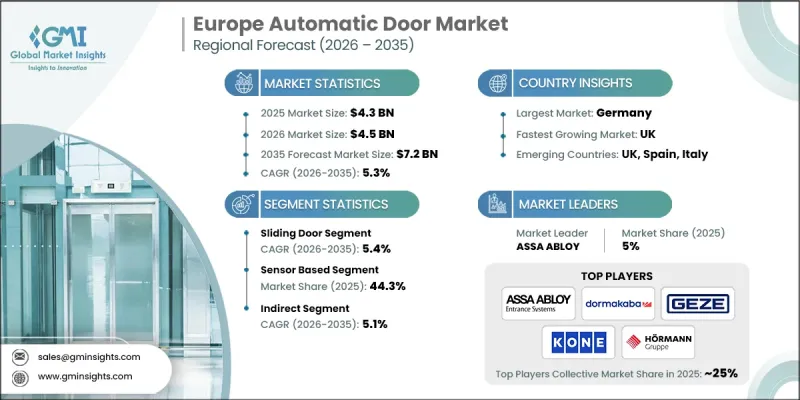
Europe Automatic Door Market was valued at USD 4.3 billion in 2025 and is estimated to grow at a CAGR of 5.3% to reach USD 7.2 billion by 2035.
Market growth is influenced by Europe's structured regulatory framework, which mandates compliance with EN 16005 standards for automated door installations in commercial and public infrastructure. These guidelines emphasize user safety, accessibility, and improved energy performance, encouraging both new installations and system upgrades. Compliance requirements ensure the integration of advanced safety mechanisms such as motion detection and emergency opening capabilities, which are critical in high-traffic environments. Infrastructure expansion and the refurbishment of aging building stock across the region are further stimulating demand. A significant share of European buildings constructed before the 1980s requires modernization to meet updated construction codes and accessibility directives. Automatic door systems play a central role in these upgrades by delivering enhanced operational efficiency and regulatory alignment. Additionally, increasing digital transformation across commercial properties is accelerating the integration of automated doors with IoT-enabled platforms, building management systems, and AI-based analytics, enabling real-time performance tracking, predictive servicing, and optimized energy usage within connected smart building ecosystems.
| Market Scope | |
|---|---|
| Start Year | 2025 |
| Forecast Year | 2026-2035 |
| Start Value | $4.3 Billion |
| Forecast Value | $7.2 Billion |
| CAGR | 5.3% |
The sliding door segment generated USD 1.7 billion in 2025 and is forecast to grow at a CAGR of 5.4% between 2026 and 2035. Demand for sliding automatic doors remains strong across multiple end-use sectors due to their space-saving configuration, seamless movement, and modern visual appeal. Their ability to maximize usable space while supporting controlled indoor climates makes them a preferred solution in evolving architectural designs. Continued emphasis on energy-efficient construction and streamlined building layouts further strengthens the segment's expansion.
The sensor-based segment held a 44.3% share in 2025 and is projected to grow at a CAGR of 5.2% from 2026 to 2035. Rising focus on hygiene standards, touchless access, and operational automation is driving the adoption of sensor-enabled door systems. These solutions improve safety and convenience by reducing direct contact while enabling smooth traffic flow. The growth of intelligent infrastructure and digitally managed facilities is further contributing to increased implementation of sensor-integrated automated entry systems.
Germany Automatic Door Market is expected to grow at a CAGR of 5.9% during the 2026-2035 forecast period. The country's automatic sliding door industry continues to develop steadily, supported by strong uptake of motorized and sensor-integrated technologies across commercial and residential developments. The transition toward contactless and automated building access solutions aligns with Germany's emphasis on modern construction practices and advanced engineering standards.
Key participants operating in the Europe Automatic Door Market include ASSA ABLOY, Dormakaba Group, Allegion, GEZE GmbH, FAAC, TORMAX, Gilgen Door Systems, Royal Boon Edam International B.V., Hormann Group, KONE Corporation, Automatic Systems, Portalp, ERREKA, Manusa, and Deutschtec GmbH. Companies competing in the Europe Automatic Door Market are reinforcing their market position through continuous product innovation, geographic expansion, and strategic collaborations. Manufacturers are prioritizing research and development to deliver energy-efficient, sensor-integrated, and IoT-compatible solutions that align with evolving building regulations. Partnerships with construction firms and facility management providers enable early integration of automatic door systems in new infrastructure projects. Firms are also strengthening distribution networks and after-sales service capabilities to enhance customer retention and brand loyalty.
Table of Contents
Chapter 1 Methodology & Scope
- 1.1 Market scope & definitions
- 1.2 Research design
- 1.2.1 Research approach
- 1.2.2 Data collection methods
- 1.3 Base estimates and calculations
- 1.3.1 Base year calculation
- 1.3.2 Market estimates & forecasts parameters
- 1.4 Forecast Model
- 1.4.1 Key trends for market estimates
- 1.4.2 Quantified market impact analysis
- 1.4.2.1 Mathematical impact of growth parameters on forecast
- 1.4.3 Scenario analysis framework
- 1.5 Primary research and validation
- 1.5.1 Some of the primary sources (but not limited to)
- 1.6 Data mining sources
- 1.6.1 Paid Sources
- 1.7 Primary research and validation
- 1.7.1 Primary sources
- 1.8 Research Trail & confidence scoring
- 1.8.1 Research trail components
- 1.8.2 Scoring components
- 1.9 Research transparency addendum
- 1.9.1 Source attribution framework
- 1.9.2 Quality assurance metrics
- 1.9.3 Our commitment to trust
- 1.10 Market Definitions
Chapter 2 Executive Summary
- 2.1 Industry 360° synopsis, 2022-2035
- 2.2 Key market trends
- 2.2.1 Country
- 2.2.2 Product type
- 2.2.3 Material
- 2.2.4 Function
- 2.2.5 End use
- 2.2.6 Distribution channel
- 2.3 CXO perspectives: Strategic imperatives
- 2.3.1 Key decision points for industry executives
- 2.3.2 Critical success factors for market players
- 2.4 Future outlook and strategic recommendations
Chapter 3 Industry Insights
- 3.1 Industry ecosystem analysis
- 3.1.1 Supplier landscape
- 3.1.2 Profit margin
- 3.1.3 Value addition at each stage
- 3.1.4 Factor affecting the value chain
- 3.2 Industry impact forces
- 3.2.1 Growth drivers
- 3.2.1.1 Strict EU safety & accessibility regulations
- 3.2.1.2 Expansion of commercial infrastructure
- 3.2.1.3 Rising focus on hygiene and touchless access
- 3.2.2 Pitfalls & Challenges
- 3.2.2.1 High installation and maintenance costs
- 3.2.2.2 Complexity of retrofitting historic European buildings
- 3.2.3 Opportunities
- 3.2.3.1 Growing demand for smart building integration
- 3.2.3.2 Rapid growth in healthcare and cleanroom applications
- 3.2.1 Growth drivers
- 3.3 Growth potential analysis
- 3.4 Future market trends
- 3.5 Technology and innovation landscape
- 3.5.1 Current technological trends
- 3.5.2 Emerging technologies
- 3.6 Price trends
- 3.6.1 By country
- 3.6.2 By product
- 3.7 Regulatory landscape
- 3.7.1 Germany: Deutsches Institut fur Normung (DIN) European Norm (EN) ISO 4210
- 3.7.2 UK: European Norm (EN) ISO 4210 / United Kingdom Conformity Assessed (UKCA)
- 3.7.3 France: European Norm (EN) ISO 4210
- 3.8 Trade data analysis
- 3.8.1 Import/export volume & value trends
- 3.8.2 Key trade corridors & tariff impact
- 3.9 Impact of AI & generative AI on the market
- 3.9.1 AI-driven disruption of existing business models
- 3.9.2 Gen AI use cases & adoption roadmap by segment
- 3.9.3 Risks, limitations & regulatory considerations
- 3.10 Porter's analysis
- 3.11 PESTEL analysis
Chapter 4 Competitive Landscape, 2025
- 4.1 Introduction
- 4.2 Company market share analysis
- 4.2.1 By Country
- 4.2.1.1 Germany
- 4.2.1.2 UK
- 4.2.1.3 France
- 4.2.1.4 Italy
- 4.2.1.5 Spain
- 4.2.1.6 Rest of Europe
- 4.2.1 By Country
- 4.3 Company matrix analysis
- 4.4 Competitive analysis of major market players
- 4.5 Competitive positioning matrix
- 4.6 Key developments
- 4.6.1 Mergers & acquisitions
- 4.6.2 Partnerships & collaborations
- 4.6.3 New product launches
- 4.6.4 Expansion plans
Chapter 5 Market Estimates & Forecast, By Product Type, 2022 - 2035, (USD Million) (Thousand Units)
- 5.1 Key trends
- 5.2 Sliding door
- 5.3 Swinging door
- 5.4 Folding door
- 5.5 Revolving door
- 5.6 Bi-fold doors
- 5.7 Others
Chapter 6 Market Estimates & Forecast, By Material, 2022 - 2035, (USD Million) (Thousand Units)
- 6.1 Key trends
- 6.2 Aluminum
- 6.3 Glass
- 6.4 Steel
- 6.5 Wood
- 6.6 PVC / UPVC
- 6.7 Composite / Hybrid
Chapter 7 Market Estimates & Forecast, By Function, 2022 - 2035, (USD Million) (Thousand Units)
- 7.1 Key trends
- 7.2 Sensor based
- 7.3 Motion based
- 7.4 Push button
- 7.5 Access control
Chapter 8 Market Estimates & Forecast, By End User, 2022 - 2035, (USD Million) (Thousand Units)
- 8.1 Key trends
- 8.2 Residential
- 8.3 Commercial
Chapter 9 Market Estimates & Forecast, By Distribution Channel, 2022 - 2035, (USD Million) (Thousand Units)
- 9.1 Key trends
- 9.2 Direct
- 9.3 Indirect
Chapter 10 Market Estimates & Forecast, By Country, 2022 - 2035, (USD Million) (Thousand Units)
- 10.1 Key trends
- 10.2 Europe
- 10.2.1 Germany
- 10.2.2 UK
- 10.2.3 France
- 10.2.4 Italy
- 10.2.5 Spain
- 10.2.6 Rest of Europe
Chapter 11 Company Profiles
- 11.1 Allegion
- 11.2 ASSA ABLOY
- 11.3 Automatic Systems
- 11.4 Deutschtec GmbH
- 11.5 Dormakaba Group
- 11.6 ERREKA
- 11.7 FAAC
- 11.8 GEZE GmbH
- 11.9 Gilgen Door Systems
- 11.10 Hormann Group
- 11.11 KONE Corporation
- 11.12 Manusa
- 11.13 Portalp
- 11.14 Royal Boon Edam International B.V.
- 11.15 TORMAX

