PUBLISHER: Global Market Insights Inc. | PRODUCT CODE: 1885881

PUBLISHER: Global Market Insights Inc. | PRODUCT CODE: 1885881
Chatbot-Based Mental Health Apps Market Opportunity, Growth Drivers, Industry Trend Analysis, and Forecast 2025 - 2034
The Global Chatbot-Based Mental Health Apps Market was valued at USD 1.8 billion in 2024 and is estimated to grow at a CAGR of 15.3% to reach USD 7.5 billion by 2034.
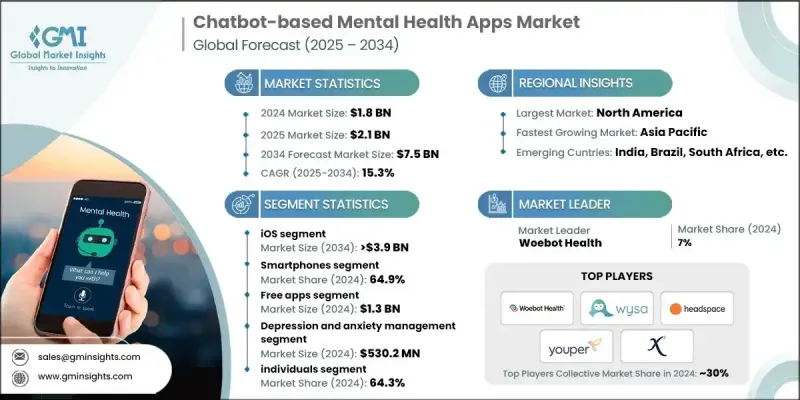
Demand is rising as more people face mental health challenges and turn toward digital tools that offer immediate, discreet, and continuous support. Adoption of AI-driven mental wellness solutions continues to expand as funding increases and digital-first care models become more common. Growing smartphone ownership and broader internet access have made app-based mental health support widely available, enabling users to integrate these tools into everyday routines. As health systems shift toward remote and preventive care, chatbot technologies are helping close the gap between limited clinical resources and the large number of individuals who need consistent guidance. By offering scalable and cost-efficient assistance, these applications provide a practical alternative for users who may not have easy access to traditional therapy. The ongoing move toward virtual care and the growing acceptance of evidence-based digital therapeutic techniques are reinforcing the market's momentum across various demographics and regions.
| Market Scope | |
|---|---|
| Start Year | 2024 |
| Forecast Year | 2025-2034 |
| Start Value | $1.8 Billion |
| Forecast Value | $7.5 Billion |
| CAGR | 15.3% |
The iOS segment held 48% share in 2024. This platform leads due to its strong presence among premium app users, confidence in Apple's data protection policies, and seamless compatibility with integrated devices. The structure of subscription-based monetization on iOS often encourages developers to prioritize launches on this system. Its robust technological environment also allows advanced AI-powered mental health features to operate securely, appealing to users looking for clinically reliable digital wellness tools.
The depression and anxiety management segment was valued at USD 530.2 million in 2024, representing the largest share of the market. These conditions are widespread worldwide, making them a primary focus for automated mental health tools. Chatbot-based platforms deliver structured therapeutic support, mood monitoring, and interactive guidance designed to help manage symptoms. The ability to access assistance immediately, with no social pressure attached, makes these solutions compelling for people who have limited access to conventional counseling.
North America Chatbot-Based Mental Health Apps Market accounted for a 56.7% share in 2024. High awareness of mental well-being and strong technological infrastructure contribute to this dominance. The region demonstrates rapid uptake of AI-enabled health tools, supported by a growing emphasis on emotional wellness. Adoption is propelled by workplace wellness programs and initiatives that connect mental health apps with insurance-backed benefits, reinforcing their use for issues such as anxiety, stress, and depression.
Prominent companies active in the Global Chatbot-Based Mental Health Apps Market include MindSpa, Headspace, Daylio, EARKICK, Woebot Health, Wysa, youper, Sonia, Yuna, Luka, Inc., X2AI, Inc., and matellio. Companies operating in this market are strengthening their competitive positions by enhancing AI capabilities, forming clinical partnerships, and expanding multilingual and culturally adaptive content. Many developers are integrating evidence-based therapeutic methods to improve credibility and achieve stronger validation from healthcare networks. Firms are refining natural language models to deliver more personalized conversational experiences and broaden the scope of mental health conditions addressed. Strategic collaborations with insurers, employers, and telehealth services help companies enter larger user ecosystems and increase long-term engagement.
Table of Contents
Chapter 1 Methodology and Scope
- 1.1 Market scope and definition
- 1.2 Research design
- 1.2.1 Research approach
- 1.2.2 Data collection methods
- 1.3 Data mining sources
- 1.3.1 Global
- 1.3.2 Regional/Country
- 1.4 Base estimates and calculations
- 1.4.1 Base year calculation
- 1.4.2 Key trends for market estimation
- 1.5 Primary research and validation
- 1.5.1 Primary sources
- 1.6 Forecast model
- 1.7 Research assumptions and limitations
Chapter 2 Executive Summary
- 2.1 Industry 3600 synopsis
- 2.2 Key market trends
- 2.2.1 Regional trends
- 2.2.2 Platform trends
- 2.2.3 Device trends
- 2.2.4 Revenue model trends
- 2.2.5 Application trends
- 2.2.6 End use trends
- 2.3 CXO perspectives: Strategic imperatives
- 2.3.1 Key decision points for industry executives
- 2.3.2 Critical success factors for market players
- 2.4 Future outlook and strategic recommendations
Chapter 3 Industry Insights
- 3.1 Industry ecosystem analysis
- 3.2 Industry impact forces
- 3.2.1 Growth drivers
- 3.2.1.1 Rising prevalence of mental health disorders
- 3.2.1.2 Growing adoption of digital health technologies for mental wellness
- 3.2.1.3 Round-the-clock accessibility and destigmatization benefits
- 3.2.2 Industry pitfalls and challenges
- 3.2.2.1 Data privacy and connectivity issues
- 3.2.3 Opportunities
- 3.2.3.1 Integration with wearable technology
- 3.2.3.2 Growing focus on preventive and personalized wellness
- 3.2.1 Growth drivers
- 3.3 Growth potential analysis
- 3.4 Regulatory landscape
- 3.4.1 North America
- 3.4.2 Europe
- 3.4.3 Asia Pacific
- 3.5 Technology and innovation landscape
- 3.5.1 Current technological trends
- 3.5.2 Emerging technologies
- 3.6 Investment landscape
- 3.7 Reimbursement scenario
- 3.8 Healthcare delivery model transformation
- 3.9 Evolution of chatbot technology
- 3.10 Policy outlook
- 3.11 Porter's analysis
- 3.12 PESTEL analysis
- 3.13 Gap analysis
- 3.14 Future market trends
Chapter 4 Competitive Landscape, 2024
- 4.1 Introduction
- 4.2 Company matrix analysis
- 4.3 Company market share analysis
- 4.3.1 Global
- 4.3.2 North America
- 4.3.3 Europe
- 4.3.4 Asia Pacific
- 4.4 Competitive analysis of major market players
- 4.5 Competitive positioning matrix
- 4.6 Key developments
- 4.6.1 Mergers & acquisitions
- 4.6.2 Partnerships & collaborations
- 4.6.3 New product launches
- 4.6.4 Expansion plans
Chapter 5 Market Estimates and Forecast, By Platform, 2021 - 2034 ($ Mn)
- 5.1 Key trends
- 5.2 iOS
- 5.3 Android
- 5.4 Other platform types
Chapter 6 Market Estimates and Forecast, By Device, 2021 - 2034 ($ Mn)
- 6.1 Key trends
- 6.2 Smartphones
- 6.3 Tablets
- 6.4 Laptops/desktops
Chapter 7 Market Estimates and Forecast, By Revenue Model, 2021 - 2034 ($ Mn)
- 7.1 Key trends
- 7.2 Free apps
- 7.3 Subscription-based
Chapter 8 Market Estimates and Forecast, By Application, 2021 - 2034 ($ Mn)
- 8.1 Key trends
- 8.2 Depression and anxiety management
- 8.3 Meditation management
- 8.4 Stress management
- 8.5 Wellness management
- 8.6 Other applications
Chapter 9 Market Estimates and Forecast, By End Use, 2021 - 2034 ($ Mn)
- 9.1 Key trends
- 9.2 Individuals
- 9.3 Corporates & employers
- 9.4 Other end use
Chapter 10 Market Estimates and Forecast, By Region, 2021 - 2034 ($ Mn)
- 10.1 Key trends
- 10.2 North America
- 10.2.1 U.S.
- 10.2.2 Canada
- 10.3 Europe
- 10.3.1 Germany
- 10.3.2 UK
- 10.3.3 France
- 10.3.4 Spain
- 10.3.5 Italy
- 10.3.6 Netherlands
- 10.4 Asia Pacific
- 10.4.1 China
- 10.4.2 Japan
- 10.4.3 India
- 10.4.4 Australia
- 10.4.5 South Korea
- 10.5 Latin America
- 10.5.1 Brazil
- 10.5.2 Mexico
- 10.5.3 Argentina
- 10.6 MEA
- 10.6.1 South Africa
- 10.6.2 Saudi Arabia
- 10.6.3 UAE
Chapter 11 Company Profiles
- 11.1 Daylio
- 11.2 EARKICK
- 11.3 Headspace
- 11.4 Luka, Inc.
- 11.5 mindspa
- 11.6 Sonia
- 11.7 Woebot Health
- 11.8 Wysa
- 11.9 youper
- 11.10 Yuna
- 11.11 matellio
- 11.12 X2AI, Inc.

