PUBLISHER: Global Market Insights Inc. | PRODUCT CODE: 1885888

PUBLISHER: Global Market Insights Inc. | PRODUCT CODE: 1885888
Pet Food Protein Hydrolysates Market Opportunity, Growth Drivers, Industry Trend Analysis, and Forecast 2025 - 2034
The Global Pet Food Protein Hydrolysates Market was valued at USD 1.7 billion in 2024 and is estimated to grow at a CAGR of 5.5% to reach USD 2.8 billion by 2034.
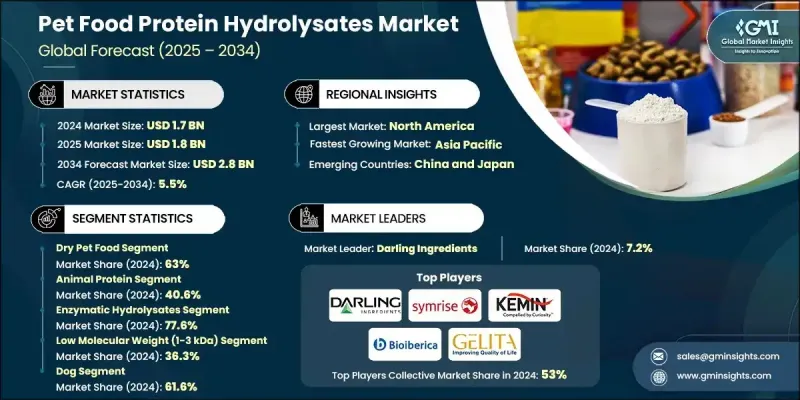
The market expansion is driven by the growing focus on functional pet nutrition, as pet owners increasingly seek solutions for animals with allergies or digestive sensitivities. Hydrolyzed proteins, valued for their high digestibility and low antigenicity, are becoming a staple in premium and therapeutic diets. Pet owners are prioritizing high-quality, natural, and minimally processed ingredients, while veterinary-prescribed diets increasingly incorporate hydrolysates to manage gastrointestinal conditions and food sensitivities. These proteins improve amino acid absorption and palatability, making them ideal for clinical and health-focused formulations. Manufacturers are heavily investing in hydrolyzed protein technologies to meet the rising demand for allergy-friendly and easily digestible pet food. This trend reflects a broader market shift toward premiumization and health-centric nutrition in the pet care sector, with clinical and therapeutic applications reinforcing adoption across dry, wet, and specialized diet segments.
| Market Scope | |
|---|---|
| Start Year | 2024 |
| Forecast Year | 2025-2034 |
| Start Value | $1.7 Billion |
| Forecast Value | $2.8 Billion |
| CAGR | 5.5% |
The dry pet food segment held 63% share and is projected to grow at a CAGR of 5.2% through 2034. Its dominance is supported by convenience, long shelf life, and affordability. Manufacturers are increasingly adding hydrolyzed proteins to dry formulations to improve digestibility and palatability, particularly for older pets and those with sensitivities.
The animal protein segment accounted for a 40.6% share in 2024 and is expected to grow at a 5.1% CAGR through 2034. It remains dominant due to superior amino acid content, high bioavailability, and consumer preference for meat-based diets. Hydrolyzed animal proteins are widely used in both dry and wet pet foods to enhance taste while minimizing allergenic responses. Fish protein is gaining traction for its omega-3 fatty acids and hypoallergenic properties, positioning it as a premium ingredient, although higher costs and supply challenges limit broader adoption.
North America Pet Food Protein Hydrolysates Market held a 33.1% share in 2024. The region's growth is fueled by high pet ownership, strong demand for functional and premium diets, and the presence of major pet food manufacturers. Hydrolyzed proteins are widely incorporated into therapeutic diets to address allergies, improve digestibility, and enhance overall pet health. Rising pet humanization and higher spending on specialized nutrition continue to support the market expansion.
Key players in the Pet Food Protein Hydrolysates Market include Symrise Pet Food (Diana Pet Food/Nuvin), PB Leiner/Tessenderlo Group, Darling Ingredients - Sonac Brand, GELITA, Copalis, Bioiberica, BRF Ingredients, Kemin Industries, Rousselot, and Roquette. Companies in the Pet Food Protein Hydrolysates Market are strengthening their market presence by investing in research and development to enhance hydrolysate formulations for digestibility, palatability, and hypoallergenic performance. They are forming partnerships with veterinary nutritionists and pet food manufacturers to expand clinical and therapeutic product lines. Many are diversifying their protein sources to include animal, plant, and fish proteins to meet consumer demand for premium, functional, and sustainable options. Strategic acquisitions, geographic expansion, and improved supply chain efficiency are also being employed to capture a larger market share and respond to regional regulatory requirements.
Table of Contents
Chapter 1 Methodology & Scope
- 1.1 Market scope and definition
- 1.2 Research design
- 1.2.1 Research approach
- 1.2.2 Data collection methods
- 1.3 Data mining sources
- 1.3.1 Global
- 1.3.2 Regional/Country
- 1.4 Base estimates and calculations
- 1.4.1 Base year calculation
- 1.4.2 Key trends for market estimation
- 1.5 Primary research and validation
- 1.5.1 Primary sources
- 1.6 Forecast model
- 1.7 Research assumptions and limitations
Chapter 2 Executive Summary
- 2.1 Industry 360° synopsis
- 2.2 Key market trends
- 2.2.1 Regional
- 2.2.2 Product
- 2.2.3 Protein Source
- 2.2.4 Technology
- 2.2.5 Molecular Weight
- 2.2.6 Pet
- 2.3 TAM Analysis, 2025-2034
- 2.4 CXO perspectives: Strategic imperatives
- 2.4.1 Executive decision points
- 2.4.2 Critical success factors
- 2.5 Future Outlook and Strategic Recommendations
Chapter 3 Industry Insights
- 3.1 Industry ecosystem analysis
- 3.1.1 Supplier landscape
- 3.1.2 Profit margin
- 3.1.3 Value addition at each stage
- 3.1.4 Factor affecting the value chain
- 3.1.5 Disruptions
- 3.2 Industry impact forces
- 3.2.1 Growth drivers
- 3.2.2 Industry pitfalls and challenges
- 3.2.3 Market opportunities
- 3.3 Growth potential analysis
- 3.4 Regulatory landscape
- 3.4.1 North America
- 3.4.2 Europe
- 3.4.3 Asia Pacific
- 3.4.4 Latin America
- 3.4.5 Middle East & Africa
- 3.5 Porter's analysis
- 3.6 PESTEL analysis
- 3.7 Price trends
- 3.8 Future market trends
- 3.9 Technology and Innovation landscape
- 3.9.1 Current technological trends
- 3.9.2 Emerging technologies
- 3.10 Patent Landscape
- 3.11 Trade statistics (HS code) ( Note: the trade statistics will be provided for key countries only)
- 3.11.1 Major importing countries
- 3.11.2 Major exporting countries
- 3.12 Sustainability and environmental aspects
- 3.12.1 Sustainable practices
- 3.12.2 Waste reduction strategies
- 3.12.3 Energy efficiency in production
- 3.12.4 Eco-friendly initiatives
- 3.13 Carbon footprint consideration
Chapter 4 Competitive Landscape, 2024
- 4.1 Introduction
- 4.2 Company market share analysis
- 4.2.1 By region
- 4.2.1.1 North America
- 4.2.1.2 Europe
- 4.2.1.3 Asia Pacific
- 4.2.1.4 LATAM
- 4.2.1.5 MEA
- 4.2.1 By region
- 4.3 Company matrix analysis
- 4.4 Competitive analysis of major market players
- 4.5 Competitive positioning matrix
- 4.6 Key developments
- 4.6.1 Mergers & acquisitions
- 4.6.2 Partnerships & collaborations
- 4.6.3 New Product Launches
- 4.6.4 Expansion Plans
Chapter 5 Market Estimates and Forecast, By Product, 2021-2034 (USD Million) (Kilo Tons)
- 5.1 Key trends
- 5.2 Dry pet food
- 5.3 Wet pet food
- 5.4 Pet treats & chews
- 5.5 Pet food supplements
Chapter 6 Market Estimates and Forecast, By Protein Source Type, 2021-2034 (USD Million) (Kilo Tons)
- 6.1 Key trends
- 6.2 Animal Protein
- 6.2.1 Poultry
- 6.2.2 Pork
- 6.2.3 Beef
- 6.2.4 Others
- 6.3 Fish Protein
- 6.4 Plant Protein
- 6.4.1 Wheat
- 6.4.2 Pea
- 6.4.3 Potato
- 6.4.4 Corn
- 6.4.5 Soy
- 6.5 Others
Chapter 7 Market Estimates and Forecast, By Technology, 2021-2034 (USD Million) (Kilo Tons)
- 7.1 Key trends
- 7.2 Enzymatic Hydrolysates
- 7.2.1 Alcalase-Based Hydrolysates
- 7.2.2 Protamex-Based Hydrolysates
- 7.2.3 Flavourzyme-Based Hydrolysates
- 7.3 Acid Hydrolysates
- 7.4 Alkaline Hydrolysates
- 7.5 Thermal & Pressure Hydrolysates
- 7.6 Microbial & Fermentation Hydrolysates
Chapter 8 Market Estimates and Forecast, By Molecular Weight, 2021-2034 (USD Million) (Kilo Tons)
- 8.1 Key trends
- 8.2 Ultra-Low Molecular Weight (<1 kDa)
- 8.3 Low Molecular Weight (1-3 kDa)
- 8.4 Medium Molecular Weight (3-10 kDa)
- 8.5 High Molecular Weight (>10 kDa)
Chapter 9 Market Estimates and Forecast, By Pet Type, 2021-2034 (USD Million) (Kilo Tons)
- 9.1 Key trends
- 9.2 Dog
- 9.3 Cat
- 9.4 Others
Chapter 10 Market Estimates and Forecast, By Region, 2021-2034 (USD Million) (Kilo Tons)
- 10.1 Key trends
- 10.2 North America
- 10.2.1 U.S.
- 10.2.2 Canada
- 10.3 Europe
- 10.3.1 Germany
- 10.3.2 UK
- 10.3.3 France
- 10.3.4 Spain
- 10.3.5 Italy
- 10.3.6 Rest of Europe
- 10.4 Asia Pacific
- 10.4.1 China
- 10.4.2 India
- 10.4.3 Japan
- 10.4.4 Australia
- 10.4.5 South Korea
- 10.4.6 Rest of Asia Pacific
- 10.5 Latin America
- 10.5.1 Brazil
- 10.5.2 Mexico
- 10.5.3 Argentina
- 10.5.4 Rest of Latin America
- 10.6 Middle East and Africa
- 10.6.1 Saudi Arabia
- 10.6.2 South Africa
- 10.6.3 UAE
- 10.6.4 Rest of Middle East and Africa
Chapter 11 Company Profiles
- 11.1 Kemin Industries
- 11.2 Symrise Pet Food (Diana Pet Food/Nuvin)
- 11.3 Darling Ingredients - Sonac Brand
- 11.4 BRF Ingredients
- 11.5 Bioiberica
- 11.6 GELITA
- 11.7 Rousselot
- 11.8 Copalis
- 11.9 Roquette
- 11.10 PB Leiner/Tessenderlo Group

