PUBLISHER: Global Market Insights Inc. | PRODUCT CODE: 1929004

PUBLISHER: Global Market Insights Inc. | PRODUCT CODE: 1929004
Pet Food Ingredients Market Opportunity, Growth Drivers, Industry Trend Analysis, and Forecast 2026 - 2035
The Global Pet Food Ingredients Market was valued at USD 37.8 billion in 2025 and is estimated to grow at a CAGR of 5.5% to reach USD 64.5 billion by 2035.
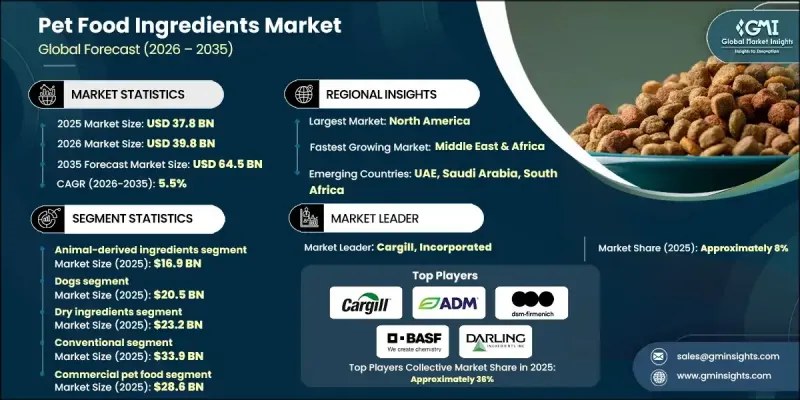
The growth is driven by the rising number of pet owners and their increasing preference for high-quality, nutritionally balanced diets for their pets. Urbanization and higher disposable income levels are encouraging pet owners to treat pets as family members, leading to greater demand for functional and fortified ingredients. Pet food formulations are evolving from basic feed to advanced blends containing proteins, vitamins, probiotics, and other functional additives. Consumers are increasingly aware of the link between diet and pet health, prompting a surge in natural, organic, and sustainable ingredient adoption. This shift has accelerated innovation in plant-based proteins, omega fatty acids, antioxidants, and other specialized additives. Manufacturers are investing heavily in research and development to address digestive health, immunity enhancement, and weight management, further supporting market expansion.
| Market Scope | |
|---|---|
| Start Year | 2025 |
| Forecast Year | 2026-2035 |
| Start Value | $37.8 Billion |
| Forecast Value | $64.5 Billion |
| CAGR | 5.5% |
The animal-derived ingredients segment was valued at USD 16.9 billion in 2025 and is estimated to grow at a CAGR of 5.3% from 2026 to 2035. Animal-based proteins remain crucial for palatability and high-quality nutrition, while plant-derived ingredients are increasingly incorporated as sources of fiber, carbohydrates, and alternative proteins. Functional additives such as vitamins, minerals, antioxidants, and enzymes are being integrated into formulations to improve health outcomes, resulting in a versatile ingredient portfolio that supports both standard and specialized pet food products.
The dog segment accounted for USD 20.5 billion in 2025 and is expected to grow at a CAGR of 5.2% during 2026-2035. Demand for pet food ingredients varies based on species-specific nutritional needs, with dog and cat foods representing the largest share. Growing awareness of optimal nutrition for birds, fish, small mammals, and reptiles is driving the use of specialized proteins, oils, and micronutrients. These trends are prompting suppliers to develop species-specific ingredient blends, highlighting differences in formulation requirements across pet types and creating opportunities for niche and high-value products.
North America Pet Food Ingredients Market reached USD 13.9 billion in 2025. The region's expansion is fueled by continuous pet food reformulations, innovations in functional additives, and the rising demand for balanced protein mixes. Manufacturers are diversifying their ingredient portfolios to enable product differentiation and personalized nutrition options. Advanced processing infrastructure and integration of high-quality ingredient solutions across pet categories have supported steady market growth, making North America a key region for the pet food ingredients industry.
Major players in the Global Pet Food Ingredients Market include DSM-Firmenich, Darling Ingredients Inc., Cargill, Incorporated, BASF SE, Archer-Daniels-Midland Company (ADM), and others. These companies are leveraging strong research and development capabilities, expanding production facilities, and forming strategic partnerships with pet food manufacturers to maintain market leadership. Key strategies adopted by companies in the Pet Food Ingredients Market include investing in R&D to develop functional, species-specific, and fortified ingredients tailored to evolving consumer preferences. Firms are expanding manufacturing capacities to meet growing demand in urban and high-income regions. Strategic partnerships with pet food brands and distributors allow companies to penetrate new markets and ensure product availability.
Table of Contents
Chapter 1 Methodology
- 1.1 Market scope and definition
- 1.2 Research design
- 1.2.1 Research approach
- 1.2.2 Data collection methods
- 1.3 Data mining sources
- 1.3.1 Global
- 1.3.2 Regional/Country
- 1.4 Base estimates and calculations
- 1.4.1 Base year calculation
- 1.4.2 Key trends for market estimation
- 1.5 Primary research and validation
- 1.5.1 Primary sources
- 1.6 Forecast model
- 1.7 Research assumptions and limitations
Chapter 2 Executive Summary
- 2.1 Industry 360° synopsis
- 2.2 Key market trends
- 2.2.1 Regional
- 2.2.2 Ingredient Type
- 2.2.3 Pet Type
- 2.2.4 Form
- 2.2.5 Source
- 2.2.6 Application
- 2.3 TAM Analysis, 2026-2035
- 2.4 CXO perspectives: Strategic imperatives
- 2.4.1 Executive decision points
- 2.4.2 Critical success factors
- 2.5 Future Outlook and Strategic Recommendations
Chapter 3 Industry Insights
- 3.1 Industry ecosystem analysis
- 3.1.1 Supplier Landscape
- 3.1.2 Profit Margin
- 3.1.3 Value addition at each stage
- 3.1.4 Factor affecting the value chain
- 3.1.5 Disruptions
- 3.2 Industry impact forces
- 3.2.1 Growth drivers
- 3.2.2 Industry pitfalls and challenges
- 3.2.3 Market opportunities
- 3.3 Growth potential analysis
- 3.4 Regulatory landscape
- 3.4.1 North America
- 3.4.2 Europe
- 3.4.3 Asia Pacific
- 3.4.4 Latin America
- 3.4.5 Middle East & Africa
- 3.5 Porter';s analysis
- 3.6 PESTEL analysis
- 3.7 Price trends
- 3.7.1 By region
- 3.7.2 By product
- 3.8 Future market trends
- 3.9 Technology and Innovation landscape
- 3.9.1 Current technological trends
- 3.9.2 Emerging technologies
- 3.10 Patent Landscape
- 3.11 Trade statistics (Note: the trade statistics will be provided for key countries only)
- 3.11.1 Major importing countries
- 3.11.2 Major exporting countries
- 3.12 Sustainability and Environmental Aspects
- 3.12.1 Sustainable Practices
- 3.12.2 Waste Reduction Strategies
- 3.12.3 Energy Efficiency in Production
- 3.12.4 Eco-friendly Initiatives
- 3.13 Carbon Footprint Considerations
Chapter 4 Competitive Landscape, 2025
- 4.1 Introduction
- 4.2 Company market share analysis
- 4.2.1 By region
- 4.2.1.1 North America
- 4.2.1.2 Europe
- 4.2.1.3 Asia Pacific
- 4.2.1.4 LATAM
- 4.2.1.5 MEA
- 4.2.1 By region
- 4.3 Company matrix analysis
- 4.4 Competitive analysis of major market players
- 4.5 Competitive positioning matrix
- 4.6 Key developments
- 4.6.1 Mergers & acquisitions
- 4.6.2 Partnerships & collaborations
- 4.6.3 New Product Launches
- 4.6.4 Expansion Plans
Chapter 5 Market Estimates and Forecast, By Ingredient Type, 2022- 2035 (USD Billion, Kilo Tons)
- 5.1 Key trends
- 5.2 Animal-Derived Ingredients
- 5.2.1 Meat Products
- 5.2.2 Fish Products
- 5.2.3 Animal Fats
- 5.3 Plant-Derived Ingredients
- 5.3.1 Cereals & Grains (corn, wheat, rice)
- 5.3.2 Oilseeds & Pulses (soybean, peas)
- 5.3.3 Fruits & Vegetables
- 5.4 Additives
- 5.4.1 Vitamins & Minerals
- 5.4.2 Enzymes
- 5.4.3 Probiotics & Prebiotics
- 5.4.4 Flavors & Colorants
- 5.4.5 Preservatives
- 5.5 Others
- 5.5.1 Novel Proteins (insect protein, algae)
- 5.5.2 Functional Ingredients (omega-3, antioxidants)
Chapter 6 Market Estimates and Forecast, By Pet Type, 2022- 2035 (USD Billion, Kilo Tons)
- 6.1 Key trends
- 6.2 Dogs
- 6.3 Cats
- 6.4 Birds
- 6.5 Fish
- 6.6 Others
Chapter 7 Market Estimates and Forecast, By Form, 2022 - 2035 (USD Billion, Kilo Tons)
- 7.1 Key trends
- 7.2 Dry Ingredients
- 7.3 Wet Ingredients
- 7.4 Liquid Ingredients
Chapter 8 Market Estimates and Forecast, By Source, 2022 - 2035 (USD Billion, Kilo Tons)
- 8.1 Key trends
- 8.2 Conventional
- 8.3 Organic
Chapter 9 Market Estimates and Forecast, By Application, 2022 - 2035 (USD Billion, Kilo Tons)
- 9.1 Key trends
- 9.2 Commercial Pet Food
- 9.3 Homemade Pet Food
- 9.4 Treats & Snacks
- 9.5 Others
Chapter 10 Market Estimates and Forecast, By Region, 2022 - 2035 (USD Billion, Kilo Tons)
- 10.1 Key trends
- 10.2 North America
- 10.2.1 U.S.
- 10.2.2 Canada
- 10.3 Europe
- 10.3.1 Germany
- 10.3.2 UK
- 10.3.3 France
- 10.3.4 Italy
- 10.3.5 Spain
- 10.3.6 Rest of Europe
- 10.4 Asia Pacific
- 10.4.1 China
- 10.4.2 India
- 10.4.3 Japan
- 10.4.4 Australia
- 10.4.5 South Korea
- 10.4.6 Rest of Asia Pacific
- 10.5 Latin America
- 10.5.1 Brazil
- 10.5.2 Mexico
- 10.5.3 Argentina
- 10.5.4 Rest of Latin America
- 10.6 Middle East & Africa
- 10.6.1 Saudi Arabia
- 10.6.2 South Africa
- 10.6.3 UAE
- 10.6.4 Rest of Middle East & Africa
Chapter 11 Company Profiles
- 11.1 DSM-Firmenich
- 11.2 Cargill, Incorporated
- 11.3 Archer-Daniels-Midland Company (ADM)
- 11.4 Evonik Industries AG
- 11.5 BASF SE
- 11.6 Adisseo France SAS
- 11.7 Kemin Industries, Inc.
- 11.8 Symrise AG
- 11.9 Darling Ingredients Inc.
- 11.10 Ingredion, Inc.
- 11.11 Prinova
- 11.12 Novus International

