
PUBLISHER: Global Market Insights Inc. | PRODUCT CODE: 1885921

PUBLISHER: Global Market Insights Inc. | PRODUCT CODE: 1885921
Rolling Stock Market Opportunity, Growth Drivers, Industry Trend Analysis, and Forecast 2025 - 2034
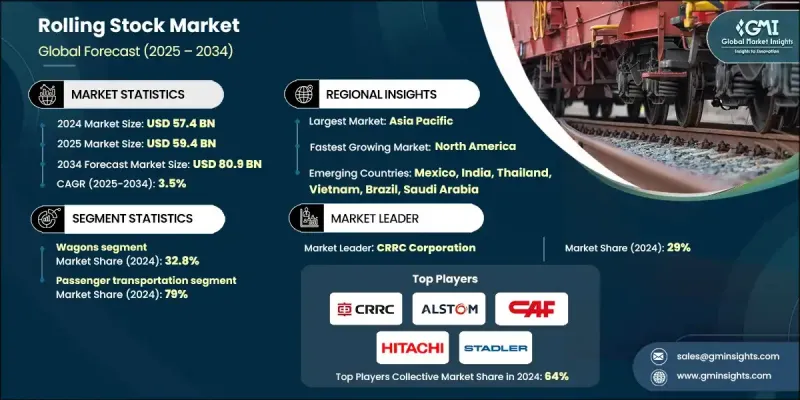
The Global Rolling Stock Market was valued at USD 57.4 billion in 2024 and is estimated to grow at a CAGR of 3.5% to reach USD 80.9 billion by 2034.
The expansion of rail networks worldwide continues to stimulate steady demand for locomotives, passenger vehicles, and freight units as nations strengthen transportation infrastructure to support economic growth. Railways are becoming increasingly important for both freight and passenger movement, especially in regions where limited sea or air connectivity raises transportation risks and costs. As cross-border trade intensifies, governments are prioritizing long-term logistics strategies that depend heavily on rail-based systems. This fuels the need for advanced rolling stock capable of supporting heavy-duty freight movement and reliable urban mobility. Rapid urbanization also drives investments in transit systems, as growing populations require efficient transportation solutions. Many countries are upgrading their existing train fleets, expanding high-speed corridors, and adding new metro and light rail capacity. With sustainability commitments evolving and rail transport emerging as a low-emission choice for large-scale movement, the market is likely to maintain consistent growth throughout the next decade.
| Market Scope | |
|---|---|
| Start Year | 2024 |
| Forecast Year | 2025-2034 |
| Start Value | $57.4 Billion |
| Forecast Value | $80.9 Billion |
| CAGR | 3.5% |
The wagons category captured a 32.8% share in 2024. These units remain essential for bulk material transport and contribute significantly to global and domestic supply chains across energy, minerals, and heavy industrial sectors.
The passenger-related rolling stock segment held a 79% share in 2024. Increasing demand for dependable urban travel continues to drive the adoption of metro systems, commuter trains, and multiple-unit vehicles, as cities look for ways to manage congestion and improve daily mobility through modern rail expansions and fleet upgrades.
U.S. Rolling Stock Market generated USD 6.1 billion in 2024. Growth across the country is supported by ongoing infrastructure enhancements, modernization of older vehicles, and rising freight movement. Major cities across North America are advancing new transit lines while freight rail operators invest in technologies that improve operational efficiency.
Key companies participating in the Global Rolling Stock Market include Alstom, Stadler Rail, Kawasaki Heavy Industries, Wabtec, Hyundai Rotem, The Greenbrier Companies, Hitachi Rail, CRRC, Siemens, and CAF. Companies in the Rolling Stock Market are adopting strategies that strengthen their competitive position across both passenger and freight markets. Many are expanding manufacturing capabilities and focusing on modular platforms that support easier customization for different regions. Firms are investing in energy-efficient propulsion systems, digital monitoring tools, and automation technologies to improve performance and reduce operational costs. Strategic partnerships with governments and transit agencies allow companies to secure long-term contracts for fleet renewal and major rail expansions. Global players are also increasing their presence in emerging markets by forming joint ventures and establishing local production units to meet regional demand.
Table of Contents
Chapter 1 Methodology
- 1.1 Market scope and definition
- 1.2 Research design
- 1.2.1 Research approach
- 1.2.2 Data collection methods
- 1.3 Data mining sources
- 1.3.1 Global
- 1.3.2 Regional/Country
- 1.4 Base estimates and calculations
- 1.4.1 Base year calculation
- 1.4.2 Key trends for market estimation
- 1.5 Primary research and validation
- 1.5.1 Primary sources
- 1.6 Forecast
- 1.7 Research assumptions and limitations
Chapter 2 Executive Summary
- 2.1 Industry 360° synopsis
- 2.2 Key market trends
- 2.2.1 Regional
- 2.2.2 Product
- 2.2.3 Application
- 2.3 TAM analysis, 2025-2034
- 2.4 CXO perspectives: Strategic imperatives
- 2.4.1 Executive decision points
- 2.4.2 Critical success factors
- 2.5 Future outlook and recommendations
Chapter 3 Industry Insights
- 3.1 Industry ecosystem analysis
- 3.1.1 Supplier landscape
- 3.1.2 Profit margin
- 3.1.3 Cost structure
- 3.1.4 Value addition at each stage
- 3.1.5 Factor affecting the value chain
- 3.1.6 Disruptions
- 3.2 Industry impact forces
- 3.2.1 Growth drivers
- 3.2.1.1 Industry 4.0 & Smart Manufacturing Adoption
- 3.2.1.2 IoT & Sensor Technology Advancement
- 3.2.1.3 AI/ML Integration Capabilities
- 3.2.1.4 Predictive Maintenance Cost Benefits
- 3.2.2 Industry pitfalls and challenges
- 3.2.2.1 High Implementation Costs & Complexity
- 3.2.2.2 Cybersecurity & Privacy Concerns
- 3.2.3 Market opportunities
- 3.2.3.1 Edge Computing Integration
- 3.2.3.2 Rolling Stock-as-a-Service Models
- 3.2.3.3 Cross-Industry Platform Development
- 3.2.3.4 Emerging Market Penetration
- 3.2.1 Growth drivers
- 3.3 Growth potential analysis
- 3.4 Regulatory landscape
- 3.4.1 North America
- 3.4.2 Europe
- 3.4.3 Asia Pacific
- 3.4.4 Latin America
- 3.4.5 Middle East & Africa
- 3.5 Porter's analysis
- 3.6 PESTEL analysis
- 3.7 Technology and innovation landscape
- 3.7.1 Current technological trends
- 3.7.2 Emerging technologies
- 3.7.3 Technology roadmaps & evolution
- 3.7.4 Technology adoption lifecycle analysis
- 3.8 Price trends
- 3.8.1 By region
- 3.8.2 By product
- 3.9 Production statistics
- 3.9.1 Production hubs
- 3.9.2 Consumption hubs
- 3.9.3 Export and import
- 3.10 Cost breakdown analysis
- 3.10.1 Vehicle manufacturing cost structure
- 3.10.2 Operational cost analysis
- 3.10.3 Infrastructure cost analysis
- 3.10.4 Cost optimization strategies
- 3.11 Patent analysis
- 3.12 Business models & procurement structures
- 3.12.1 Traditional procurement (direct purchase)
- 3.12.2 Leasing models
- 3.12.3 Public-private partnerships
- 3.12.4 Maintenance contracts
- 3.13 Fleet management & asset optimization
- 3.13.1 Fleet size & composition analysis by region
- 3.13.2 Fleet age distribution & replacement cycles
- 3.14 Safety & accident analysis
- 3.14.1 Railway safety statistics & trends
- 3.14.2 Rolling stock-related accidents
- 3.14.3 Root cause analysis
- 3.14.4 Safety management systems & safety culture
- 3.15 Environmental impact & sustainability
- 3.15.1 Carbon footprint analysis by propulsion type
- 3.15.2 Energy consumption analysis
- 3.15.3 Lifecycle environmental assessment
- 3.15.4 Noise pollution & mitigation measures
- 3.15.5 Material sustainability & recyclability
- 3.16 Standardization vs customization dynamics
- 3.16.1 Benefits of standardization
- 3.16.2 Drivers of customization
- 3.17 Lead times & delivery schedules
- 3.17.1 Typical procurement-to-delivery timelines
- 3.17.2 Design & engineering phase
- 3.17.3 Manufacturing phase
- 3.17.4 Testing & commissioning phase
- 3.17.5 Fast-track delivery options
- 3.18 Rolling stock procurement opportunities by project type
- 3.18.1 High-speed trainsets
- 3.18.2 Metro cars
- 3.18.3 Light rail vehicles
- 3.18.4 Locomotives
- 3.18.5 Freight wagons
- 3.18.6 Regional & commuter trains
- 3.19 Railway investment overview
- 3.19.1 Asia-Pacific
- 3.19.2 Europe
- 3.19.3 North America
- 3.19.4 Middle East & Africa
- 3.19.5 Latin America
- 3.20 Global Project Pipeline Overview
- 3.20.1 High-speed rail projects
- 3.20.2 Urban metro & rapid transit projects
- 3.20.3 Light rail & tram projects
- 3.20.4 Freight rail & dedicated freight corridor projects
- 3.20.5 Intercity & regional rail modernization projects
- 3.20.6 Electrification & infrastructure upgrade projects
- 3.21 Zero-emission transition overview
- 3.21.1 Current propulsion mix & evolution
- 3.21.2 Electrification (Catenary) expansion
- 3.21.3 Battery-electric rolling stock revolution
- 3.21.4 Hydrogen fuel cell rolling stock emergence
- 3.21.5 Hybrid & dual-mode technologies
- 3.21.6 Biofuels & renewable diesel
Chapter 4 Competitive Landscape, 2024
- 4.1 Introduction
- 4.2 Company market share analysis
- 4.2.1 North America
- 4.2.2 Europe
- 4.2.3 Asia Pacific
- 4.2.4 LATAM
- 4.2.5 MEA
- 4.3 Competitive analysis of major market players
- 4.4 Competitive positioning matrix
- 4.5 Strategic outlook matrix
- 4.6 Key developments
- 4.6.1 Mergers & acquisitions
- 4.6.2 Partnerships & collaborations
- 4.6.3 New product launches
- 4.6.4 Expansion plans and funding
- 4.7 Vendor selection criteria
Chapter 5 Market Estimates & Forecast, By Product, 2021 - 2034 ($Bn, Units)
- 5.1 Key trends
- 5.2 Locomotives
- 5.2.1 Diesel
- 5.2.2 Electric
- 5.2.3 Electro-diesel locomotives
- 5.2.4 Others
- 5.3 Wagons
- 5.4 Multiple units (MUs)
- 5.5 Metro vehicles
- 5.6 Light rail vehicles
- 5.7 People movers & monorail
- 5.8 High-speed trains
- 5.9 Others
Chapter 6 Market Estimates & Forecast, By Application, 2021 - 2034 ($Bn, Units)
- 6.1 Key trends
- 6.2 Passenger Transportation
- 6.3 Freight Transportation
Chapter 7 Market Estimates & Forecast, By Region, 2021 - 2034 ($Bn, Units)
- 7.1 Key trends
- 7.2 North America
- 7.2.1 US
- 7.2.2 Canada
- 7.3 Europe
- 7.3.1 Germany
- 7.3.2 UK
- 7.3.3 France
- 7.3.4 Italy
- 7.3.5 Spain
- 7.3.6 Russia
- 7.3.7 Nordics
- 7.3.8 Benelux
- 7.4 Asia Pacific
- 7.4.1 China
- 7.4.2 India
- 7.4.3 Japan
- 7.4.4 South Korea
- 7.4.5 ANZ
- 7.4.6 Singapore
- 7.4.7 Malaysia
- 7.4.8 Indonesia
- 7.4.9 Vietnam
- 7.4.10 Thailand
- 7.5 Latin America
- 7.5.1 Brazil
- 7.5.2 Mexico
- 7.5.3 Argentina
- 7.5.4 Colombia
- 7.6 MEA
- 7.6.1 South Africa
- 7.6.2 Saudi Arabia
- 7.6.3 UAE
Chapter 8 Company Profiles
- 8.1 Global companies
- 8.1.1 Alstom
- 8.1.2 Siemens Mobility
- 8.1.3 CRRC Corporation
- 8.1.4 Stadler Rail
- 8.1.5 CAF
- 8.1.6 Hitachi Rail
- 8.1.7 Kawasaki Heavy Industries
- 8.2 Regional companies
- 8.2.1 Hyundai Rotem
- 8.2.2 Talgo
- 8.2.3 Transmashholding
- 8.2.4 BEML
- 8.2.5 Wabtec
- 8.2.6 The Greenbrier Companies
- 8.2.7 Progress Rail
- 8.2.8 Nippon Sharyo
- 8.2.9 Kinki Sharyo
- 8.2.10 Skoda Transportation
- 8.3 Emerging companies
- 8.3.1 Trinity Industries
- 8.3.2 FreightCar America
- 8.3.3 Railpool
- 8.3.4 Eversholt Rail
- 8.3.5 Newag
- 8.3.6 Medha Servo Drives
- 8.3.7 Titagarh Rail Systems
- 8.3.8 J-TREC

