
PUBLISHER: Global Market Insights Inc. | PRODUCT CODE: 1892651

PUBLISHER: Global Market Insights Inc. | PRODUCT CODE: 1892651
Europe Personalized/Customized Skin Care Market Opportunity, Growth Drivers, Industry Trend Analysis, and Forecast 2025 - 2034
Europe Personalized/Customized Skin Care Market was valued at USD 7.3 billion in 2024 and is estimated to grow at a CAGR of 6.4% to reach USD 13.6 billion by 2034.
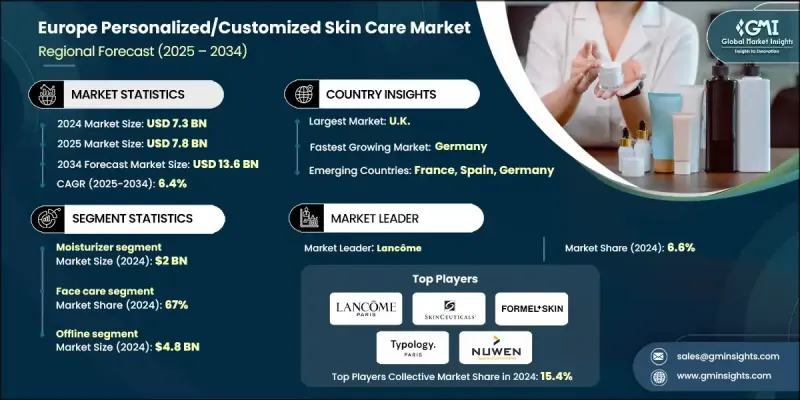
Consumers across Europe are becoming more informed about how skin biology, ingredient transparency, and individual skin differences influence product performance, pushing demand for tailored formulations rather than generalized skincare options. Growing concerns about product safety and a rising preference for dermatology-backed information shared through digital channels have prompted interest in skincare solutions that reflect unique skin characteristics, including differences in microbiome profiles. Expectations have expanded beyond traditional claims and now focus on targeted treatments for issues such as hormonal breakouts, pigment irregularities, and sensitivities related to environmental exposure and diverse skin tones. Younger consumers, particularly Millennials and Gen Z in regions like France, Scandinavia, Germany, and the UK, are leading the shift toward data-driven skincare, marking a major cultural and commercial transformation toward personalized beauty in Europe. Advanced technologies such as AI-powered diagnostics, image-based skin assessment tools, at-home biological testing kits, and virtual dermatology platforms are removing barriers to customization and making professional-level personalization accessible to mainstream users.
| Market Scope | |
|---|---|
| Start Year | 2024 |
| Forecast Year | 2025-2034 |
| Start Value | $7.3 Billion |
| Forecast Value | $13.6 Billion |
| CAGR | 6.4% |
The moisturizer segment captured USD 2 billion in 2024 and is projected to grow at a 7.1% CAGR throughout 2034. Growing interest in solutions tailored to dryness, sensitivity, aging, and blemish-prone skin is driving demand for customized moisturizers. These formulations provide focused benefits such as hydration enhancement, irritation control, and condition-specific treatment. The growing push toward wellness-oriented skincare has elevated interest in products formulated with nourishing ingredients, including plant extracts, vitamins, and antioxidant blends.
The face care segment held 67% share in 2024. Facial skin receives greater attention due to its visibility and its strong link to personal appearance, prompting consumers to prioritize products that address wrinkles, uneven tone, sensitivity, and breakouts. The popularity of beauty routines shared on digital platforms has increased demand for specialized facial serums, treatments, and masks. This interest encourages companies to dedicate significant innovation resources to high-performance facial formulations and personalized solutions.
UK Personalized/Customized Skin Care Market held a 37.2% share and generated USD 2.7 billion in 2024. Rising demand for personalized, transparent, and science-backed skincare is shaping market expansion in the region. Younger consumers are particularly inclined toward advanced digital tools and data-based skincare customization, contributing to strong adoption of premium brands that offer clinically supported products.
Key companies in the Europe Personalized/Customized Skin Care Market include Pettenon Cosmetics Spa, Nuwen, L.A. Schmitt GmbH, Typology, FORMEL Skin, Cosmesit SRL, Perseida Belleza SL, Intercos Europe, Pole Cosmetique, Lancome Le Teint Particulier, SkinCeuticals Custom D.O.S.E., SBLC Cosmetics, Skinovators GmbH, HSA Cosmetics SpA, and Ideapro GmbH. Companies competing in the Europe Personalized/Customized Skin Care Market are focusing on several strategies to strengthen their position. Many are investing in AI-driven diagnostics, advanced formulation engines, and digital skin assessment technologies to deliver highly individualized product recommendations. Firms are expanding their ingredient libraries and incorporating biotech-derived actives to offer more targeted and effective formulations. Strategic collaborations with dermatologists, laboratories, and technology partners are enhancing product credibility and accelerating innovation. Companies are also adopting flexible manufacturing models to support small-batch customized production, enabling rapid fulfillment of bespoke orders.
Table of Contents
Chapter 1 Methodology and Scope
- 1.1 Market scope and definition
- 1.2 Research design
- 1.2.1 Research approach
- 1.2.2 Data collection methods
- 1.3 Data mining sources
- 1.3.1 Regional
- 1.3.2 Country
- 1.4 Base estimates and calculations
- 1.4.1 Base year calculation
- 1.4.2 Key trends for market estimation
- 1.5 Primary research and validation
- 1.5.1 Primary sources
- 1.6 Forecast model
- 1.7 Research assumptions and limitations
Chapter 2 Executive Summary
- 2.1 Industry 360° synopsis
- 2.2 Key market trends
- 2.2.1 Country
- 2.2.2 Product
- 2.2.3 Category
- 2.2.4 Price
- 2.2.5 Consumer Group
- 2.2.6 Distribution channel
- 2.3 CXO perspectives: strategic imperatives
- 2.3.1 Key decision points for industry executives
- 2.3.2 Critical success factors for market players
- 2.4 Future outlook and strategic recommendations
Chapter 3 Industry Insights
- 3.1 Industry ecosystem analysis
- 3.1.1 Supplier landscape
- 3.1.2 Profit margin
- 3.1.3 Value addition at each stage
- 3.1.4 Factor affecting the value chain
- 3.2 Industry impact forces
- 3.2.1 Growth drivers
- 3.2.1.1 Heightened consumer awareness and demand for individualization
- 3.2.1.2 Rapid advancement and adoption of diagnostic technologies
- 3.2.1.3 Premiumization trend and willingness to pay among affluent segments
- 3.2.2 Pitfalls & Challenges
- 3.2.2.1 Regulatory complexity and lengthy approval cycles under eu cosmetics regulation
- 3.2.2.2 Supply-chain complexity
- 3.2.3 Opportunities
- 3.2.3.1 Convergence with health-tech and clinical dermatology ecosystems
- 3.2.3.2 Leadership in clean, sustainable, and locally sourced personalization
- 3.2.1 Growth drivers
- 3.3 Growth potential analysis
- 3.4 Future market trends
- 3.5 Technology and innovation landscape
- 3.5.1 Current technological trends
- 3.5.2 Emerging technologies
- 3.6 Price trends
- 3.6.1 By country
- 3.6.2 By material
- 3.7 Regulatory landscape
- 3.7.1 Standards and compliance requirements
- 3.7.2 Regional regulatory frameworks
- 3.7.3 Certification standards
- 3.8 Gap Analysis
- 3.9 Risk assessment and mitigation
- 3.10 Porter's analysis
- 3.11 PESTEL analysis
- 3.12 Consumer behaviour analysis
- 3.12.1 Purchasing patterns
- 3.12.2 Preference analysis
- 3.12.3 Regional variations in consumer behaviour
- 3.12.4 Impact of e-commerce on buying decisions
Chapter 4 Competitive Landscape, 2024
- 4.1 Introduction
- 4.2 Company market share analysis
- 4.2.1 By country
- 4.2.1.1 Germany
- 4.2.1.2 France
- 4.2.1.3 Italy
- 4.2.1.4 Spain
- 4.2.1.5 Rest of Europe
- 4.2.1 By country
- 4.3 Company matrix analysis
- 4.4 Competitive analysis of major market players
- 4.5 Competitive positioning matrix
- 4.6 Key developments
- 4.6.1 Mergers & acquisitions
- 4.6.2 Partnerships & collaborations
- 4.6.3 New product launches
- 4.6.4 Expansion plans
Chapter 5 Market Estimates and Forecast, By Product Type, 2021 - 2034 (USD Billion) (Million Units)
- 5.1 Key trends
- 5.2 Cleanser
- 5.3 Face serum
- 5.4 Moisturizer
- 5.5 Active
- 5.6 Body lotion
- 5.7 Body duo
- 5.8 Others (face masks, lip care, eye creams, etc.)
Chapter 6 Market Estimates and Forecast, By Category, 2021 - 2034 (USD Billion) (Million Units)
- 6.1 Key trends
- 6.2 Face care
- 6.3 Body care
Chapter 7 Market Estimates and Forecast, By Price Range, 2021 - 2034 (USD Billion) (Million Units)
- 7.1 Key trends
- 7.2 Low
- 7.3 Medium
- 7.4 High
Chapter 8 Market Estimates and Forecast, By Consumer Group, 2021 - 2034 (USD Billion) (Million Units)
- 8.1 Key trends
- 8.2 Men
- 8.3 Women
- 8.4 Kids
Chapter 9 Market Estimates and Forecast, By Distribution Channel, 2021 - 2034 (USD Billion) (Million Units)
- 9.1 Key trends
- 9.2 Online
- 9.2.1 E-commerce
- 9.2.2 Company websites
- 9.3 Offline
- 9.3.1 Specialty stores
- 9.3.2 Retail stores
- 9.3.3 Spas & salons
- 9.3.4 Pharmacies, dermatology clinics, etc.
Chapter 10 Market Estimates and Forecast, By Country, 2021 - 2034 (USD Billion) (Million Units)
- 10.1 Key trends
- 10.2 Germany
- 10.3 UK
- 10.4 France
- 10.5 Italy
- 10.6 Spain
- 10.7 Rest of Europe
Chapter 11 Company Profiles
- 11.1 Cosmesit SRL
- 11.2 FORMEL Skin
- 11.3 HSA Cosmetics SpA
- 11.4 Ideapro GmbH
- 11.5 Intercos Europe
- 11.6 L.A. Schmitt GmbH
- 11.7 Lancome Le Teint Particulier
- 11.8 Nuwen
- 11.9 Perseida Belleza SL
- 11.10 Pettenon Cosmetics Spa
- 11.11 Pole Cosmetique
- 11.12 SBLC Cosmetics
- 11.13 SkinCeuticals Custom D.O.S.E
- 11.14 Skinovators GmbH
- 11.15 Typology

