
PUBLISHER: Global Market Insights Inc. | PRODUCT CODE: 1892656

PUBLISHER: Global Market Insights Inc. | PRODUCT CODE: 1892656
Quantum Error Correction Materials Market Opportunity, Growth Drivers, Industry Trend Analysis, and Forecast 2025 - 2034
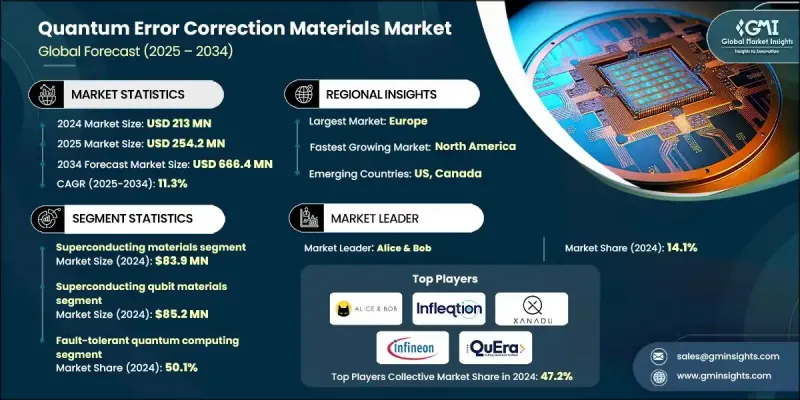
The Global Quantum Error Correction Materials Market was valued at USD 213 million in 2024 and is estimated to grow at a CAGR of 11.3% to reach USD 666.4 million by 2034.
Quantum error correction (QEC) materials are engineered to safeguard quantum information from noise, decoherence, and operational imperfections that impact the performance of quantum systems. These materials form the foundation of qubits and associated components, as they must sustain long coherence times, deliver stable quantum operations, and support the algorithms needed for fault-tolerant architectures. The field is transitioning from small-scale demonstrations to larger, more robust quantum computing systems, increasing demand for advanced materials that maintain qubit functionality over extended timeframes. Newly refined QEC materials, including improved superconducting films, high-purity semiconductor structures, and emerging topological materials, continue to elevate stability and reduce error rates. Their advancement is enabling generations of quantum devices capable of handling more complex computational tasks than earlier prototypes, helping accelerate the shift toward systems that can reliably perform operations once considered unattainable. These developments highlight the critical role of QEC materials as quantum computing moves toward broader commercial and scientific relevance.
| Market Scope | |
|---|---|
| Start Year | 2024 |
| Forecast Year | 2025-2034 |
| Start Value | $213 Million |
| Forecast Value | $666.4 Million |
| CAGR | 11.3% |
The superconducting materials segment generated USD 83.9 million in 2024. Market growth is being shaped by innovations in materials that support qubit function, with superconducting options increasingly optimized for reduced energy loss and enhanced purity to maintain strong coherence and support high-threshold quantum error-correcting designs. Semiconductor-based quantum materials incorporate isotopically refined silicon and advanced heterostructures to reduce both spin and charge-related noise, contributing to more predictable qubit behavior. Diamond-based materials with color-center configurations are achieving improvements in structural control and optical consistency, further reinforcing their position in hybrid and photon-enabled QEC applications.
The fault-tolerant quantum computing segment accounted for a 50.1% share in 2024. Demand for high-reliability operations has elevated the need for materials that can support deeper quantum circuits without accumulating detrimental errors. Quantum simulation and specialized materials-science workloads also rely heavily on QEC to deliver stable, detailed insights into molecular and exotic systems that require substantial operational depth and accuracy.
U.S. Quantum Error Correction Materials Market reached USD 79 million in 2024. North America remains a key hub for global development, with the United States driving momentum through extensive participation from research institutions, startups, and technology companies working to scale quantum hardware. Regional initiatives emphasize superconducting and trapped-ion platforms while universities and national laboratories push forward the development of long-term fault-tolerant designs. Canada contributes to ongoing innovation through research in photonic architectures and silicon-based spin qubits.
Major organizations active in the Global Quantum Error Correction Materials Market include Element Six, IQM, Alice & Bob, SpinQ, Infineon Technologies, Oxford Instruments, Atom Computing, QuEra Computing, Xanadu, PsiQuantum, and Infleqtion. Companies operating in the Quantum Error Correction Materials Market are strengthening their market positions by prioritizing high-purity production methods, advancing cryogenic material performance, and investing in scalable fabrication techniques. Many organizations are forming partnerships with quantum hardware developers to ensure alignment between material design and qubit architecture, enabling more efficient implementation. Firms are also increasing funding for research on low-loss superconductors, refined semiconductor substrates, and stable defect-engineered materials to minimize noise and extend coherence times.
Table of Contents
Chapter 1 Methodology & Scope
- 1.1 Market scope and definition
- 1.2 Research design
- 1.2.1 Research approach
- 1.2.2 Data collection methods
- 1.3 Data mining sources
- 1.3.1 Global
- 1.3.2 Regional/Country
- 1.4 Base estimates and calculations
- 1.4.1 Base year calculation
- 1.4.2 Key trends for market estimation
- 1.5 Primary research and validation
- 1.5.1 Primary sources
- 1.6 Forecast model
- 1.7 Research assumptions and limitations
Chapter 2 Executive Summary
- 2.1 Industry 3600 synopsis
- 2.2 Key market trends
- 2.2.1 Material type
- 2.2.2 Qubit platform
- 2.2.3 Application
- 2.2.4 Regional
- 2.3 TAM Analysis, 2025-2034
- 2.4 CXO perspectives: Strategic imperatives
- 2.4.1 Executive decision points
- 2.4.2 Critical success factors
- 2.5 Future outlook and strategic recommendations
Chapter 3 Industry Insights
- 3.1 Industry ecosystem analysis
- 3.1.1 Supplier landscape
- 3.1.2 Profit margin
- 3.1.3 Value addition at each stage
- 3.1.4 Factor affecting the value chain
- 3.1.5 Disruptions
- 3.2 Industry impact forces
- 3.2.1 Growth drivers
- 3.2.1.1 Demand for fault-tolerant quantum computing
- 3.2.1.2 Advanced qubit materials
- 3.2.1.3 Innovations in material engineering
- 3.2.2 Industry pitfalls and challenges
- 3.2.2.1 Challenges in scaling and integration
- 3.2.2.2 High sensitivity to radiation and stray signals
- 3.2.3 Market opportunities
- 3.2.3.1 Material-driven quantum networking
- 3.2.3.2 Enabling new quantum applications
- 3.2.3.3 Support for hybrid classical-quantum systems
- 3.2.1 Growth drivers
- 3.3 Growth potential analysis
- 3.4 Regulatory landscape
- 3.4.1 North America
- 3.4.2 Europe
- 3.4.3 Asia Pacific
- 3.4.4 Latin America
- 3.4.5 Middle East & Africa
- 3.5 Porter's analysis
- 3.6 PESTEL analysis
- 3.7 Technology and innovation landscape
- 3.7.1 Current technological trends
- 3.7.2 Emerging technologies
- 3.8 Price trends
- 3.8.1 By region
- 3.8.2 By material type
- 3.9 Future market trends
- 3.10 Patent landscape
- 3.11 Trade statistics (HS code) (Note: the trade statistics will be provided for key countries only)
- 3.11.1 Major importing countries
- 3.11.2 Major exporting countries
- 3.12 Sustainability and environmental aspects
- 3.12.1 Sustainable practices
- 3.12.2 Waste reduction strategies
- 3.12.3 Energy efficiency in production
- 3.12.4 Eco-friendly initiatives
- 3.13 Carbon footprint consideration
Chapter 4 Competitive Landscape, 2024
- 4.1 Introduction
- 4.2 Company market share analysis
- 4.2.1 By region
- 4.2.1.1 North America
- 4.2.1.2 Europe
- 4.2.1.3 Asia Pacific
- 4.2.1.4 LATAM
- 4.2.1.5 MEA
- 4.2.1 By region
- 4.3 Company matrix analysis
- 4.4 Competitive analysis of major market players
- 4.5 Competitive positioning matrix
- 4.6 Key developments
- 4.6.1 Mergers & acquisitions
- 4.6.2 Partnerships & collaborations
- 4.6.3 New product launches
- 4.6.4 Expansion plans
Chapter 5 Market Estimates and Forecast, By Material Type, 2021-2034 (USD Million) (Kilo Tons)
- 5.1 Key trends
- 5.2 Superconducting materials
- 5.3 Semiconductor quantum materials
- 5.4 Diamond & color center materials
- 5.5 Substrate & dielectric materials
- 5.6 Encapsulation & protective materials
Chapter 6 Market Estimates and Forecast, By Qubit Platform, 2021-2034 (USD Million) (Kilo Tons)
- 6.1 Key trends
- 6.2 Superconducting qubit materials
- 6.3 Trapped-ion qubit materials
- 6.4 Neutral-atom qubit materials
- 6.5 Cat qubit materials
- 6.6 Photonic qubit materials
- 6.7 Spin qubit materials (silicon & SiC)
- 6.8 Topological qubit materials
Chapter 7 Market Estimates and Forecast, By Application, 2021-2034 (USD Million) (Kilo Tons)
- 7.1 Key trends
- 7.2 Fault-tolerant quantum computing
- 7.3 Quantum simulation and material science
- 7.4 Quantum cryptography
- 7.5 Quantum-enhanced AI and optimization
Chapter 8 Market Estimates and Forecast, By Region, 2021-2034 (USD Million) (Kilo Tons)
- 8.1 Key trends
- 8.2 North America
- 8.2.1 U.S.
- 8.2.2 Canada
- 8.2.3 Mexico
- 8.3 Europe
- 8.3.1 Germany
- 8.3.2 UK
- 8.3.3 France
- 8.3.4 Spain
- 8.3.5 Italy
- 8.3.6 Rest of Europe
- 8.4 Asia Pacific
- 8.4.1 China
- 8.4.2 India
- 8.4.3 Japan
- 8.4.4 Australia
- 8.4.5 South Korea
- 8.4.6 Rest of Asia Pacific
- 8.5 Latin America
- 8.5.1 Brazil
- 8.5.2 Mexico
- 8.5.3 Argentina
- 8.5.4 Rest of Latin America
- 8.6 Middle East and Africa
- 8.6.1 Saudi Arabia
- 8.6.2 South Africa
- 8.6.3 UAE
- 8.6.4 Rest of Middle East and Africa
Chapter 9 Company Profiles
- 9.1 Element Six
- 9.2 IQM
- 9.3 Alice & Bob
- 9.4 SpinQ
- 9.5 Infineon Technologies
- 9.6 Oxford Instruments
- 9.7 Atom Computing
- 9.8 QuEra Computing
- 9.9 Xanadu
- 9.10 PsiQuantum
- 9.11 Infleqtion

