
PUBLISHER: Global Market Insights Inc. | PRODUCT CODE: 1892704

PUBLISHER: Global Market Insights Inc. | PRODUCT CODE: 1892704
Supercapacitor Materials Market Opportunity, Growth Drivers, Industry Trend Analysis, and Forecast 2025 - 2034
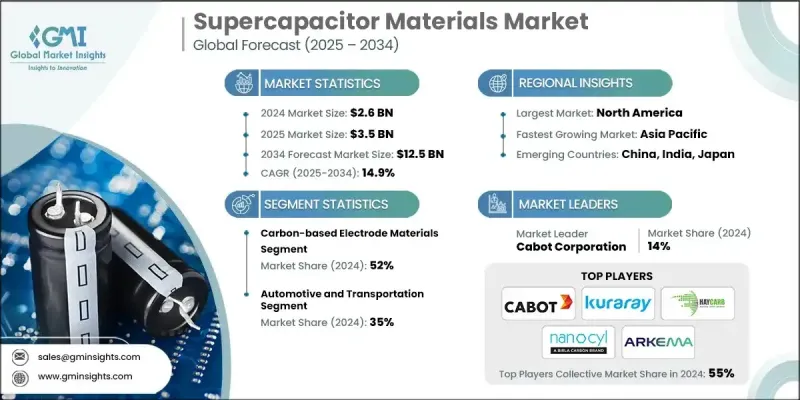
The Global Supercapacitor Materials Market was valued at USD 2.6 billion in 2024 and is estimated to grow at a CAGR of 14.9% to reach USD 12.5 billion by 2034.
The segment continues to set itself apart from traditional storage technologies because its design favors instant power delivery and extremely high cycling durability. Industry trends point to strong, long-term expansion that surpasses many energy-oriented storage categories. Rising electric vehicle demand is sharply increasing the need for advanced energy storage materials worldwide. At the same time, flexible and textile-based devices are progressing into real-world applications, demonstrating that adaptable supercapacitor formats are becoming commercially relevant. Advancements in material science, including ternary oxides with elevated specific capacitance and graphene-oxide combinations offering substantial surface-based performance, are supporting this shift by improving overall energy density and strengthening long-cycle stability. Wearable and flexible power components see consistent traction within smart clothing, medical monitoring systems, and personal electronics that require rapid, safe power bursts. These developments highlight a market environment where innovation and integration potential continue to accelerate, positioning supercapacitor materials as a critical component in next-generation storage technologies.
| Market Scope | |
|---|---|
| Start Year | 2024 |
| Forecast Year | 2025-2034 |
| Start Value | $2.6 Billion |
| Forecast Value | $12.5 Billion |
| CAGR | 14.9% |
The metal oxides segment held 18% share in 2024, supported by pseudocapacitive behavior that raises overall capacitance while still requiring optimized conductivity enhancements and controlled structural design. Hydrous ruthenium oxide has achieved performance levels of up to 650 F/g, and ternary metal oxides such as nickel-copper-cobalt compositions have reached 596 C/g, with related devices showing energy densities near 96 Wh/kg at around 841 W/kg. These developments indicate that engineered composites can help reduce the difference between energy-focused and power-focused storage without sacrificing rapid response capabilities.
The energy and grid-related segment captured a 22% share in 2024, reflecting the need for voltage and frequency management as renewable energy installations expand. Industrial environments continue to rely on supercapacitors for peak-load control, reliable operation at temperatures as low as -40°C (when paired with suitable electrolytes), and backup functions in systems where instant response and high cycle lives are essential.
North America Supercapacitor Materials Market accounted for a 20% share in 2024. Growth in the region is supported by favorable energy-storage policy frameworks and manufacturing-onshoring initiatives, strengthened by measures such as the Investment Tax Credit for standalone storage and FERC Order 841, which enables broader participation in wholesale markets. The United States pipeline includes a USD 50 million Department of Energy-supported facility for CNT and conductive additive production, alongside a USD 1 billion evaluation for a potential supercapacitor manufacturing campus aimed at the automotive, defense, and artificial intelligence sectors.
Major companies active in the Supercapacitor Materials Market include Cabot Corporation, Kuraray Co., Haycarb PLC, Nanocyl SA, Applied Graphene Materials PLC, Arkema Group, IOXUS, YUNASKO, Nippon Chemi-Con Corporation, Tecate Group, and Skeleton Technologies. Companies in the Supercapacitor Materials Market are strengthening their positions by expanding production capacity, improving material purity, and investing heavily in R&D to achieve higher capacitance and longer cycle life. Many organizations are forming partnerships with automotive, electronics, and grid-solution manufacturers to secure long-term supply agreements and accelerate product integration. Firms are also optimizing conductive additives, surface-engineered carbons, and advanced electrolytes to meet performance targets for next-generation devices. Regional expansion, especially in North America and Asia, is helping companies reduce logistics costs and improve access to major end-use industries.
Table of Contents
Chapter 1 Methodology & Scope
- 1.1 Market scope and definition
- 1.2 Research design
- 1.2.1 Research approach
- 1.2.2 Data collection methods
- 1.3 Data mining sources
- 1.3.1 Global
- 1.3.2 Regional/Country
- 1.4 Base estimates and calculations
- 1.4.1 Base year calculation
- 1.4.2 Key trends for market estimation
- 1.5 Primary research and validation
- 1.5.1 Primary sources
- 1.6 Forecast model
- 1.7 Research assumptions and limitations
Chapter 2 Executive Summary
- 2.1 Industry 3600 synopsis
- 2.2 Key market trends
- 2.2.1 Material type
- 2.2.2 Application
- 2.3 TAM analysis, 2025-2034
- 2.4 CXO perspectives: Strategic imperatives
- 2.4.1 Executive decision points
- 2.4.2 Critical success factors
- 2.5 Outlook and strategic recommendations
Chapter 3 Industry Insights
- 3.1 Industry ecosystem analysis
- 3.1.1 Supplier landscape
- 3.1.2 Profit margin
- 3.1.3 Value addition at each stage
- 3.1.4 Factor affecting the value chain
- 3.1.5 Disruptions
- 3.2 Industry impact forces
- 3.2.1 Growth drivers
- 3.2.2 Industry pitfalls and challenges
- 3.2.3 Market opportunities
- 3.3 Growth potential analysis
- 3.4 Regulatory landscape
- 3.4.1 North America
- 3.4.2 Europe
- 3.4.3 Asia Pacific
- 3.4.4 Latin America
- 3.4.5 Middle East & Africa
- 3.5 Porter's analysis
- 3.6 PESTEL analysis
- 3.7 Price trends
- 3.7.1 By region
- 3.8 Future market trends
- 3.9 Technology and innovation landscape
- 3.9.1 Current technological trends
- 3.9.2 Emerging technologies
- 3.10 Patent landscape
- 3.11 Trade statistics (HS code) (Note: the trade statistics will be provided for key countries only)
- 3.11.1 Major importing countries
- 3.11.2 Major exporting countries
- 3.12 Sustainability and environmental aspects
- 3.12.1 Sustainable practices
- 3.12.2 Waste reduction strategies
- 3.12.3 Energy efficiency in production
- 3.12.4 Eco-friendly initiatives
- 3.13 Carbon footprint considerations
Chapter 4 Competitive Landscape, 2024
- 4.1 Introduction
- 4.2 Company market share analysis
- 4.2.1 By region
- 4.2.1.1 North America
- 4.2.1.2 Europe
- 4.2.1.3 Asia Pacific
- 4.2.1.4 Latin America
- 4.2.1.5 Middle East & Africa
- 4.2.1 By region
- 4.3 Company matrix analysis
- 4.4 Competitive analysis of major market players
- 4.5 Competitive positioning matrix
- 4.6 Key developments
- 4.6.1 Mergers & acquisitions
- 4.6.2 Partnerships & collaborations
- 4.6.3 New product launches
- 4.6.4 Expansion plans
Chapter 5 Market Size and Forecast, By Material Type, 2021-2034 (USD Billion, Kilo Tons)
- 5.1 Key trends
- 5.2 Carbon-based electrode materials
- 5.2.1 Activated carbon
- 5.2.2 Graphene & graphene derivatives
- 5.2.3 Carbon nanotubes
- 5.2.4 Carbon aerogels & 3d carbon structures
- 5.2.5 Carbon fibers & activated carbon fibers
- 5.2.6 Others
- 5.3 Metal oxide materials
- 5.4 Conducting polymer materials
- 5.5 Composite & hybrid materials
- 5.6 Electrolyte materials
- 5.7 Current collector & substrate materials
- 5.8 Others
Chapter 6 Market Size and Forecast, By Application, 2021-2034 (USD Billion, Kilo Tons)
- 6.1 Key trends
- 6.2 Automotive & transportation
- 6.3 Consumer electronics
- 6.4 Energy & grid applications
- 6.5 Industrial equipment
- 6.6 Medical devices
- 6.7 Marine & offshore
- 6.8 Aerospace & defense
Chapter 7 Market Size and Forecast, By Region, 2021-2034 (USD Billion, Kilo Tons)
- 7.1 Key trends
- 7.2 North America
- 7.2.1 U.S.
- 7.2.2 Canada
- 7.3 Europe
- 7.3.1 UK
- 7.3.2 Germany
- 7.3.3 France
- 7.3.4 Italy
- 7.3.5 Spain
- 7.3.6 Rest of Europe
- 7.4 Asia Pacific
- 7.4.1 China
- 7.4.2 India
- 7.4.3 Japan
- 7.4.4 South Korea
- 7.4.5 Australia
- 7.4.6 Rest of Asia Pacific
- 7.5 Latin America
- 7.5.1 Brazil
- 7.5.2 Mexico
- 7.5.3 Argentina
- 7.5.4 Rest of Latin America
- 7.6 Middle East & Africa
- 7.6.1 South Africa
- 7.6.2 Saudi Arabia
- 7.6.3 UAE
- 7.6.4 Rest of Middle East & Africa
Chapter 8 Company Profiles
- 8.1 Cabot Corporation
- 8.2 Kuraray
- 8.3 Haycarb
- 8.4 Applied Graphene Materials
- 8.5 Nanocyl
- 8.6 Arkema Group
- 8.7 YUNASKO
- 8.8 IOXUS
- 8.9 Nippon Chemi-Con Corporation
- 8.10 Tecate Group
- 8.11 Skeleton Technologies

