PUBLISHER: Global Market Insights Inc. | PRODUCT CODE: 1892715

PUBLISHER: Global Market Insights Inc. | PRODUCT CODE: 1892715
Groundwater Management Market Opportunity, Growth Drivers, Industry Trend Analysis, and Forecast 2026 - 2035
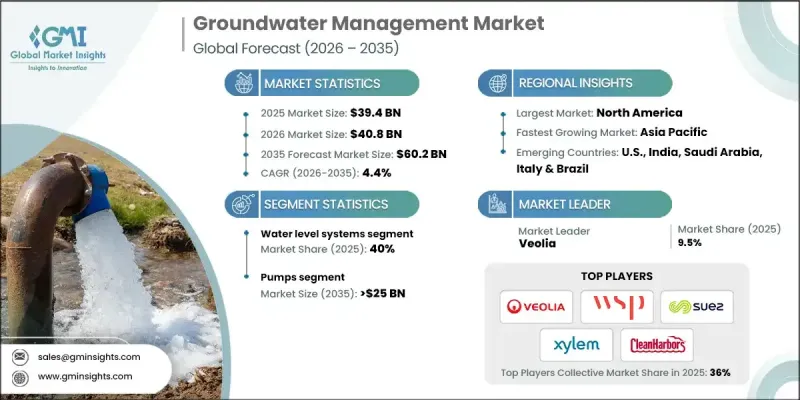
The Global Groundwater Management Market was valued at USD 39.4 billion in 2025 and is estimated to grow at a CAGR of 4.4% to reach USD 60.2 billion by 2035.
Market growth is driven by continuous innovations in modular and simplified designs combined with advanced automation technologies. The deployment of smart sensors and telemetry systems allows operators to monitor groundwater levels, water quality, and recharge rates in real time. Predictive analytics provide actionable insights to prevent over-extraction and contamination, which fuels demand for groundwater management solutions. Groundwater management encompasses specialized techniques and systems designed to ensure sustainable utilization and protection of subsurface water resources. Its functions include monitoring aquifer levels, regulating extraction rates, preventing contamination, and supporting recharge processes. The sector has evolved beyond basic water extraction to a strategic role in optimizing resource efficiency, controlling contamination risks, and supporting sustainability goals. Incorporating recharge strategies and treated water reuse further enhances operational efficiency and cost-effectiveness.
| Market Scope | |
|---|---|
| Start Year | 2025 |
| Forecast Year | 2026-2035 |
| Start Value | $39.4 Billion |
| Forecast Value | $60.2 Billion |
| CAGR | 4.4% |
The water level systems segment held a 40% share in 2025. Increasing regulatory mandates and emphasis on sustainable water use are driving the adoption of advanced water level monitoring systems. Rising demand for portable, cost-effective, and easy-to-install sensors is boosting penetration, particularly in rural areas. These devices now provide accurate measurements of pH, turbidity, dissolved oxygen, and contaminants, ensuring compliance with strict water quality standards.
The pumps segment held a 45% share in 2025 and is expected to grow to USD 25 billion by 2035. The integration of variable frequency drives and automated flow regulation improves pumping efficiency and reduces wastage. Demand is rising for solar and hybrid pump systems that align with carbon reduction initiatives. Manufacturers are focusing on modular designs and corrosion-resistant materials to ensure reliability across diverse hydrogeological conditions.
North America Groundwater Management Market will reach USD 18 billion by 2035. Municipal and industrial operators are increasingly deploying advanced sensors and automated pumping systems to comply with strict environmental regulations. Strong collaboration between public agencies and private enterprises, coupled with ongoing infrastructure investments, is accelerating market growth.
Key players in the Groundwater Management Market include Arcadis, Black & Veatch, Clean Harbors Environmental Services, DMT Group, Envirogen Technologies, GEI Consultants, Grundfos, HEPACO, HPC AG, iFLUX, INDUS Environmental Services, Koop Wasserbau, Minetek, Remedial Construction Services, Sensoil Innovations, Stantec, SUEZ, Sweco AB, Tetra Tech, The Groundwater Company, Veolia, WJ Group, WSP Global, and Xylem Water Solutions.
Companies in the Groundwater Management Market are employing several strategies to enhance their market presence. They are investing in R&D to develop smart, automated, and modular systems with improved monitoring and predictive capabilities. Strategic partnerships with municipalities, industrial operators, and environmental agencies expand market reach and accelerate adoption. Businesses are also focusing on geographic expansion into regions facing water scarcity. Integration of renewable-powered pumps and corrosion-resistant materials ensures adaptability in diverse hydrogeological conditions. Additionally, companies are offering value-added services such as data analytics, maintenance support, and training programs to strengthen client relationships, enhance operational efficiency, and drive long-term growth.
Table of Contents
Chapter 1 Methodology & Scope
- 1.1 Research design
- 1.1.1 Research approach
- 1.1.2 Data collection methods
- 1.2 Base estimates and calculations
- 1.2.1 Base year calculation
- 1.2.2 Market estimates & forecast parameters
- 1.3 Forecast
- 1.3.1 Key trends for market estimates
- 1.3.2 Quantified market impact analysis
- 1.3.2.1 Mathematical impact of growth parameters on forecast
- 1.3.3 Scenario analysis framework
- 1.4 Primary research and validation
- 1.4.1 Some of the primary sources (but not limited to)
- 1.5 Data mining sources
- 1.5.1 Paid Sources
- 1.5.2 Sources, by region
- 1.6 Research trail & scoring components
- 1.6.1 Research trail components
- 1.6.2 Scoring components
- 1.7 Research transparency addendum
- 1.7.1 Source attribution framework
- 1.7.2 Quality assurance metrics
- 1.7.3 Our commitment to trust
- 1.8 Market definitions
Chapter 2 Executive Summary
- 2.1 Industry synopsis, 2022 - 2035
- 2.2 Business trends
- 2.3 Monitoring trends
- 2.4 Extraction trends
- 2.5 Recharge trends
- 2.6 Treatment trends
- 2.7 End use trends
- 2.8 Regional trends
Chapter 3 Industry Insights
- 3.1 Industry ecosystem analysis
- 3.1.1 Raw material availability & sourcing analysis
- 3.1.2 Manufacturing capacity assessment
- 3.1.3 Supply chain resilience & risk factors
- 3.1.4 Distribution network analysis
- 3.2 Regulatory landscape
- 3.3 Industry impact forces
- 3.3.1 Growth drivers
- 3.3.2 Industry pitfalls & challenges
- 3.4 Growth potential analysis
- 3.5 Porter's analysis
- 3.5.1 Bargaining power of suppliers
- 3.5.2 Bargaining power of buyers
- 3.5.3 Threat of new entrants
- 3.5.4 Threat of substitutes
- 3.6 PESTEL analysis
- 3.6.1 Political factors
- 3.6.2 Economic factors
- 3.6.3 Social factors
- 3.6.4 Technological factors
- 3.6.5 Legal factors
- 3.6.6 Environmental factors
- 3.7 Cost structure analysis of groundwater management
- 3.8 Emerging opportunities & trends
- 3.9 Digitalization & IoT integration
- 3.10 Investment analysis & future outlook
Chapter 4 Competitive Landscape, 2025
- 4.1 Introduction
- 4.2 Company market share analysis, by region, 2025
- 4.2.1 North America
- 4.2.2 Europe
- 4.2.3 Asia Pacific
- 4.2.4 Middle East & Africa
- 4.2.5 Latin America
- 4.3 Strategic dashboard
- 4.4 Strategic initiatives
- 4.4.1 Key partnerships & collaborations
- 4.4.2 Major M&A activities
- 4.4.3 Product innovations & launches
- 4.4.4 Market expansion strategies
- 4.5 Competitive benchmarking
- 4.6 Innovation & sustainability landscape
Chapter 5 Market Size and Forecast, By Monitoring, 2022 - 2035 (USD Million)
- 5.1 Key trends
- 5.2 Water quality sensors
- 5.3 Water level systems
- 5.4 IoT loggers
- 5.5 Geospatial analysis
Chapter 6 Market Size and Forecast, By Extraction, 2022 - 2035 (USD Million)
- 6.1 Key trends
- 6.2 Pumps
- 6.3 Borewell drilling
- 6.4 Well casing & screens
- 6.5 Integrated infiltration systems
Chapter 7 Market Size and Forecast, By Recharge, 2022 - 2035 (USD Million)
- 7.1 Key trends
- 7.2 Artificial recharge structures
- 7.3 MAR systems
- 7.4 Recharge wells
- 7.5 Stormwater infiltration
Chapter 8 Market Size and Forecast, By Treatment, 2022 - 2035 (USD Million)
- 8.1 Key trends
- 8.2 Filtration systems
- 8.3 Pump & treat
- 8.4 Desalination & chemical treatment
- 8.5 Biological & in-situ remediation
Chapter 9 Market Size and Forecast, By End Use, 2022 - 2035 (USD Million)
- 9.1 Key trends
- 9.2 Agriculture
- 9.3 Municipal
- 9.4 Industrial
Chapter 10 Market Size and Forecast, By Region, 2022 - 2035 (USD Million)
- 10.1 Key trends
- 10.2 North America
- 10.2.1 U.S.
- 10.2.2 Canada
- 10.3 Europe
- 10.3.1 Germany
- 10.3.2 France
- 10.3.3 UK
- 10.3.4 Italy
- 10.3.5 Spain
- 10.4 Asia Pacific
- 10.4.1 China
- 10.4.2 Japan
- 10.4.3 Indonesia
- 10.4.4 India
- 10.4.5 Australia
- 10.5 Middle East & Africa
- 10.5.1 Saudi Arabia
- 10.5.2 UAE
- 10.5.3 Iran
- 10.5.4 South Africa
- 10.5.5 Egypt
- 10.6 Latin America
- 10.6.1 Brazil
- 10.6.2 Argentina
- 10.6.3 Chile
Chapter 11 Company Profiles
- 11.1 Arcadis
- 11.2 Black & Veatch
- 11.3 Clean Harbors Environmental Services
- 11.4 DMT Group
- 11.5 Envirogen Technologies
- 11.6 GEI Consultants
- 11.7 Grundfos
- 11.8 HEPACO
- 11.9 HPC AG
- 11.10 iFLUX
- 11.11 INDUS Environmental Services
- 11.12 Koop Wasserbau
- 11.13 Minetek
- 11.14 Remedial Construction Services
- 11.15 Sensoil Innovations
- 11.16 Stantec
- 11.17 SUEZ
- 11.18 Sweco AB
- 11.19 Tetra Tech
- 11.20 The Groundwater Company
- 11.21 Veolia
- 11.22 WJ Group
- 11.23 WSP Global
- 11.24 Xylem Water Solutions

