PUBLISHER: Global Market Insights Inc. | PRODUCT CODE: 1892726

PUBLISHER: Global Market Insights Inc. | PRODUCT CODE: 1892726
Power System Simulator Market Opportunity, Growth Drivers, Industry Trend Analysis, and Forecast 2025 - 2034
The Global Power System Simulator Market was valued at USD 832.1 million in 2024 and is estimated to grow at a CAGR of 3.9% to reach USD 1.22 billion by 2034.
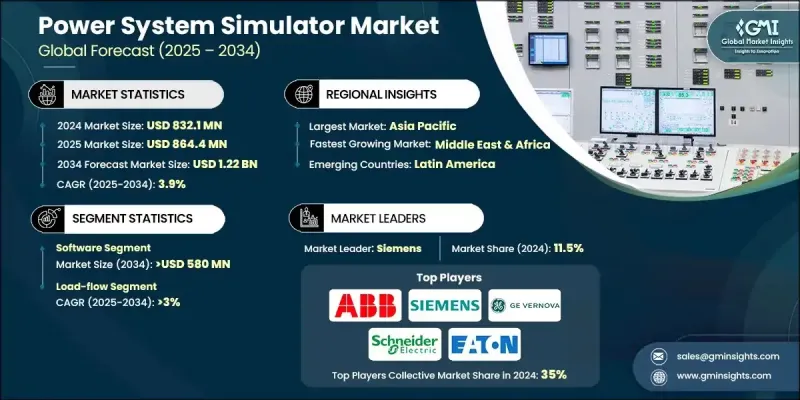
Market expansion is fueled by the growing complexity of electric grids and the accelerating deployment of renewable energy resources. As more nations transition toward sustainable power, simulation tools are becoming indispensable for evaluating designs, executing stress tests, and protecting grid stability without impacting real-world assets. Public initiatives are also accelerating market momentum, with policy frameworks emphasizing improved planning, resilience, and operational reliability areas that depend heavily on accurate simulation technologies. Utilities and research bodies are increasingly turning to real-time digital simulation platforms and hardware-in-the-loop systems to validate protection configurations and assess inverter-based resources under variable renewable conditions. Momentum around digital twins is also escalating, enabling operators to build virtual models of their networks for predictive diagnostics and performance refinement. As global energy networks expand and interconnect, the demand for advanced simulation software continues to grow, reinforcing the importance of sophisticated tools to support complex renewable integration scenarios.
| Market Scope | |
|---|---|
| Start Year | 2024 |
| Forecast Year | 2025-2034 |
| Start Value | $832.1 Million |
| Forecast Value | $1.22 Billion |
| CAGR | 3.9% |
The software segment is expected to reach USD 580 million by 2034. This growth is tied to rising grid complexity as distributed energy, storage technologies, and variable renewable systems become more prevalent. Software-based simulation platforms offer adaptability and support accurate modeling, helping operators refine contingency strategies and improve overall system performance while avoiding physical infrastructure risks.
The short-circuit simulation category is projected to reach USD 290 million by 2034. This module plays an essential role in evaluating system response during fault events and calculating fault currents, ensuring proper protection-device selection and verifying that components can withstand fault-induced stress.
United States Power System Simulator Market was valued at USD 214 million in 2024. Continued growth is closely linked to renewable energy expansion, transportation electrification, and the modernization of grid infrastructure. Strong cooperation between utilities, technology firms, and government bodies strengthens the adoption of advanced simulation systems, further supported by investments in smart grids, metering technologies, and distributed resource integration.
Key players in the Global Power System Simulator Market include Nayak Corporation, Neplan, Eaton, Protasis, AspenTech, PowerWorld, Onsemi, ABB, Opal-RT, GE Vernova, Siemens, MATPOWER, Vicor Corporation, Schneider Electric, NuScale Power Corporation, RTDS Technologies, Fuji Electric, EATAP, CORYS, and Mathworks. Companies participating in the Global Power System Simulator Market are using strategic initiatives to reinforce their global positioning. Many are investing in advanced simulation algorithms, cloud-based platforms, and modular software architectures to meet rising demands for flexible, real-time modeling. Firms are strengthening collaborations with utilities, research institutes, and grid operators to co-develop customized solutions tailored to renewable integration and grid modernization goals. Investments in digital twin platforms, cybersecurity enhancements, and high-fidelity HIL systems are supporting more accurate scenario analysis. Companies are expanding global service networks, offering training programs, and integrating AI-based analytics to differentiate their offerings.
Table of Contents
Chapter 1 Methodology & Scope
- 1.1 Research design
- 1.2 Market estimates & forecast parameters
- 1.3 Forecast calculation
- 1.4 Data sources
- 1.4.1 Primary
- 1.4.2 Secondary
- 1.4.2.1 Paid
- 1.4.2.2 Public
Chapter 2 Executive Summary
- 2.1 Industry synopsis, 2021 - 2034
Chapter 3 Industry Insights
- 3.1 Industry ecosystem analysis
- 3.2 Regulatory landscape
- 3.3 Industry impact forces
- 3.3.1 Growth drivers
- 3.3.2 Industry pitfalls & challenges
- 3.4 Growth potential analysis
- 3.5 Porter's analysis
- 3.5.1 Bargaining power of suppliers
- 3.5.2 Bargaining power of buyers
- 3.5.3 Threat of new entrants
- 3.5.4 Threat of substitutes
- 3.6 PESTEL analysis
- 3.6.1 Political factors
- 3.6.2 Economic factors
- 3.6.3 Social factors
- 3.6.4 Technological factors
- 3.6.5 Legal factors
- 3.6.6 Environmental factors
- 3.7 Emerging opportunities & trends
- 3.7.1 Digitalization & IoT integration
- 3.7.2 Emerging market penetration
- 3.8 Investment analysis & future outlook
Chapter 4 Competitive Landscape, 2025
- 4.1 Introduction
- 4.2 Company market share analysis, by Region, 2024
- 4.2.1 North America
- 4.2.2 Europe
- 4.2.3 Asia Pacific
- 4.2.4 Middle East & Africa
- 4.2.5 Latin America
- 4.3 Strategic initiatives
- 4.4 Competitive benchmarking depictions
- 4.5 Strategy dashboard
- 4.6 Innovation & technology landscape
Chapter 5 Market Size and Forecast, By Offering, 2021 - 2034 (USD Million)
- 5.1 Key trends
- 5.2 Hardware
- 5.3 Software
- 5.4 Services
Chapter 6 Market Size and Forecast, By Modules, 2021 - 2034 (USD Million)
- 6.1 Key trends
- 6.2 Load flow
- 6.3 Short circuit
- 6.4 Arc flash
- 6.5 Device coordination selectivity
- 6.6 Harmonics
- 6.7 Others
Chapter 7 Market Size and Forecast, By Application, 2021 - 2034 (USD Million)
- 7.1 Key trends
- 7.2 Power generation
- 7.3 Transmission & distribution
- 7.4 Oil & gas
- 7.5 Manufacturing
- 7.6 Metals & mining
- 7.7 Others
Chapter 8 Market Size and Forecast, By Region, 2021 - 2034 (USD Million)
- 8.1 Key trends
- 8.2 North America
- 8.2.1 U.S.
- 8.2.2 Canada
- 8.2.3 Mexico
- 8.3 Europe
- 8.3.1 UK
- 8.3.2 France
- 8.3.3 Germany
- 8.3.4 Italy
- 8.3.5 Russia
- 8.3.6 Spain
- 8.4 Asia Pacific
- 8.4.1 China
- 8.4.2 Australia
- 8.4.3 India
- 8.4.4 Japan
- 8.4.5 South Korea
- 8.5 Middle East & Africa
- 8.5.1 Saudi Arabia
- 8.5.2 UAE
- 8.5.3 Turkey
- 8.5.4 South Africa
- 8.5.5 Egypt
- 8.6 Latin America
- 8.6.1 Brazil
- 8.6.2 Argentina
Chapter 9 Company Profiles
- 9.1 ABB
- 9.2 AspenTech
- 9.3 CORYS
- 9.4 EATAP
- 9.5 Eaton
- 9.6 Fuji Electric
- 9.7 GE Vernova
- 9.8 Mathworks
- 9.9 MATPOWER
- 9.10 Nayak Corporation
- 9.11 Neplan
- 9.12 OPAL-RT
- 9.13 PowerWorld
- 9.14 Protasis
- 9.15 RTDS Technologies
- 9.16 Schneider Electric
- 9.17 Siemens
- 9.18 Vicor Corporation

