PUBLISHER: Global Market Insights Inc. | PRODUCT CODE: 1892811

PUBLISHER: Global Market Insights Inc. | PRODUCT CODE: 1892811
Animal Feed Enzymes Market Opportunity, Growth Drivers, Industry Trend Analysis, and Forecast 2026 - 2035
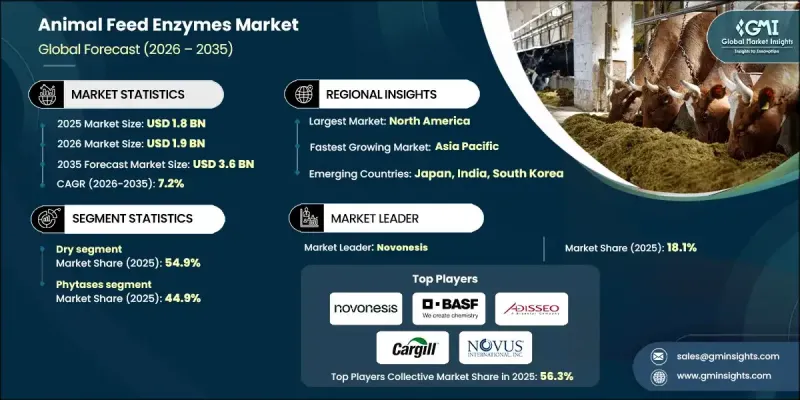
The Global Animal Feed Enzymes Market was valued at USD 1.8 billion in 2025 and is estimated to grow at a CAGR of 7.2% to reach USD 3.6 billion by 2035.
Animal feed enzymes act as biological catalysts that enhance nutrient digestibility in animal diets, supporting growth, immunity, overall health, and productivity. With global priorities focused on maximizing feed conversion efficiency rather than just nutrient storage in tissues, enzymes are becoming a crucial tool for improving animal production. They break down complex feed components, including fibers, starches, and phytates, increasing nutrient absorption. Rising feed costs, growing meat demand, and heightened attention to animal welfare and health further drive market adoption. Enzymes help reduce the need for antibiotics, hormone therapies, and waste emissions, aligning with stricter regulations on livestock antibiotic use across various regions. Additionally, ongoing technological advancements in enzyme formulations are supporting precision livestock farming, making enzymes essential for sustainable and efficient animal production.
| Market Scope | |
|---|---|
| Start Year | 2025 |
| Forecast Year | 2026-2035 |
| Start Value | $1.8 Billion |
| Forecast Value | $3.6 Billion |
| CAGR | 7.2% |
The dry enzyme segment accounted for a 54.9% share in 2025 and is expected to grow at a CAGR of 7.1% through 2035. Dry formulations dominate due to their ease of handling, longer shelf life, and stability during storage and transportation. They are less prone to spoilage and degradation than liquid enzymes, offering cost-effectiveness for both manufacturers and end-users. Their integration into premixed feed formulations also simplifies manufacturing while ensuring uniform enzyme distribution.
The phytases segment held 44.9% share in 2025, primarily because they address phosphorus deficiencies in livestock diets. By improving phosphorus bioavailability in plant-based feeds, phytases reduce reliance on inorganic phosphorus supplements, supporting both animal nutrition and cost savings in feed formulations.
North America Animal Feed Enzymes Market is expected to grow at a CAGR of 7.2% between 2026 and 2035. Growth is driven by increasing consumer awareness of environmental impact and animal welfare, creating demand for enzyme solutions that improve feed efficiency and reduce waste. Innovation in enzyme formulations tailored to specific livestock needs, combined with precision farming practices, further strengthens market growth. Supportive regulations targeting sustainable farming practices and greenhouse gas reduction also contribute to regional adoption.
Key players in the Global Animal Feed Enzymes Market include BASF SE, AB Enzymes, Adisseo, Alltech, Cargill, Inc., Elanco Animal Health, Foodchem International Corporation, International Flavors & Fragrances, Inc., Kemin Industries, Kerry Group, Novonesis, and Novus International. Companies in the Global Animal Feed Enzymes Market are enhancing their presence through multiple strategies. They focus on R&D to develop enzyme formulations tailored for specific livestock species and feed types, improving efficiency and nutritional outcomes. Strategic partnerships, mergers, and acquisitions expand distribution networks and access to new geographies. Investments in precision livestock technologies and sustainable farming solutions help position brands as environmentally responsible and innovative. Firms also engage in educational campaigns for farmers, promoting enzyme benefits and adoption.
Table of Contents
Chapter 1 Methodology & Scope
- 1.1 Market scope and definition
- 1.2 Research design
- 1.2.1 Research approach
- 1.2.2 Data collection methods
- 1.3 Data mining sources
- 1.3.1 Global
- 1.3.2 Regional/Country
- 1.4 Base estimates and calculations
- 1.4.1 Base year calculation
- 1.4.2 Key trends for market estimation
- 1.5 Primary research and validation
- 1.5.1 Primary sources
- 1.6 Forecast model
- 1.7 Research assumptions and limitations
Chapter 2 Executive Summary
- 2.1 Industry 360° synopsis
- 2.2 Key market trends
- 2.2.1 Regional
- 2.2.2 Formulation
- 2.2.3 Enzyme type
- 2.2.4 Livestock
- 2.3 TAM Analysis, 2026-2035
- 2.4 CXO perspectives: Strategic imperatives
- 2.4.1 Executive decision points
- 2.4.2 Critical success factors
- 2.5 Future Outlook and Strategic Recommendations
Chapter 3 Industry Insights
- 3.1 Industry ecosystem analysis
- 3.1.1 Supplier landscape
- 3.1.2 Profit margin
- 3.1.3 Value addition at each stage
- 3.1.4 Factor affecting the value chain
- 3.1.5 Disruptions
- 3.2 Industry impact forces
- 3.2.1 Growth drivers
- 3.2.1.1 Rising global meat consumption & protein demand
- 3.2.1.2 Feed cost optimization & efficiency pressures
- 3.2.1.3 Animal welfare & performance enhancement focus
- 3.2.2 Industry pitfalls and challenges
- 3.2.2.1 Heat stability & storage limitations
- 3.2.2.2 Competition from alternative feed additives
- 3.2.3 Market opportunities
- 3.2.3.1 Organic & non-GMO enzyme demand
- 3.2.3.2 Personalized nutrition & precision feeding
- 3.2.1 Growth drivers
- 3.3 Growth potential analysis
- 3.4 Regulatory landscape
- 3.4.1 North America
- 3.4.2 Europe
- 3.4.3 Asia Pacific
- 3.4.4 Latin America
- 3.4.5 Middle East & Africa
- 3.5 Porter's analysis
- 3.6 PESTEL analysis
- 3.7 Price trends
- 3.7.1 By region
- 3.7.2 By formulation
- 3.8 Future market trends
- 3.9 Technology and innovation landscape
- 3.9.1 Current technological trends
- 3.9.2 Emerging technologies
- 3.10 Patent Landscape
- 3.11 Trade statistics (HS code)( Note: the trade statistics will be provided for key countries only)
- 3.11.1 Major importing countries
- 3.11.2 Major exporting countries
- 3.12 Sustainability and environmental aspects
- 3.12.1 Sustainable practices
- 3.12.2 Waste reduction strategies
- 3.12.3 Energy efficiency in production
- 3.12.4 Eco-friendly initiatives
- 3.13 Carbon footprint consideration
Chapter 4 Competitive Landscape, 2025
- 4.1 Introduction
- 4.2 Company market share analysis
- 4.2.1 By region
- 4.2.1.1 North America
- 4.2.1.2 Europe
- 4.2.1.3 Asia Pacific
- 4.2.1.4 LATAM
- 4.2.1.5 MEA
- 4.2.1 By region
- 4.3 Company matrix analysis
- 4.4 Competitive analysis of major market players
- 4.5 Competitive positioning matrix
- 4.6 Key developments
- 4.6.1 Mergers & acquisitions
- 4.6.2 Partnerships & collaborations
- 4.6.3 New Product Launches
- 4.6.4 Expansion Plans
Chapter 5 Market Estimates and Forecast, By Formulation, 2022-2035 (USD Billion) (Kilo Tons)
- 5.1 Key trends
- 5.2 Dry
- 5.2.1 Powder
- 5.2.2 Granular
- 5.3 Liquid
Chapter 6 Market Estimates and Forecast, By Enzyme Type, 2022-2035 (USD Billion) (Kilo Tons)
- 6.1 Key trends
- 6.2 Phytases
- 6.2.1 3-phytase
- 6.2.2 6-phytase
- 6.2.3 Consensus phytase
- 6.3 Proteases
- 6.4 Carbohydrases
- 6.4.1 Starch-degrading enzymes (amylases)
- 6.4.2 Non-starch polysaccharide (NSP) enzymes
- 6.5 Lipases
- 6.6 Others
Chapter 7 Market Estimates and Forecast, By Livestock, 2022-2035 (USD Billion) (Kilo Tons)
- 7.1 Key trends
- 7.2 Poultry
- 7.2.1 Broilers
- 7.2.2 Layers
- 7.2.3 Turkeys
- 7.2.4 Others
- 7.3 Swine
- 7.3.1 Piglets & weaners
- 7.3.2 Growers & finishers
- 7.3.3 Sows
- 7.4 Ruminants
- 7.4.1 Dairy cattle
- 7.4.2 Beef cattle
- 7.4.3 Sheep & goats
- 7.4.4 Others
- 7.5 Aquaculture
- 7.5.1 Fish
- 7.5.2 Shrimp & crustaceans
- 7.5.3 Marine species
- 7.6 Others
- 7.6.1 Pet food
- 7.6.2 Equine
- 7.6.3 Others
Chapter 8 Market Estimates and Forecast, By Region, 2022-2035 (USD Billion) (Kilo Tons)
- 8.1 Key trends
- 8.2 North America
- 8.2.1 U.S.
- 8.2.2 Canada
- 8.3 Europe
- 8.3.1 Germany
- 8.3.2 UK
- 8.3.3 France
- 8.3.4 Spain
- 8.3.5 Italy
- 8.3.6 Rest of Europe
- 8.4 Asia Pacific
- 8.4.1 China
- 8.4.2 India
- 8.4.3 Japan
- 8.4.4 Australia
- 8.4.5 South Korea
- 8.4.6 Rest of Asia Pacific
- 8.5 Latin America
- 8.5.1 Brazil
- 8.5.2 Mexico
- 8.5.3 Argentina
- 8.5.4 Rest of Latin America
- 8.6 Middle East and Africa
- 8.6.1 Saudi Arabia
- 8.6.2 South Africa
- 8.6.3 UAE
- 8.6.4 Rest of Middle East and Africa
Chapter 9 Company Profiles
- 9.1 BASF SE
- 9.2 AB Enzymes
- 9.3 Adisseo
- 9.4 Alltech
- 9.5 Cargill, Inc.
- 9.6 Elanco Animal Health
- 9.7 Foodchem International Corporation
- 9.8 International Flavors & Fragrances, Inc.
- 9.9 Kemin Industries
- 9.10 Kerry Group
- 9.11 Novonesis
- 9.12 Novus International

