
PUBLISHER: Global Market Insights Inc. | PRODUCT CODE: 1892831

PUBLISHER: Global Market Insights Inc. | PRODUCT CODE: 1892831
Industry 4.0 Market Opportunity, Growth Drivers, Industry Trend Analysis, and Forecast 2026 - 2035
The Global Industry 4.0 Market was valued at USD 149.2 billion in 2025 and is estimated to grow at a CAGR of 24% to reach USD 1.2 trillion by 2035.
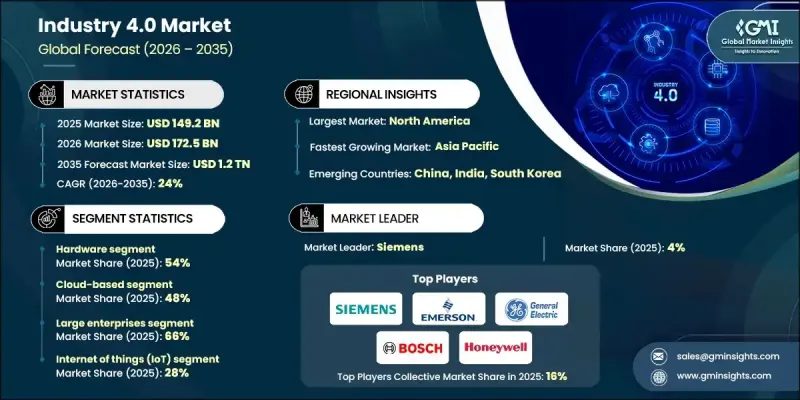
The rapid growth is driven by the accelerating convergence of digital systems, artificial intelligence, and operational technologies across industrial environments. Manufacturers are increasingly transitioning from experimental digital initiatives to full-scale deployment of smart factory frameworks to improve productivity, sustainability, and operational visibility. Artificial intelligence adoption across manufacturing processes continues to scale, supporting functions such as predictive operations, intelligent scheduling, quality monitoring, and real-time decision-making. Generative AI is further streamlining implementation timelines, allowing faster deployment of advanced applications. Robotics adoption is expanding rapidly as collaborative systems gain traction due to cost efficiency, operational safety, and ease of integration, particularly for smaller enterprises. The growing use of digital twins, edge computing, and intelligent automation platforms is reshaping industrial workflows by enabling simulation-driven optimization, enhanced asset utilization, and data-driven performance improvements. Collectively, these developments are establishing Industry 4.0 as a foundational pillar of modern industrial transformation.
| Market Scope | |
|---|---|
| Start Year | 2025 |
| Forecast Year | 2026-2035 |
| Start Value | $149.2 Billion |
| Forecast Value | $1.2 Trillion |
| CAGR | 24% |
The hardware segment accounted for a 54% share in 2025 and is expected to grow at a CAGR of 22.1% from 2026 to 2035. This segment encompasses industrial sensors, connected devices, robotics, edge infrastructure, industrial computing systems, and smart manufacturing equipment. Continued innovation in processing capability, energy efficiency, and device miniaturization is driving sustained investment in advanced industrial hardware. As industrial networks evolve to handle higher data throughput, edge hardware plays a critical role in managing AI-driven workloads and enabling real-time analytics at the production level.
The cloud-based deployment held a share of 48% in 2025 and is expected to grow at a 24.3% CAGR between 2026 and 2035. Cloud platforms support scalable adoption of Industry 4.0 technologies by offering centralized data access, advanced analytics, cost optimization, regulatory compliance, and global system integration. This model allows manufacturers of all sizes to implement digital solutions without large capital investments while maintaining operational flexibility and security.
U.S. Industry 4.0 Market is forecast to grow at a strong CAGR of 30.4% from 2026 to 2035. Market leadership is supported by advanced digital infrastructure, widespread industrial IoT deployment, and strong emphasis on automation and smart manufacturing. Ongoing public and private initiatives continue to encourage responsible digital adoption with a focus on cybersecurity, resilience, and scalable industrial growth.
Key players operating in the Global Industry 4.0 Market include Siemens, Microsoft, Schneider Electric, General Electric, Cisco Systems, Mitsubishi Electric, Oracle, Robert Bosch, Honeywell International, and Emerson Electric. Companies active in the Global Industry 4.0 Market pursue focused strategies to reinforce their competitive positioning and expand global reach. Technology providers invest heavily in research and development to advance AI-driven automation, industrial analytics, and connected systems. Strategic partnerships with manufacturers and cloud platforms enable integrated solution delivery and faster deployment cycles. Firms emphasize modular and scalable platforms to address diverse industrial needs while reducing implementation complexity. Expansion into emerging markets supports long-term growth, while cybersecurity-focused innovation builds customer trust.
Table of Contents
Chapter 1 Methodology
- 1.1 Market scope and definition
- 1.2 Research design
- 1.2.1 Research approach
- 1.2.2 Data collection methods
- 1.3 Data mining sources
- 1.3.1 Global
- 1.3.2 Regional/Country
- 1.4 Base estimates and calculations
- 1.4.1 Base year calculation
- 1.4.2 Key trends for market estimation
- 1.5 Primary research and validation
- 1.5.1 Primary sources
- 1.6 Forecast model
- 1.7 Research assumptions and limitations
Chapter 2 Executive Summary
- 2.1 Industry 3600 synopsis, 2022 - 2035
- 2.2 Key market trends
- 2.2.1 Regional
- 2.2.2 Component
- 2.2.3 Deployment Mode
- 2.2.4 Organization Size
- 2.2.5 Technology
- 2.2.6 End Use
- 2.3 TAM Analysis, 2026-2035
- 2.4 CXO perspectives: Strategic imperatives
- 2.4.1 Executive decision points
- 2.4.2 Critical success factors
- 2.5 Future outlook and strategic recommendations
Chapter 3 Industry Insights
- 3.1 Industry ecosystem analysis
- 3.1.1 Supplier landscape
- 3.1.2 Profit margin analysis
- 3.1.3 Cost structure
- 3.1.4 Value addition at each stage
- 3.1.5 Factor affecting the value chain
- 3.1.6 Disruptions
- 3.2 Industry impact forces
- 3.2.1.1 Growth drivers
- 3.2.1.2 Increasing adoption of Industrial IoT (IIoT) and smart factory solutions.
- 3.2.1.3 Rising demand for automation and robotics across manufacturing sectors.
- 3.2.1.4 Growing need for real-time data analytics and predictive maintenance.
- 3.2.1.5 Expansion of cloud computing, AI, and edge computing in industrial operations.
- 3.2.1.6 Government initiatives and investments support digital manufacturing and smart industries.
- 3.2.2 Industry pitfalls and challenges
- 3.2.2.1 High implementation costs for SMEs
- 3.2.2.2 Cybersecurity and data privacy risks
- 3.2.3 Market opportunities
- 3.2.3.1 Expansion of smart factories and automated production lines
- 3.2.3.2 Integration of AI and machine learning for predictive maintenance
- 3.2.3.3 Growth in Industrial IoT (IIoT) adoption
- 3.2.3.4 Cloud and edge computing solutions for industrial operations
- 3.2.3.5 Government incentives and initiatives promoting digital manufacturing
- 3.3 Growth potential analysis
- 3.4 Regulatory landscape
- 3.5 Porter's analysis
- 3.6 PESTEL analysis
- 3.7 Technology and innovation landscape
- 3.7.1 Current technological trends
- 3.7.2 Emerging technologies
- 3.8 Patent analysis
- 3.9 Price trends
- 3.9.1 By region
- 3.9.2 By product
- 3.10 Cost breakdown analysis
- 3.11 Use cases & success stories
- 3.12 Sustainability and environmental aspects
- 3.12.1 Sustainable practices
- 3.12.2 Waste reduction strategies
- 3.12.3 Energy efficiency in production
- 3.12.4 Eco-friendly Initiatives
- 3.12.5 Carbon footprint considerations
- 3.13 Future outlook and opportunities
Chapter 4 Competitive Landscape, 2025
- 4.1 Introduction
- 4.2 Company market share analysis
- 4.2.1 North America
- 4.2.2 Europe
- 4.2.3 Asia Pacific
- 4.2.4 LATAM
- 4.2.5 MEA
- 4.3 Competitive analysis of major market players
- 4.4 Competitive positioning matrix
- 4.5 Strategic outlook matrix
- 4.6 Key developments
- 4.6.1 Mergers & acquisitions
- 4.6.2 Partnerships & collaborations
- 4.6.3 New product launches
- 4.6.4 Expansion plans and funding
Chapter 5 Market Estimates & Forecast, By Component, 2022 - 2035 ($Bn)
- 5.1 Key trends
- 5.2 Hardware
- 5.3 Software
- 5.4 Services
Chapter 6 Market Estimates & Forecast, By Deployment Mode, 2022 - 2035 ($Bn)
- 6.1 Key trends
- 6.2 On-Premise
- 6.3 Cloud-Based
- 6.4 Hybrid
Chapter 7 Market Estimates & Forecast, By Organization Size, 2022 - 2035 ($Bn)
- 7.1 Key trends
- 7.2 Large enterprises
- 7.3 Small and medium-sized enterprises (SMEs)
Chapter 8 Market Estimates & Forecast, By Technology, 2022 - 2035 ($Bn)
- 8.1 Key trends
- 8.2 Internet of things (IoT)
- 8.3 Digital twin
- 8.4 Big data and AI analytics
- 8.5 Cybersecurity
- 8.6 Cloud computing
- 8.7 Robotics and automation
- 8.8 Augmented reality (AR)
- 8.9 Others
Chapter 9 Market Estimates & Forecast, By End Use, 2022 - 2035 ($Bn)
- 9.1 Key trends
- 9.2 Manufacturing
- 9.3 Automotive
- 9.4 Healthcare
- 9.5 Aerospace and defense
- 9.6 Energy and utilities
- 9.7 Food and beverages
- 9.8 Others
Chapter 10 Market Estimates & Forecast, By Region, 2022 - 2035 ($Bn)
- 10.1 Key trends
- 10.2 North America
- 10.2.1 US
- 10.2.2 Canada
- 10.3 Europe
- 10.3.1 Germany
- 10.3.2 UK
- 10.3.3 France
- 10.3.4 Italy
- 10.3.5 Spain
- 10.3.6 Russia
- 10.3.7 Nordics
- 10.3.8 Benelux
- 10.4 Asia Pacific
- 10.4.1 China
- 10.4.2 India
- 10.4.3 Japan
- 10.4.4 Australia
- 10.4.5 South Korea
- 10.4.6 Singapore
- 10.4.7 Thailand
- 10.4.8 Indonesia
- 10.4.9 Vietnam
- 10.5 Latin America
- 10.5.1 Brazil
- 10.5.2 Mexico
- 10.5.3 Argentina
- 10.5.4 Colombia
- 10.6 MEA
- 10.6.1 South Africa
- 10.6.2 Saudi Arabia
- 10.6.3 UAE
Chapter 11 Company Profiles
- 11.1 Global Players
- 11.1.1 ABB
- 11.1.2 Emerson Electric
- 11.1.3 Fanuc
- 11.1.4 General Electric
- 11.1.5 Honeywell International
- 11.1.6 Mitsubishi Electric
- 11.1.7 Robert Bosch
- 11.1.8 Rockwell Automation
- 11.1.9 Schneider Electric
- 11.1.10 Siemens
- 11.2 Regional Players
- 11.2.1 Beckhoff Automation
- 11.2.2 Cisco Systems
- 11.2.3 Dassault Systemes
- 11.2.4 Eaton
- 11.2.5 Hitachi
- 11.2.6 KUKA
- 11.2.7 Microsoft
- 11.2.8 Oracle
- 11.2.9 Yokogawa Electric
- 11.3 Emerging Technology Innovators
- 11.3.1 AspenTech
- 11.3.2 AVEVA
- 11.3.3 Bright Machines
- 11.3.4 Instrumental
- 11.3.5 PTC

