
PUBLISHER: Global Market Insights Inc. | PRODUCT CODE: 1892844

PUBLISHER: Global Market Insights Inc. | PRODUCT CODE: 1892844
Frozen Bakery Market Opportunity, Growth Drivers, Industry Trend Analysis, and Forecast 2026 - 2035
The Global Frozen Bakery Market was valued at USD 11.5 billion in 2025 and is estimated to grow at a CAGR of 6.1% to reach USD 20.7 billion by 2035.
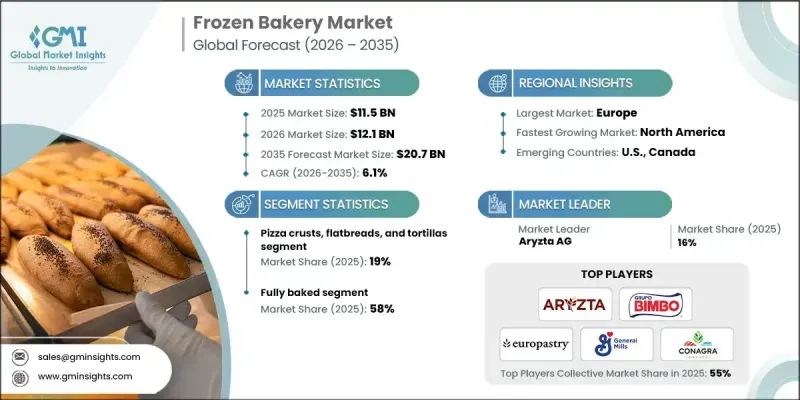
The market expansion is driven by extended shelf life, which enables longer distribution and reduces waste compared to fresh bakery products, as well as labor savings for foodservice operators who require consistent quality without increasing skilled baking staff. As cold chain infrastructure and last-mile delivery networks improve, frozen bakery products become easier to distribute, store, and list, particularly in regions adopting modern retail formats. New freezing technologies preserve dough structure and post-thaw quality, narrowing the gap between frozen and fresh products. E-commerce platforms benefit from frozen bakery due to product stability during transit and consistent quality upon delivery. Sustainable cold chains help reduce food loss, estimated at 12% due to insufficient refrigeration, and lower emissions, especially as countries phase down high-GWP refrigerants under global agreements. Manufacturers are increasingly using whole grains, natural colors, and fewer additives while investing in energy-efficient refrigeration and renewable power. European production dynamics significantly influence the market, with the EU food and drink processing sector generating EUR 1,093 billion in turnover, bakery products representing the largest employment share at around 34%, providing both domestic consumption and export-scale production.
| Market Scope | |
|---|---|
| Start Year | 2025 |
| Forecast Year | 2026-2035 |
| Start Value | $11.5 Billion |
| Forecast Value | $20.7 Billion |
| CAGR | 6.1% |
The fully baked products segment held 58% share in 2024, valued for their "heat-and-serve" convenience across retail freezers, quick-service restaurants, and institutional settings. These products include bread, rolls, and pastries, which are increasingly popular among consumers seeking time-saving options.
The Pizza crusts, flatbreads, and tortillas segment accounted for a 19% share in 2025. Their growth is supported by widespread consumer preference, versatility across retail and foodservice channels, and the ability to serve as bases for various cuisines. The segment continues to expand as innovative flavors, portion sizes, and clean-label ingredients meet evolving consumer demands. Other segments, such as Danish pastries, croissants, and specialty artisan baked goods, are gaining traction due to premiumization trends, health-focused ingredients, and growing adoption in e-commerce and foodservice channels.
U.S. Frozen Bakery Market was valued at USD 2.5 billion in 2025 and is projected to reach USD 20.7 billion by 2035. North America accounted for approximately 27% of the global market in 2025. Growth in the region is supported by rising demand for convenient, ready-to-use products and off-premises dining. The U.S. market benefits from a well-established manufacturing base, with over 160 bakeries reporting significant sales, demonstrating the region's production capacity. Canada's market is expanding alongside modern retail and cross-border brands, though logistics challenges such as truck driver shortages and cold chain equipment losses remain.
Key players operating in the Global Frozen Bakery Market include Grupo Bimbo, Europastry, Pan Pa Ya, General Mills, Rich Products Corporation, Comapan, Don Maiz SAS, Vandemoortele, Patagonia Artisan Bakers, and Aryzta AG. Companies in the Global Frozen Bakery Market are employing diverse strategies to strengthen their presence and market position. They are investing in state-of-the-art freezing and packaging technologies to extend shelf life while preserving taste and texture. Product innovation, including clean-label ingredients, whole grains, and natural flavors, caters to health-conscious consumers and premium segments. Strategic partnerships with foodservice providers and retail chains help expand distribution channels, while cross-border expansions tap into emerging markets. Firms are also enhancing e-commerce logistics, cold chain capacity, and last-mile delivery capabilities to meet growing online demand.
Table of Contents
Chapter 1 Methodology & Scope
- 1.1 Market scope and definition
- 1.2 Research design
- 1.2.1 Research approach
- 1.2.2 Data collection methods
- 1.3 Data mining sources
- 1.3.1 Global
- 1.3.2 Regional/Country
- 1.4 Base estimates and calculations
- 1.4.1 Base year calculation
- 1.4.2 Key trends for market estimation
- 1.5 Primary research and validation
- 1.5.1 Primary sources
- 1.6 Forecast model
- 1.7 Research assumptions and limitations
Chapter 2 Executive Summary
- 2.1 Industry 360° synopsis
- 2.2 Key market trends
- 2.2.1 Product type
- 2.2.2 Product form
- 2.2.3 End use
- 2.3 TAM analysis, 2025-2034
- 2.4 CXO perspectives: Strategic imperatives
- 2.4.1 Executive decision points
- 2.4.2 Critical success factors
- 2.5 Outlook and strategic recommendations
Chapter 3 Industry Insights
- 3.1 Industry ecosystem analysis
- 3.1.1 Supplier landscape
- 3.1.2 Profit margin
- 3.1.3 Value addition at each stage
- 3.1.4 Factor affecting the value chain
- 3.1.5 Disruptions
- 3.2 Industry impact forces
- 3.2.1 Growth drivers
- 3.2.2 Industry pitfalls and challenges
- 3.2.3 Market opportunities
- 3.3 Growth potential analysis
- 3.4 Regulatory landscape
- 3.4.1 North America
- 3.4.2 Europe
- 3.4.3 Asia Pacific
- 3.4.4 Latin America
- 3.4.5 Middle East & Africa
- 3.5 Porter's analysis
- 3.6 PESTEL analysis
- 3.7 Price trends
- 3.7.1 By region
- 3.8 Future market trends
- 3.9 Technology and innovation landscape
- 3.9.1 Current technological trends
- 3.9.2 Emerging technologies
- 3.10 Patent landscape
- 3.11 Trade statistics (HS code) (Note: the trade statistics will be provided for key countries only)
- 3.11.1 Major importing countries
- 3.11.2 Major exporting countries
- 3.12 Sustainability and environmental aspects
- 3.12.1 Sustainable practices
- 3.12.2 Waste reduction strategies
- 3.12.3 Energy efficiency in production
- 3.12.4 Eco-friendly initiatives
- 3.13 Carbon footprint considerations
Chapter 4 Competitive Landscape, 2025
- 4.1 Introduction
- 4.2 Company market share analysis
- 4.2.1 By region
- 4.2.1.1 North America
- 4.2.1.2 Europe
- 4.2.1.3 Asia Pacific
- 4.2.1.4 Latin America
- 4.2.1.5 Middle East & Africa
- 4.2.1 By region
- 4.3 Company matrix analysis
- 4.4 Competitive analysis of major market players
- 4.5 Competitive positioning matrix
- 4.6 Key developments
- 4.6.1 Mergers & acquisitions
- 4.6.2 Partnerships & collaborations
- 4.6.3 New product launches
- 4.6.4 Expansion plans
Chapter 5 Market Size and Forecast, By Product Type, 2022-2035 (USD Billion, Kilo Tons)
- 5.1 Key trends
- 5.2 Bread & rolls
- 5.2.1 White bread & rolls
- 5.2.2 Whole wheat
- 5.2.3 Multigrain & seeded bread
- 5.2.4 Others
- 5.3 Viennoiserie & sweet laminated pastries
- 5.3.1 Croissants
- 5.3.2 Danish pastries
- 5.3.3 Sweet dough rolls
- 5.3.4 Others
- 5.4 Cakes, muffins & sweet goods
- 5.4.1 Cakes
- 5.4.2 Muffins
- 5.4.3 Brownies & bars
- 5.4.4 Others
- 5.5 Pies, tarts & filled pastries
- 5.6 Doughnuts & fried sweet goods
- 5.6.1 Yeast-raised doughnuts
- 5.6.2 Cake doughnuts
- 5.6.3 Filled doughnuts
- 5.6.4 Others
- 5.7 Waffles, pancakes & griddle products
- 5.8 Savory baked goods & appetizers
- 5.9 Pizza crusts, flatbreads & tortillas
- 5.10 Cookies, biscuits
- 5.11 Others
Chapter 6 Market Size and Forecast, By Product Form, 2022-2035 (USD Billion, Kilo Tons)
- 6.1 Key trends
- 6.2 Ready-to-Prove
- 6.3 Ready-to-Bake
- 6.4 Fully Baked
Chapter 7 Market Size and Forecast, By End use, 2022-2035 (USD Billion, Kilo Tons)
- 7.1 Key trends
- 7.2 Retail/consumer
- 7.2.1 Supermarkets & hypermarkets
- 7.2.2 Convenience stores
- 7.2.3 Specialty food stores
- 7.2.4 Online channels/e-commerce
- 7.3 Foodservice
- 7.3.1 Hotels, restaurants, and catering (HORECA)
- 7.3.2 Quick-service restaurants (QSR)
- 7.3.3 Cafeterias & institutional dining
- 7.4 Artisan bakeries & in-store bakeries
- 7.5 Bakery chains
- 7.6 Institutional/school nutrition programs
- 7.7 Others
Chapter 8 Market Size and Forecast, By Region, 2022-2035 (USD Billion, Kilo Tons)
- 8.1 Key trends
- 8.2 North America
- 8.2.1 U.S.
- 8.2.2 Canada
- 8.3 Europe
- 8.3.1 UK
- 8.3.2 Germany
- 8.3.3 France
- 8.3.4 Italy
- 8.3.5 Spain
- 8.3.6 Rest of Europe
- 8.4 Asia Pacific
- 8.4.1 China
- 8.4.2 India
- 8.4.3 Japan
- 8.4.4 South Korea
- 8.4.5 Australia
- 8.4.6 Rest of Asia Pacific
- 8.5 Latin America
- 8.5.1 Brazil
- 8.5.2 Mexico
- 8.5.3 Argentina
- 8.5.4 Rest of Latin America
- 8.6 Middle East & Africa
- 8.6.1 South Africa
- 8.6.2 Saudi Arabia
- 8.6.3 UAE
- 8.6.4 Rest of Middle East & Africa
Chapter 9 Company Profiles
- 9.1 Grupo Bimbo
- 9.2 Europastry
- 9.3 Pan Pa Ya
- 9.4 General Mills
- 9.5 Rich Products Corporation
- 9.6 Comapan
- 9.7 Don Maiz
- 9.8 Vandemoortele
- 9.9 Patagonia Artisan Bakers
- 9.10 Aryzta AG
- 9.11 Canada Bread Company
- 9.12 Kellogg Company
- 9.13 BredenMaster
- 9.14 Conagra Brands
- 9.15 Associated British Foods
- 9.16 CSM Bakery Solutions
- 9.17 Delifrance
- 9.18 Weston Foods
- 9.19 Custom Foods

