PUBLISHER: Global Market Insights Inc. | PRODUCT CODE: 1892856

PUBLISHER: Global Market Insights Inc. | PRODUCT CODE: 1892856
Cancer Diagnostics Market Opportunity, Growth Drivers, Industry Trend Analysis, and Forecast 2026 - 2035
The Global Cancer Diagnostics Market was valued at USD 171.7 billion in 2025 and is estimated to grow at a CAGR of 9.1% to reach USD 408.9 billion by 2035.
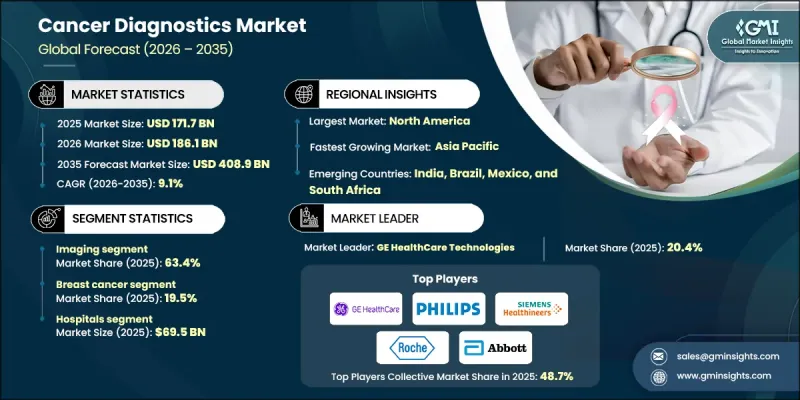
Market expansion is fueled by the rising prevalence of cancer and the growing adoption of advanced diagnostic technologies that enable precise disease detection. Cancer diagnostics encompass a wide range of technologies, processes, and tests designed to identify the type, stage, and location of cancer, supporting early treatment and better outcomes. Innovations in personalized medicine, particularly biomarker-driven approaches, are transforming detection, monitoring, and therapy selection. Non-invasive methods such as liquid biopsies allow real-time monitoring of treatment responses and early detection of tumors, driving adoption among healthcare providers. Advanced imaging, AI-assisted diagnostic tools, and lab-based testing techniques are further enhancing accuracy and reliability, encouraging widespread uptake in hospitals and diagnostic centers globally. The integration of these technologies is also accelerating clinical research and treatment optimization, supporting overall market growth.
| Market Scope | |
|---|---|
| Start Year | 2025 |
| Forecast Year | 2026-2035 |
| Start Value | $171.7 Billion |
| Forecast Value | $408.9 Billion |
| CAGR | 9.1% |
The imaging segment held a 63.4% share in 2025. The rising number of cancer cases is increasing demand for diagnostic imaging, which is essential for early detection and precise treatment planning. Innovations such as PET-CT, MRI, and AI-assisted imaging are improving accuracy, boosting the adoption of imaging technologies worldwide.
The hospitals segment generated USD 69.5 billion in 2025. The growth of this segment is driven by increasing hospital numbers, urbanization, and the availability of skilled personnel to operate advanced diagnostic systems. Hospitals also offer access to advanced technologies, including imaging, biopsies, and liquid biopsy platforms, supporting comprehensive cancer diagnostics and improved patient outcomes.
North America Cancer Diagnostics Market held a 40.5% share in 2025. High cancer prevalence, coupled with strong research initiatives and advanced healthcare infrastructure, is driving market expansion. Pharmaceutical companies, biotechnology firms, and research institutions are heavily investing in innovative diagnostic solutions, further supporting growth in the region.
Key players in the Global Cancer Diagnostics Market include Guardant Health, Abbott Laboratories, Thermo Fisher Scientific, Biocare Medical, Bio-Rad Laboratories, Biomerieux, Danaher Corporation, Siemens Healthineers, Hologic, QIAGEN, GE HealthCare Technologies, Becton Dickinson and Company, Biocartis, F. Hoffmann-La Roche, and Koninklijke Philips.
Companies in the Global Cancer Diagnostics Market are implementing multiple strategies to strengthen their market presence and competitive positioning. They are investing heavily in R&D to develop next-generation diagnostic solutions, including AI-assisted imaging, liquid biopsy platforms, and biomarker-focused tests. Strategic collaborations, partnerships, and acquisitions help expand geographic reach and technological capabilities. Firms are also enhancing product portfolios by introducing innovative, high-precision diagnostic tools that improve early detection and treatment monitoring. Additionally, companies are targeting emerging markets, optimizing manufacturing processes, and offering comprehensive customer support and training to increase adoption in hospitals and diagnostic centers, while maintaining strong regulatory compliance and supply chain efficiency.
Table of Contents
Chapter 1 Methodology and Scope
- 1.1 Market scope and definitions
- 1.2 Research design
- 1.2.1 Research approach
- 1.2.2 Data collection methods
- 1.3 Data mining sources
- 1.3.1 Global
- 1.3.2 Regional/country
- 1.4 Base estimates and calculations
- 1.4.1 Base year calculation
- 1.4.2 Key trends for market estimation
- 1.5 Primary research and validation
- 1.5.1 Primary sources
- 1.6 Forecast model
- 1.7 Research assumptions and limitations
Chapter 2 Executive Summary
- 2.1 Industry 3600 synopsis
- 2.2 Key market trends
- 2.2.1 Regional trends
- 2.2.2 Application trends
- 2.2.3 Cancer type trends
- 2.2.4 End use trends
- 2.3 CXO perspectives: Strategic imperatives
- 2.3.1 Key decision points for industry executives
- 2.3.2 Critical success factors for market players
- 2.4 Future outlook and strategic recommendations
Chapter 3 Industry Insights
- 3.1 Industry ecosystem analysis
- 3.2 Industry impact forces
- 3.2.1 Growth drivers
- 3.2.1.1 Rising prevalence of cancer globally
- 3.2.1.2 Several initiatives undertaken by government and other organizations to spread disease awareness
- 3.2.1.3 Growing number of diagnostic laboratories in developing countries
- 3.2.1.4 Technology advancements in cancer diagnostics
- 3.2.2 Industry pitfalls and challenges
- 3.2.2.1 High capital investment coupled with high costs associated with diagnostic imaging systems
- 3.2.2.2 Risk related with high radiation exposure affecting use of CT scanner
- 3.2.3 Market opportunities
- 3.2.3.1 Regional expansion in emerging markets
- 3.2.3.2 Integration of AI and digital pathology
- 3.2.1 Growth drivers
- 3.3 Growth potential analysis
- 3.4 Regulatory landscape
- 3.4.1 North America
- 3.4.2 Europe
- 3.4.3 Asia Pacific
- 3.5 Technology landscape
- 3.5.1 Current technological trends
- 3.5.2 Emerging technologies
- 3.6 Patent analysis
- 3.7 Pricing analysis, 2025
- 3.8 Future market trends
- 3.9 Porter's analysis
- 3.10 PESTEL analysis
Chapter 4 Competitive Landscape, 2025
- 4.1 Introduction
- 4.2 Company market share analysis
- 4.2.1 Global
- 4.2.2 North America
- 4.2.3 Europe
- 4.2.4 Asia Pacific
- 4.3 Company matrix analysis
- 4.4 Competitive analysis of major market players
- 4.5 Competitive positioning matrix
- 4.6 Key development
- 4.6.1 Mergers and acquisitions
- 4.6.2 Partnerships and collaborations
- 4.6.3 New product launches
- 4.6.4 Expansion plans
Chapter 5 Market Estimates and Forecast, By Application, 2022 - 2035 ($ Mn)
- 5.1 Key trends
- 5.2 Tumor biomarkers tests
- 5.3 Imaging
- 5.3.1 Ultrasound and radiology
- 5.3.2 Mammography
- 5.3.3 MRI scan
- 5.3.4 PET scan
- 5.3.5 CT scan
- 5.3.6 SPECT and other imaging
- 5.4 Biopsy
- 5.5 Liquid biopsy
- 5.6 Immunohistochemistry
- 5.7 In situ hybridization
Chapter 6 Market Estimates and Forecast, By Cancer Type, 2022 - 2035 ($ Mn)
- 6.1 Key trends
- 6.2 Bladder cancer
- 6.3 Breast cancer
- 6.4 Colon and rectal cancer
- 6.5 Endometrial cancer
- 6.6 Kidney cancer
- 6.7 Leukemia
- 6.8 Liver and lung cancer
- 6.9 Melanoma
- 6.10 Non-Hodgkin lymphoma
- 6.11 Pancreatic cancer
- 6.12 Prostate cancer
- 6.13 Thyroid cancer
- 6.14 Other cancer types
Chapter 7 Market Estimates and Forecast, By End Use, 2022 - 2035 ($ Mn)
- 7.1 Key trends
- 7.2 Hospitals
- 7.3 Diagnostic laboratories
- 7.4 Diagnostic imaging centers
- 7.5 Cancer research institutes
Chapter 8 Market Estimates and Forecast, By Region, 2022 - 2035 ($ Mn)
- 8.1 Key trends
- 8.2 North America
- 8.2.1 U.S.
- 8.2.2 Canada
- 8.3 Europe
- 8.3.1 Germany
- 8.3.2 UK
- 8.3.3 France
- 8.3.4 Italy
- 8.3.5 Spain
- 8.3.6 Netherlands
- 8.4 Asia Pacific
- 8.4.1 China
- 8.4.2 India
- 8.4.3 Japan
- 8.4.4 Australia
- 8.4.5 South Korea
- 8.5 Latin America
- 8.5.1 Brazil
- 8.5.2 Mexico
- 8.5.3 Argentina
- 8.6 Middle East and Africa
- 8.6.1 Saudi Arabia
- 8.6.2 South Africa
- 8.6.3 UAE
Chapter 9 Company Profiles
- 9.1 Abbott Laboratories
- 9.2 Becton, Dickinson and Company
- 9.3 Biocare Medical
- 9.4 Biocartis
- 9.5 Biomerieux
- 9.6 Bio-Rad Laboratories
- 9.7 Danaher Corporation
- 9.8 Exact Sciences Corporation
- 9.9 F-Hoffmann-La Roche
- 9.10 GE HealthCare Technologies
- 9.11 Guardant Health
- 9.12 Hologic
- 9.13 Koninklijke Philips
- 9.14 QIAGEN
- 9.15 Siemens Healthineers
- 9.16 Sysmex Corporation
- 9.17 Thermo Fisher Scientific

