PUBLISHER: Global Market Insights Inc. | PRODUCT CODE: 1892866

PUBLISHER: Global Market Insights Inc. | PRODUCT CODE: 1892866
OTR Tire Market Opportunity, Growth Drivers, Industry Trend Analysis, and Forecast 2026 - 2035
The Global OTR Tire Market was valued at USD 4.96 billion in 2025 and is estimated to grow at a CAGR of 7.4% to reach USD 9.89 billion by 2035.
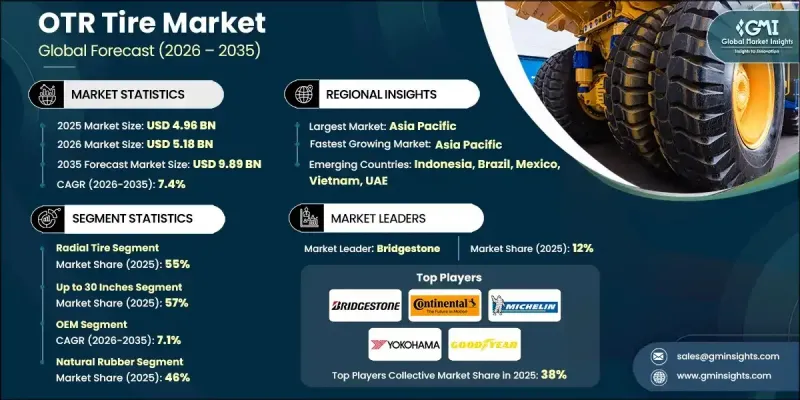
Market growth is driven by the rising use of heavy-duty machinery, such as haul trucks, loaders, and dozers, due to the ongoing expansion of mining and quarrying operations worldwide. Increasing global demand for mineral and metal extraction has fueled the need for robust off-the-road (OTR) tires capable of handling high load capacities, enduring abrasive conditions, and operating continuously for long hours. Investments in infrastructure projects, including roads, bridges, energy initiatives, industrial zones, and urban developments, have further boosted the demand for construction equipment, which in turn relies on durable OTR tires. The modernization of agriculture and adoption of tractors, harvesters, and advanced machinery are driving demand for specialized agricultural OTR tires that provide excellent traction, reduce soil compaction, and offer extended wear life, supporting efficient large-scale farming across both emerging and developed markets.
| Market Scope | |
|---|---|
| Start Year | 2025 |
| Forecast Year | 2026-2035 |
| Start Value | $4.96 Billion |
| Forecast Value | $9.89 Billion |
| CAGR | 7.4% |
The radial tire segment held a 55% share in 2025 and is projected to grow at a CAGR of 7% from 2026 to 2035. Radial tires are preferred in off-road and automotive applications for their long tread life and smoother ride. The design, featuring steel belts with cords oriented perpendicular to the travel direction, ensures improved traction, stability, fuel efficiency, and heat dissipation.
The OEM segment held a 44% share in 2025 and is expected to grow at a CAGR of 7.1% through 2034. OEM channels provide manufacturers with direct access to tire requirements for new machinery, reflecting trends in construction, mining, and agriculture, and offering insights into production volumes and technological integration in new vehicles.
U.S. OTR Tire Market reached USD 1.22 billion in 2025. Mining and construction sectors dominate demand for off-the-road tires, with fleet operators favoring radial and mixed-compound designs for durability and fuel efficiency. Growth is supported by infrastructure development, including highways and urban projects, and sustainability initiatives such as retreading, recycled tire materials, and energy-efficient designs that enhance operational efficiency and compliance with environmental standards.
Leading players operating in the OTR Tire Market include Titan International, The Goodyear Tire & Rubber Company, Bridgestone, Sumitomo Rubber, Yokohama Rubber Company, Michelin, Triangle, Pirelli, Continental, and Balkrishna Industries. Companies in the OTR Tire Market are adopting several strategies to strengthen their market position. They are investing in research and development to create longer-lasting, high-performance tires suitable for extreme conditions. Strategic partnerships with construction, mining, and agricultural equipment manufacturers help ensure OEM adoption. Geographic expansion into emerging markets increases sales opportunities, while sustainability initiatives, such as energy-efficient tire designs and retreading programs, meet regulatory requirements and environmental demands.
Table of Contents
Chapter 1 Methodology
- 1.1 Market scope and definition
- 1.2 Research design
- 1.2.1 Research approach
- 1.2.2 Data collection methods
- 1.3 Data mining sources
- 1.3.1 Global
- 1.3.2 Regional/Country
- 1.4 Base estimates and calculations
- 1.4.1 Base year calculation
- 1.4.2 Key trends for market estimation
- 1.5 Primary research and validation
- 1.5.1 Primary sources
- 1.6 Forecast model
- 1.7 Research assumptions and limitations
Chapter 2 Executive Summary
- 2.1 Industry 360° synopsis
- 2.2 Key market trends
- 2.2.1 Regional
- 2.2.2 Tire
- 2.2.3 Equipment
- 2.2.4 Rim size
- 2.2.5 Industry
- 2.2.6 Material
- 2.2.7 Distribution channel
- 2.3 TAM analysis, 2026-2035
- 2.4 CXO perspectives: Strategic imperatives
- 2.4.1 Executive decision points
- 2.4.2 Critical success factors
- 2.5 Future outlook
- 2.6 Strategic recommendations
Chapter 3 Industry Insights
- 3.1 Industry ecosystem analysis
- 3.1.1 Supplier landscape
- 3.1.2 Profit margin
- 3.1.3 Cost structure
- 3.1.4 Value addition at each stage
- 3.1.5 Factor affecting the value chain
- 3.1.6 Disruptions
- 3.2 Industry impact forces
- 3.2.1 Growth drivers
- 3.2.1.1 Expansion of mining and quarrying activities
- 3.2.1.2 Infrastructure development and construction growth
- 3.2.1.3 Agricultural mechanization
- 3.2.1.4 Shift toward radial tire adoption
- 3.2.2 Industry pitfalls and challenges
- 3.2.2.1 Raw material price volatility
- 3.2.2.2 High failure rates from heat and overloading
- 3.2.3 Market opportunities
- 3.2.3.1 Growth in emerging mining markets
- 3.2.3.2 Automation in mining and construction equipment
- 3.2.3.3 Expansion in port and material handling operations
- 3.2.3.4 Aftermarket replacement demand growth
- 3.2.1 Growth drivers
- 3.3 Growth potential analysis
- 3.4 Regulatory landscape
- 3.4.1 Global
- 3.4.1.1 Safety & performance standards
- 3.4.1.2 Environmental & sustainability regulations
- 3.4.1.3 Import/export regulations & tariffs
- 3.4.1.4 Mining & construction site regulations
- 3.4.2 North America
- 3.4.3 Europe
- 3.4.4 Asia Pacific
- 3.4.5 Latin America
- 3.4.6 Middle East & Africa
- 3.4.1 Global
- 3.5 Porter's analysis
- 3.6 PESTEL analysis
- 3.7 Technology and innovation landscape
- 3.7.1 Current technological trends
- 3.7.1.1 Proprietary technologies (MASTERCORE, V.PLY, LSW, NRF)
- 3.7.1.2 Digital tire monitoring systems (TPMS)
- 3.7.1.3 Intelligent tire technologies
- 3.7.1.4 Advanced materials & compounds
- 3.7.2 Emerging technologies
- 3.7.2.1 Airless autonomous
- 3.7.2.2 AI, Blockchain, 3D Printing, self-healing
- 3.7.2.3 Electric & hybrid equipment tire technologies
- 3.7.1 Current technological trends
- 3.8 Pricing analysis
- 3.8.1.1 Pricing by tire construction type
- 3.8.1.2 Pricing by tire size & rim diameter
- 3.8.1.3 Pricing by application segment
- 3.8.1.4 OEM vs aftermarket pricing
- 3.8.1.5 Regional pricing analysis
- 3.9 Production statistics
- 3.9.1 Production hubs
- 3.9.2 Consumption hubs
- 3.9.3 Export and import
- 3.10 Cost breakdown analysis
- 3.10.1 Manufacturing cost structure
- 3.10.2 Raw material cost analysis
- 3.10.3 Manufacturing & production costs
- 3.10.4 Logistics & distribution costs
- 3.10.5 R&D investment allocation
- 3.11 Patent analysis
- 3.12 Sustainability and environmental aspects
- 3.12.1 Sustainable practices
- 3.12.2 Waste reduction strategies
- 3.12.3 Energy efficiency in production
- 3.12.4 Eco-friendly initiatives
- 3.12.5 Carbon footprint considerations
- 3.13 End use behavior & consumption analysis
- 3.13.1 End use segmentation framework
- 3.13.2 Mining sector user behavior
- 3.13.3 Construction sector user behavior
- 3.13.4 Agriculture sector user behavior
- 3.13.5 Port & material handling user behavior
- 3.13.6 Purchase influencers & decision makers
- 3.14 Risk assessment & mitigation framework
- 3.14.1 Supply chain risks
- 3.14.2 Financial & economic risks
- 3.14.3 Regulatory & compliance risks
- 3.14.4 Operational risks
- 3.14.5 Technology & innovation risks
- 3.15 OTR lifecycle analysis
- 3.15.1 Lifecycle analysis framework
- 3.15.2 Raw material extraction phase
- 3.15.3 Manufacturing phase lifecycle impact
- 3.15.4 Distribution & logistics phase
- 3.15.5 Lifecycle cost analysis (LCCA)
- 3.15.6 Lifecycle performance metrics
Chapter 4 Competitive Landscape, 2025
- 4.1 Introduction
- 4.2 Company market share analysis
- 4.2.1 North America
- 4.2.2 Europe
- 4.2.3 Asia Pacific
- 4.2.4 LATAM
- 4.2.5 MEA
- 4.3 Competitive analysis of major market players
- 4.4 Competitive positioning matrix
- 4.5 Strategic outlook matrix
- 4.6 Key developments
- 4.6.1 Mergers & acquisitions
- 4.6.2 Partnerships & collaborations
- 4.6.3 New product launches
- 4.6.4 Expansion plans and funding
Chapter 5 Market Estimates & Forecast, By Tire, 2022 - 2035 ($Mn, Units)
- 5.1 Key trends
- 5.2 Radial tire
- 5.3 Bias tire
- 5.4 Solid tire
Chapter 6 Market Estimates & Forecast, By Rim Size, 2022 - 2035 ($Mn, Units)
- 6.1 Key trends
- 6.2 Up to 30 inches
- 6.3 31-50 inches
- 6.4 Above 51 inches
Chapter 7 Market Estimates & Forecast, By Equipment, 2022 - 2035 ($Mn, Units)
- 7.1 Key trends
- 7.2 Dump trucks
- 7.2.1 Articulated dump trucks
- 7.2.2 Rigid dump trucks
- 7.3 Loaders
- 7.3.1 Backhoe loaders
- 7.3.2 Crawler loaders
- 7.3.3 Skid-steer loaders
- 7.4 Excavators
- 7.4.1 Crawler excavators
- 7.4.2 Mini excavators
- 7.4.3 Wheeled excavators
- 7.5 Asphalt finishers
- 7.6 Crawler dozer
- 7.7 Motor graders
- 7.8 RTLT-telescopic
- 7.9 Agriculture tractors
- 7.10 Others
Chapter 8 Market Estimates & Forecast, By Industry, 2022 - 2035 ($Mn, Units)
- 8.1 Key trends
- 8.2 Construction
- 8.3 Mining
- 8.4 Agriculture
- 8.5 Forestry
- 8.6 Industrial
- 8.7 Ports & logistics
- 8.8 Others
Chapter 9 Market Estimates & Forecast, By Material, 2022 - 2035 ($Mn, Units)
- 9.1 Key trends
- 9.2 Natural rubber
- 9.3 Synthetic rubber
- 9.4 Mixed/compound tires
Chapter 10 Market Estimates & Forecast, By Distribution Channel, 2022 - 2035 ($Mn, Units)
- 10.1 Key trends
- 10.2 OEM
- 10.3 Aftermarket
Chapter 11 Market Estimates & Forecast, By Region, 2022 - 2035 ($Mn, Units)
- 11.1 Key trends
- 11.2 North America
- 11.2.1 US
- 11.2.2 Canada
- 11.3 Europe
- 11.3.1 Germany
- 11.3.2 UK
- 11.3.3 France
- 11.3.4 Italy
- 11.3.5 Spain
- 11.3.6 Nordics
- 11.3.7 Russia
- 11.3.8 Poland
- 11.3.9 Romania
- 11.4 Asia Pacific
- 11.4.1 China
- 11.4.2 India
- 11.4.3 Japan
- 11.4.4 South Korea
- 11.4.5 ANZ
- 11.4.6 Vietnam
- 11.4.7 Indonesia
- 11.5 Latin America
- 11.5.1 Brazil
- 11.5.2 Mexico
- 11.5.3 Argentina
- 11.6 MEA
- 11.6.1 South Africa
- 11.6.2 Saudi Arabia
- 11.6.3 UAE
Chapter 12 Company Profiles
- 12.1 Global companies
- 12.1.1 Balkrishna Industries
- 12.1.2 Bridgestone
- 12.1.3 Continental
- 12.1.4 Double Coin
- 12.1.5 Goodyear Tire & Rubber Company
- 12.1.6 Linglong Tire
- 12.1.7 Michelin
- 12.1.8 Pirelli
- 12.1.9 Sumitomo Rubber Industries
- 12.1.10 Titan International
- 12.1.11 Triangle Tyre
- 12.1.12 Yokohama Rubber Company
- 12.1.13 Zhongce Rubber
- 12.2 Regional players
- 12.2.1 Aeolus Tyre
- 12.2.2 Apollo Tyres
- 12.2.3 CEAT
- 12.2.4 Guizhou Tyre
- 12.2.5 JK Tyre & Industries
- 12.2.6 Magna Tyres
- 12.2.7 MRF
- 12.2.8 Sailun
- 12.2.9 Techking Tires
- 12.2.10 Vipal Rubber
- 12.3 Emerging players
- 12.3.1 Kal Tire Mining Tire
- 12.3.2 OTR Engineered Solutions
- 12.3.3 Revvo Technologies
- 12.3.4 RubberJet
- 12.3.5 The SMART Tire

