PUBLISHER: Global Market Insights Inc. | PRODUCT CODE: 1892875

PUBLISHER: Global Market Insights Inc. | PRODUCT CODE: 1892875
Whiskey Market Opportunity, Growth Drivers, Industry Trend Analysis, and Forecast 2026 - 2035
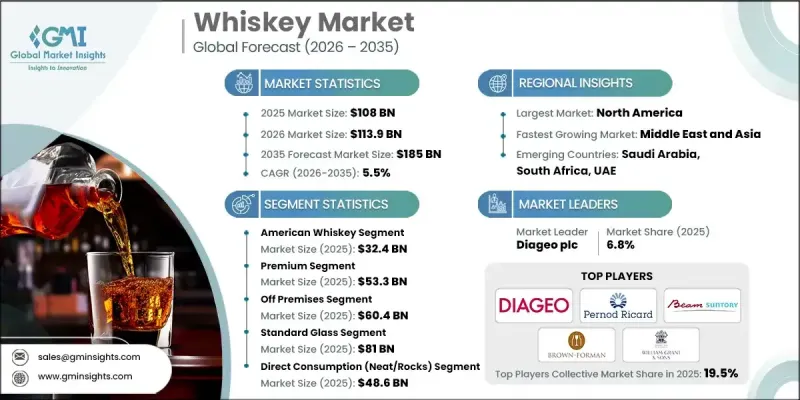
The Global Whiskey Market was valued at USD 108 billion in 2025 and is estimated to grow at a CAGR of 5.5% to reach USD 185 billion by 2035.
Market growth is driven by rising premiumization, expanding global consumption, and increasing consumer interest in authentic, aged, and craft whiskey products. Growth is further supported by the expansion of on-trade and off-trade retail channels, greater digital accessibility, and the rising popularity of cocktail culture among younger demographics. Enhanced global distribution networks and the premium shift in emerging markets continue to create robust demand across all whiskey categories. Whiskey's cultural resonance, heritage-driven branding, and product innovation, such as cask finishes and limited-edition releases, are boosting consumer engagement. Producers are increasingly investing in modernization, small-batch production, and sustainable distilling technologies to improve operational efficiency while preserving product authenticity. The proliferation of e-commerce platforms and subscription-based tasting experiences has also strengthened brand-consumer relationships, allowing distillers to access new audiences across international markets.
| Market Scope | |
|---|---|
| Start Year | 2025 |
| Forecast Year | 2026-2035 |
| Start Value | $108 Billion |
| Forecast Value | $185 Billion |
| CAGR | 5.5% |
The premium segment generated USD 53.3 billion in 2025. Its continued growth is driven by the balance of quality and affordability, making it attractive to regular whiskey consumers. Super-premium whiskey, meanwhile, is witnessing faster expansion as more consumers are willing to spend extra for distinctive flavors, unique finishes, and reputable brands. Rising disposable incomes among younger and middle-income consumers have fueled a shift from standard whiskies to premium and super-premium varieties, reflecting evolving tastes and a desire for elevated drinking experiences.
The off-premises sales segment reached USD 60.4 billion in 2025. Retail outlets, supermarkets, and online platforms are seeing strong growth as more consumers prefer purchasing whiskey for home consumption. The rise of e-commerce allows buyers to easily compare prices, explore new brands, and order premium bottles conveniently. On-premises sales through bars, restaurants, and clubs are also recovering steadily, benefiting from increased social activities and nightlife, while remaining crucial for promoting whiskey brands and premium offerings.
U.S. Whiskey Market was valued at USD 34.3 billion in 2025. North America's demand is largely driven by the U.S. and Canada, supported by high consumption and exports of bourbon, rye, and Canadian whiskies. Bourbon continues to dominate domestically and internationally, bolstered by premiumization trends and the rise of craft distilleries. Interest in smooth, easy-to-drink American whiskies is growing in Canada, appealing to both casual drinkers and cocktail enthusiasts. The region's strong distribution networks and rich whiskey culture further support innovation and market expansion.
Key players in the Global Whiskey Market include Diageo, Pernod Ricard, Beam Suntory, William Grant & Sons, Brown-Forman, and Whyte & Mackay, all of which continue to invest in product innovation, global expansion, and premiumization strategies to maintain competitive strength in the evolving whiskey landscape. Companies operating in the Whiskey Market increasingly rely on premiumization, launching aged, limited-edition, and cask-finished expressions to attract enthusiasts willing to pay higher prices. Major players also emphasize innovation, experimenting with unique maturation techniques, regional ingredients, and collaborative releases to differentiate their portfolios. Global expansion remains a priority, with firms strengthening distribution networks in high-growth regions such as Asia Pacific through partnerships and localized marketing campaigns. Many brands are investing heavily in digital engagement, using e-commerce, virtual tastings, and storytelling-driven social media campaigns to reach younger consumers.
Table of Contents
Chapter 1 Methodology & Scope
- 1.1 Market scope and definition
- 1.2 Research design
- 1.2.1 Research approach
- 1.2.2 Data collection methods
- 1.3 Data mining sources
- 1.3.1 Global
- 1.3.2 Regional/Country
- 1.4 Base estimates and calculations
- 1.4.1 Base year calculation
- 1.4.2 Key trends for market estimation
- 1.5 Primary research and validation
- 1.5.1 Primary sources
- 1.6 Forecast model
- 1.7 Research assumptions and limitations
Chapter 2 Executive Summary
- 2.1 Industry 360° synopsis
- 2.2 Key market trends
- 2.2.1 Product type
- 2.2.2 Price tier
- 2.2.3 Distribution channel
- 2.2.4 Packaging material
- 2.2.5 Application
- 2.2.6 Regional
- 2.3 TAM Analysis, 2025-2034
- 2.4 CXO perspectives: Strategic imperatives
- 2.4.1 Executive decision points
- 2.4.2 Critical success factors
- 2.5 Future outlook and strategic recommendations
Chapter 3 Industry Insights
- 3.1 Industry ecosystem analysis
- 3.1.1 Supplier landscape
- 3.1.2 Profit margin
- 3.1.3 Value addition at each stage
- 3.1.4 Factor affecting the value chain
- 3.1.5 Disruptions
- 3.2 Industry impact forces
- 3.2.1 Growth drivers
- 3.2.1.1 Rising demand for premium whiskey
- 3.2.1.2 Interest in aged and specialty spirits
- 3.2.1.3 Expansion through e-commerce
- 3.2.2 Industry pitfalls and challenges
- 3.2.2.1 High production and aging costs
- 3.2.2.2 Increasing market competition
- 3.2.3 Market opportunities
- 3.2.3.1 Expansion into emerging markets
- 3.2.3.2 Innovation in flavors and techniques
- 3.2.3.3 Adoption of sustainable practices
- 3.2.1 Growth drivers
- 3.3 Growth potential analysis
- 3.4 Regulatory landscape
- 3.4.1 North America
- 3.4.2 Europe
- 3.4.3 Asia Pacific
- 3.4.4 Latin America
- 3.4.5 Middle East & Africa
- 3.5 Porter's analysis
- 3.6 PESTEL analysis
- 3.7 Technology and innovation landscape
- 3.7.1 Current technological trends
- 3.7.2 Emerging technologies
- 3.8 Price trends
- 3.8.1 By region
- 3.8.2 By product type
- 3.9 Future market trends
- 3.10 Technology and innovation landscape
- 3.10.1 Current technological trends
- 3.10.2 Emerging technologies
- 3.11 Patent landscape
- 3.12 Trade statistics (HS code) (Note: the trade statistics will be provided for key countries only)
- 3.12.1 Major importing countries
- 3.12.2 Major exporting countries
- 3.13 Sustainability and environmental aspects
- 3.13.1 Sustainable practices
- 3.13.2 Waste reduction strategies
- 3.13.3 Energy efficiency in production
- 3.13.4 Eco-friendly initiatives
- 3.14 Carbon footprint consideration
Chapter 4 Competitive Landscape, 2025
- 4.1 Introduction
- 4.2 Company market share analysis
- 4.2.1 By region
- 4.2.1.1 North America
- 4.2.1.2 Europe
- 4.2.1.3 Asia Pacific
- 4.2.1.4 LATAM
- 4.2.1.5 MEA
- 4.2.1 By region
- 4.3 Company matrix analysis
- 4.4 Competitive analysis of major market players
- 4.5 Competitive positioning matrix
- 4.6 Key developments
- 4.6.1 Mergers & acquisitions
- 4.6.2 Partnerships & collaborations
- 4.6.3 New product launches
- 4.6.4 Expansion plans
Chapter 5 Market Estimates and Forecast, By Product Type, 2021-2034 (USD Billion) (Million Liters)
- 5.1 Key trends
- 5.2 American whiskey
- 5.2.1 Bourbon whiskey
- 5.2.2 Straight bourbon
- 5.2.3 Tennessee whiskey
- 5.2.4 Others
- 5.3 Scotch whisky
- 5.3.1 Single malt scotch
- 5.3.2 Single grain scotch
- 5.3.3 Blended scotch whisky
- 5.3.4 Blended malt scotch
- 5.3.5 Blended grain scotch
- 5.4 Irish whiskey
- 5.4.1 Single pot still Irish whiskey
- 5.4.2 Single malt Irish whiskey
- 5.4.3 Single grain Irish whiskey
- 5.4.4 Blended Irish whiskey
- 5.5 Canadian whisky
- 5.5.1 Canadian blended whisky
- 5.5.2 Canadian rye whisky
- 5.6 Japanese whisky
- 5.6.1 Japanese single malt
- 5.6.2 Japanese blended whisky
- 5.6.3 Japanese single grain
- 5.7 Flavored whiskey
- 5.7.1 Honey-flavored whiskey
- 5.7.2 Apple-flavored whiskey
- 5.7.3 Cinnamon-flavored whiskey
- 5.7.4 Other flavored variants
- 5.8 Ready-to-drink (RTD) whiskey
- 5.8.1 Whiskey & cola RTD
- 5.8.2 Whiskey & ginger ale RTD
- 5.8.3 Whiskey cocktail RTD
Chapter 6 Market Estimates and Forecast, By Price Tier, 2021-2034 (USD Billion) (Million Liters)
- 6.1 Key trends
- 6.2 Premium segment
- 6.3 Super-premium segment
- 6.4 Luxury/ultra-premium segment ($100+ retail)
Chapter 7 Market Estimates and Forecast, By Distribution Channel, 2021-2034 (USD Billion) (Million Liters)
- 7.1 Key trends
- 7.2 On-premise
- 7.3 Off-premise
- 7.4 Travel retail/duty-free
- 7.5 Institutional/wholesale
Chapter 8 Market Estimates and Forecast, By Packaging Material, 2021-2034 (USD Billion) (Million Liters)
- 8.1 Key trends
- 8.2 Standard glass
- 8.3 Sustainable material
- 8.4 Premium packaging
Chapter 9 Market Estimates and Forecast, By Application, 2021-2034 (USD Billion) (Million Liters)
- 9.1 Key trends
- 9.2 Direct consumption (neat, on the rocks, with water)
- 9.3 Cocktails & mixed drinks
- 9.4 Cooking & culinary
- 9.5 Gifting
- 9.6 Others
Chapter 10 Market Estimates and Forecast, By Region, 2021-2034 (USD Billion) (Million Liters)
- 10.1 Key trends
- 10.2 North America
- 10.2.1 U.S.
- 10.2.2 Canada
- 10.2.3 Mexico
- 10.3 Europe
- 10.3.1 Germany
- 10.3.2 UK
- 10.3.3 France
- 10.3.4 Spain
- 10.3.5 Italy
- 10.3.6 Rest of Europe
- 10.4 Asia Pacific
- 10.4.1 China
- 10.4.2 India
- 10.4.3 Japan
- 10.4.4 Australia
- 10.4.5 South Korea
- 10.4.6 Rest of Asia Pacific
- 10.5 Latin America
- 10.5.1 Brazil
- 10.5.2 Mexico
- 10.5.3 Argentina
- 10.5.4 Rest of Latin America
- 10.6 Middle East and Africa
- 10.6.1 Saudi Arabia
- 10.6.2 South Africa
- 10.6.3 UAE
- 10.6.4 Rest of Middle East and Africa
Chapter 11 Company Profiles
- 11.1 Bacardi Limited
- 11.2 Balcones Distilling
- 11.3 Beam Suntory
- 11.4 Brown-Forman Corporation
- 11.5 Campari Group
- 11.6 Diageo plc
- 11.7 Edrington Group
- 11.8 Heaven Hill Brands
- 11.9 Kings County Distillery
- 11.10 Pernod Ricard
- 11.11 Remy Cointreau
- 11.12 Sazerac Company
- 11.13 Starward Whisky
- 11.14 Stranahan's Colorado Whiskey
- 11.15 Teeling Whiskey Company
- 11.16 Westland Distillery
- 11.17 William Grant & Sons

