
PUBLISHER: Global Market Insights Inc. | PRODUCT CODE: 1892878

PUBLISHER: Global Market Insights Inc. | PRODUCT CODE: 1892878
Superconducting Material Market Opportunity, Growth Drivers, Industry Trend Analysis, and Forecast 2026 - 2035
The Global Superconducting Material Market was valued at USD 9.3 billion in 2025 and is estimated to grow at a CAGR of 13.2% to reach USD 32.3 billion by 2035.
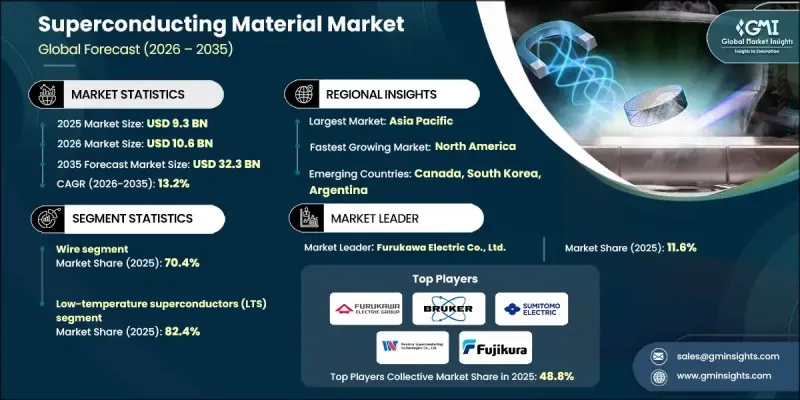
The market is advancing steadily as superconducting materials gain wider acceptance across high-performance and next-generation technologies. These materials enable the transmission of electrical current without resistance and exhibit strong magnetic characteristics once operated below specific temperature thresholds, making them indispensable in advanced applications. Rising investments in healthcare systems are playing a central role in market growth, as superconducting materials are essential components in sophisticated diagnostic and imaging equipment. Increasing healthcare expenditure and infrastructure upgrades across developing economies are accelerating adoption. At the same time, growth in the electronics sector, driven by demand for next-level computing, communication systems, and advanced components, is strengthening market momentum. Asia Pacific continues to represent the largest share due to its strong manufacturing ecosystem and rapid technology deployment, while North America is emerging as the fastest-growing region, supported by substantial research funding, innovation-focused policies, and growing emphasis on advanced energy and transportation technologies.
| Market Scope | |
|---|---|
| Start Year | 2025 |
| Forecast Year | 2026-2035 |
| Start Value | $9.3 Billion |
| Forecast Value | $32.3 Billion |
| CAGR | 13.2% |
The wire segment accounted for a 70.4% share in 2025 and is expected to grow at a CAGR of 13.3% through 2035. Superconducting wires are widely preferred due to their ability to handle high current densities efficiently, making them suitable for large-scale power, research, and industrial systems.
The low-temperature superconductors segment held a share of 82.4% in 2025, supported by established production capabilities and proven reliability. Their long-standing use in precision-driven environments continues to reinforce their market leadership despite higher cooling requirements.
North America Superconducting Material Market is anticipated to grow at a CAGR of 13.4% from 2026 to 2035, driven by increasing deployment of advanced grid technologies and energy efficiency initiatives.
Key companies operating in the Global Superconducting Material Market include Sumitomo Electric Industries Ltd, American Superconductor, Nexans SA, Fujikura Ltd., Western Superconducting Technologies Co., Ltd., MetOx International, Bruker Energy & Supercon Tech, Furukawa Electric Co., Ltd, ASG Superconductors spa, SuNAM Co., Ltd, Kiswire Advanced Technology Co., Ltd, Japan Superconductor Technology, Inc., Luvata, and Supercon, Inc. Companies in the Global Superconducting Material Market are strengthening their competitive position through sustained investment in research and development to enhance performance, scalability, and cost efficiency of superconducting products. Strategic collaborations with research institutes, healthcare equipment manufacturers, and energy providers are helping accelerate commercialization. Firms are also expanding production capacity and refining manufacturing processes to reduce costs and improve yield. Geographic expansion into high-growth regions is a key focus to secure long-term demand.
Table of Contents
Chapter 1 Methodology & Scope
- 1.1 Market scope and definition
- 1.2 Research design
- 1.2.1 Research approach
- 1.2.2 Data collection methods
- 1.3 Data mining sources
- 1.3.1 Global
- 1.3.2 Regional/Country
- 1.4 Base estimates and calculations
- 1.4.1 Base year calculation
- 1.4.2 Key trends for market estimation
- 1.5 Primary research and validation
- 1.5.1 Primary sources
- 1.6 Forecast model
- 1.7 Research assumptions and limitations
Chapter 2 Executive Summary
- 2.1 Industry 360° synopsis
- 2.2 Key market trends
- 2.2.1 Regional
- 2.2.2 Form
- 2.2.3 Product
- 2.2.4 Application
- 2.3 TAM Analysis, 2026-2035
- 2.4 CXO perspectives: Strategic imperatives
- 2.4.1 Executive decision points
- 2.4.2 Critical success factors
- 2.5 Future Outlook and Strategic Recommendations
Chapter 3 Industry Insights
- 3.1 Industry ecosystem analysis
- 3.1.1 Supplier landscape
- 3.1.2 Profit margin
- 3.1.3 Value addition at each stage
- 3.1.4 Factor affecting the value chain
- 3.1.5 Disruptions
- 3.2 Industry impact forces
- 3.2.1 Growth drivers
- 3.2.1.1 Robust growth in the medical industry
- 3.2.1.2 Robust product demand in the electronics industry
- 3.2.1.3 Demand for strong superconducting materials from the R&D industry
- 3.2.2 Industry pitfalls and challenges
- 3.2.2.1 Volatile raw material prices
- 3.2.2.2 Limited availability of raw materials
- 3.2.3 Market opportunities
- 3.2.3.1 Expansion into transportation sectors like maglev trains and electric aircraft
- 3.2.3.2 Development of next-generation quantum computing technologies
- 3.2.1 Growth drivers
- 3.3 Growth potential analysis
- 3.4 Regulatory landscape
- 3.4.1 North America
- 3.4.2 Europe
- 3.4.3 Asia Pacific
- 3.4.4 Latin America
- 3.4.5 Middle East & Africa
- 3.5 Porter's analysis
- 3.6 PESTEL analysis
- 3.7 Price trends
- 3.7.1 By region
- 3.7.2 By form
- 3.8 Future market trends
- 3.9 Technology and Innovation landscape
- 3.9.1 Current technological trends
- 3.9.2 Emerging technologies
- 3.10 Patent Landscape
- 3.11 Trade statistics (HS code)( Note: the trade statistics will be provided for key countries only)
- 3.11.1 Major importing countries
- 3.11.2 Major exporting countries
- 3.12 Sustainability and environmental aspects
- 3.12.1 Sustainable practices
- 3.12.2 Waste reduction strategies
- 3.12.3 Energy efficiency in production
- 3.12.4 Eco-friendly initiatives
- 3.13 Carbon footprint consideration
Chapter 4 Competitive Landscape, 2025
- 4.1 Introduction
- 4.2 Company market share analysis
- 4.2.1 By region
- 4.2.1.1 North America
- 4.2.1.2 Europe
- 4.2.1.3 Asia Pacific
- 4.2.1.4 LATAM
- 4.2.1.5 MEA
- 4.2.1 By region
- 4.3 Company matrix analysis
- 4.4 Competitive analysis of major market players
- 4.5 Competitive positioning matrix
- 4.6 Key developments
- 4.6.1 Mergers & acquisitions
- 4.6.2 Partnerships & collaborations
- 4.6.3 New Product Launches
- 4.6.4 Expansion Plans
Chapter 5 Market Estimates and Forecast, By Form, 2022-2035 (USD Billion) (Kilo Tons)
- 5.1 Key trends
- 5.2 Wire
- 5.3 Tape
- 5.4 Bulk materials
- 5.5 Thin films
- 5.6 Others
Chapter 6 Market Estimates and Forecast, By Product, 2022-2035 (USD Billion) (Kilo Tons)
- 6.1 Key trends
- 6.2 Low-temperature superconductors (LTS)
- 6.2.1 Niobium-titanium (NbTi)
- 6.2.2 Niobium-tin (Nb3Sn)
- 6.2.3 Others
- 6.3 High-temperature superconductors (HTS)
- 6.3.1 Cuprate-based HTS
- 6.3.2 Iron-based superconductors
- 6.3.3 Magnesium diboride
- 6.3.4 Others
Chapter 7 Market Estimates and Forecast, By Application, 2022-2035 (USD Billion) (Kilo Tons)
- 7.1 Key trends
- 7.2 Medical & healthcare
- 7.2.1 Magnetic resonance imaging (MRI)
- 7.2.2 Nuclear magnetic resonance (NMR) spectroscopy
- 7.2.3 Particle therapy systems
- 7.2.4 Others
- 7.3 Energy & utilities
- 7.3.1 Power transmission cables
- 7.3.2 Transformers
- 7.3.3 Fault current limiters (FCL)
- 7.3.4 Others
- 7.4 Transportation
- 7.4.1 Maglev trains
- 7.4.2 Ship propulsion
- 7.4.3 Aircraft systems
- 7.4.4 Others
- 7.5 Electronics & computing
- 7.5.1 Quantum computing
- 7.5.2 Superconducting qubits
- 7.5.3 RF & microwave filters
- 7.5.4 Others
- 7.6 Industrial applications
- 7.6.1 Magnetic separation
- 7.6.2 Mining & mineral processing
- 7.6.3 Recycling & waste management
- 7.6.4 Food processing
- 7.6.5 Others
- 7.7 Defense & aerospace
- 7.7.1 Naval applications
- 7.7.2 Radar & surveillance systems
- 7.7.3 Space propulsion
- 7.7.4 Others
- 7.8 Others
Chapter 8 Market Estimates and Forecast, By Region, 2022-2035 (USD Billion) (Kilo Tons)
- 8.1 Key trends
- 8.2 North America
- 8.2.1 U.S.
- 8.2.2 Canada
- 8.3 Europe
- 8.3.1 Germany
- 8.3.2 UK
- 8.3.3 France
- 8.3.4 Spain
- 8.3.5 Italy
- 8.3.6 Rest of Europe
- 8.4 Asia Pacific
- 8.4.1 China
- 8.4.2 India
- 8.4.3 Japan
- 8.4.4 Australia
- 8.4.5 South Korea
- 8.4.6 Rest of Asia Pacific
- 8.5 Latin America
- 8.5.1 Brazil
- 8.5.2 Mexico
- 8.5.3 Argentina
- 8.5.4 Rest of Latin America
- 8.6 Middle East and Africa
- 8.6.1 Saudi Arabia
- 8.6.2 South Africa
- 8.6.3 UAE
- 8.6.4 Rest of Middle East and Africa
Chapter 9 Company Profiles
- 9.1 American Superconductor
- 9.2 ASG Superconductors spa
- 9.3 Bruker Energy & Supercon Tech
- 9.4 Fujikura Ltd.
- 9.5 Furukawa Electric Co., Ltd
- 9.6 Japan Superconductor Technology, Inc
- 9.7 Kiswire Advanced Technology Co., Ltd
- 9.8 Luvata
- 9.9 MetOx International
- 9.10 Nexans SA
- 9.11 Sumitomo Electric Industries Ltd
- 9.12 SuNAM Co., Ltd
- 9.13 Supercon, Inc
- 9.14 Western Superconducting Technologies Co., Ltd

