
PUBLISHER: Global Market Insights Inc. | PRODUCT CODE: 1913273

PUBLISHER: Global Market Insights Inc. | PRODUCT CODE: 1913273
Southeast Asia Recirculating Aquaculture System (RAS) Market Opportunity, Growth Drivers, Industry Trend Analysis, and Forecast 2026 - 2035
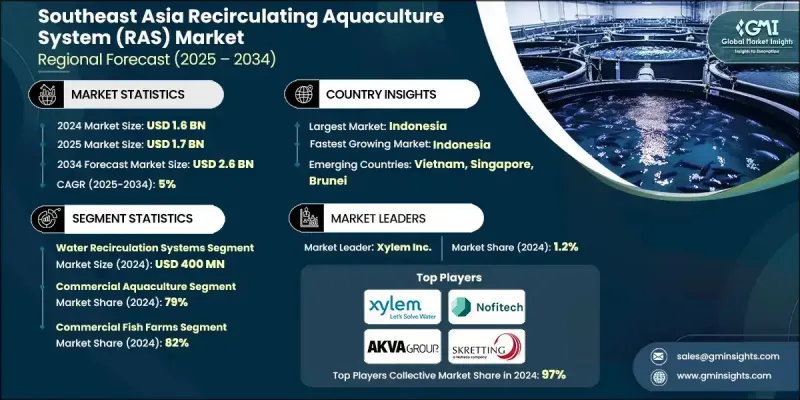
Southeast Asia Recirculating Aquaculture System (RAS) Market was valued at USD 1.6 billion in 2025 and is estimated to grow at a CAGR of 5% to reach USD 2.6 billion by 2035.
Growth across Southeast Asia is driven by the need for reliable and environmentally responsible seafood production as natural resources face mounting pressure. RAS technology is increasingly adopted because it allows consistent control over farming conditions while optimizing water use and improving output stability. Producers are reported to favor controlled systems that support predictable harvest cycles and reduce dependency on external water sources. Expanding urban populations and changing consumption patterns are further accelerating demand for locally produced seafood, positioning RAS as a practical solution for land-constrained regions. The market outlook reflects strong alignment with regional sustainability initiatives and long-term food security objectives, supported by continuous technological refinement and increased private-sector participation.
| Market Scope | |
|---|---|
| Start Year | 2025 |
| Forecast Year | 2026-2035 |
| Start Value | $1.6 Billion |
| Forecast Value | $2.6 Billion |
| CAGR | 5% |
The water recirculation systems segment generated USD 400 million in 2025. These systems are positioned as the core infrastructure within RAS facilities, enabling repeated water reuse while minimizing discharge volumes. Regional operators are increasingly focused on lowering operating costs and complying with tightening environmental standards through advanced system designs and improved process efficiency. The market reflects a clear shift toward fully enclosed configurations that support enhanced water management and pathogen control while maintaining stable production conditions.
The commercial aquaculture segment held 79% share in 2025. This dominance is linked to strong domestic consumption, export-oriented production, and rising emphasis on sustainable farming practices. RAS adoption within commercial operations is associated with improved water conditions, enhanced disease management, and continuous year-round production capabilities. These systems are positioned as a critical solution for meeting growing protein demand while reducing environmental impact and improving operational consistency across aquaculture value chains.
Indonesia Recirculating Aquaculture System (RAS) Market held 58% share, generating USD 916 million in 2025. The regional market environment is shaped by increasing investment in sustainable aquaculture and efficiency-focused farming methods. Southeast Asian countries are described as prioritizing controlled aquaculture systems to address land scarcity, variable water conditions, and consumer demand for higher-quality seafood. Broader advancements across the Asia Pacific region continue to influence system design, performance standards, and adoption rates within Southeast Asia.
Key participants operating in the Southeast Asia Recirculating Aquaculture System (RAS) Market include Xylem, AKVA Group, AquaMaof, Billund Aquaculture, Nofitech, PR Aqua, RADAQUA, Skretting, Blue Planet Ecosystems, Aquacare Environment, Eyvi, FRD Japan, Hesy Aquaculture, Clewer Aquaculture, Guangdong ZKAQUA Aquaculture Equipment Co., Ltd., Chongrui Tech (Fujian) Co., Ltd., Qingdao Haixing, Qingdao Hishing Smart Equipment Co., Ltd., Thomson (China), and eWater (China). Companies active in the Southeast Asia Recirculating Aquaculture System (RAS) Market are strengthening their position through a combination of technology enhancement, regional expansion, and strategic partnerships. Leading players are focusing on improving system efficiency, scalability, and reliability to address diverse production requirements across the region. Investment in localized manufacturing and service networks is helping companies reduce costs and improve customer responsiveness.
Table of Contents
Chapter 1 Methodology and Scope
- 1.1 Market scope and definition
- 1.2 Research design
- 1.2.1 Research approach
- 1.2.2 Data collection methods
- 1.3 Data mining sources
- 1.3.1 Global
- 1.3.2 Regional/Country
- 1.4 Base estimates and calculations
- 1.4.1 Base year calculation
- 1.4.2 Key trends for market estimation
- 1.5 Primary research and validation
- 1.5.1 Primary sources
- 1.6 Forecast model
- 1.7 Research assumptions and limitations
Chapter 2 Executive Summary
- 2.1 Industry 360° synopsis
- 2.2 Key market trends
- 2.2.1 By Country
- 2.2.2 By Component
- 2.2.3 By System type
- 2.2.4 By Fish type
- 2.2.5 By Application
- 2.2.6 By Species
- 2.2.7 By End Use
- 2.3 CXO perspectives: Strategic imperatives
- 2.3.1 Key decision points for industry executives
- 2.3.2 Critical success factors for market players
- 2.4 Future outlook and strategic recommendations
Chapter 3 Industry Insights
- 3.1 Industry ecosystem analysis
- 3.1.1 Supplier landscape
- 3.1.2 Profit margin
- 3.1.3 Value addition at each stage
- 3.1.4 Factor affecting the value chain
- 3.2 Industry impact forces
- 3.2.1 Growth drivers
- 3.2.1.1 Rising need for sustainable and controlled aquaculture
- 3.2.1.2 Increasing consumer awareness of seafood safety and quality
- 3.2.1.3 Advancements in water treatment and automation technologies
- 3.2.2 Industry pitfalls & challenges
- 3.2.2.1 High initial investment and operational complexity
- 3.2.2.2 Limited technical expertise and workforce skill gaps
- 3.2.3 Opportunities
- 3.2.3.1 Urban and near-urban aquaculture expansion
- 3.2.3.2 Integration of digital tools and smart farming solutions
- 3.2.1 Growth drivers
- 3.3 Growth potential analysis
- 3.4 Major market trends and Disruption
- 3.5 Future market trends
- 3.6 Risk and mitigation Analysis
- 3.7 Technology and innovation landscape
- 3.7.1 Current technological trends
- 3.7.2 Emerging technologies
- 3.8 Price trends
- 3.9 Regulatory landscape
- 3.10 Porter's analysis
- 3.11 PESTEL analysis
Chapter 4 Competitive Landscape, 2025
- 4.1 Introduction
- 4.2 Company market share analysis
- 4.3 Company matrix analysis
- 4.4 Competitive analysis of major market players
- 4.5 Competitive positioning matrix
- 4.6 Key developments
- 4.6.1 Mergers & acquisitions
- 4.6.2 Partnerships & collaborations
- 4.6.3 New product launches
- 4.6.4 Expansion plans
Chapter 5 Market Estimates & Forecast, By Component, 2022-2035 (USD Billion) (Thousand Units)
- 5.1 Key trends
- 5.2 Water recirculation systems
- 5.3 Biofiltration units
- 5.4 Oxygenation systems
- 5.5 Heating and cooling systems
- 5.6 Monitoring and control systems
- 5.7 Equipment (tanks, pumps, aerators, etc.)
- 5.8 Other
Chapter 6 Market Estimates & Forecast, By System Type, 2022-2035 (USD Billion) (Thousand Units)
- 6.1 Key trends
- 6.2 Indoor RAS
- 6.3 Outdoor RAS
- 6.4 Modular RAS
- 6.5 Containerized RAS
- 6.6 Freshwater RAS
- 6.7 Saltwater RAS
- 6.8 Hybrid RAS
- 6.9 Integrated systems
- 6.10 Specialized systems
Chapter 7 Market Estimates & Forecast, By Fish Type, 2022-2035 (USD Billion) (Thousand Units)
- 7.1 Key trends
- 7.2 Salmon
- 7.3 Trout
- 7.4 Grouper
- 7.5 Sea bass
- 7.6 Barramundi
- 7.7 Tilapia
- 7.8 Pangasius
- 7.9 Mahseer
- 7.10 Other (white shrimp, mud crab etc.)
Chapter 8 Market Estimates & Forecast, By Application, 2022-2035 (USD Billion) (Thousand Units)
- 8.1 Key trends
- 8.2 Commercial aquaculture
- 8.3 Fish farming
- 8.4 Shellfish farming
- 8.5 Research & development
- 8.6 Experimental aquaculture
- 8.7 Urban aquaculture
Chapter 9 Market Estimates & Forecast, By Species, 2022-2035 (USD Billion) (Thousand Units)
- 9.1 Key trends
- 9.2 Finfish
- 9.3 Shellfish
- 9.4 Others
Chapter 10 Market Estimates & Forecast, By End Use, 2022-2035 (USD Billion) (Thousand Units)
- 10.1 Key trends
- 10.2 Commercial fish farms
- 10.2.1 Supermarkets
- 10.2.2 Seafood distributors
- 10.2.3 Restaurants
- 10.3 Research institutes
- 10.4 Educational institutes
- 10.5 Academic institutions
Chapter 11 Market Estimates and Forecast, By Region, 2022 - 2035 (USD Billion) (Thousand Units)
- 11.1 Key trends
- 11.2 Singapore
- 11.3 Brunei
- 11.4 Indonesia
- 11.5 Vietnam
- 11.6 Philippines
- 11.7 Malaysia
- 11.8 Thailand
Chapter 12 Company Profiles
- 12.1 AKVA Group
- 12.2 Aquacare Environment
- 12.3 AquaMaof
- 12.4 Billund Aquaculture
- 12.5 Blue Planet Ecosystems
- 12.6 Chongrui Tech (Fujian) Co. Ltd
- 12.7 Clewer Aquaculture
- 12.8 Eyvi
- 12.9 eWater (China)
- 12.10 FRD Japan
- 12.11 Guangdong ZKAQUA Aquaculture Equipment Co. Ltd
- 12.12 Hesy Aquaculture
- 12.13 Nofitech
- 12.14 PR Aqua
- 12.15 Qingdao Haixing
- 12.16 Qingdao Hishing Smart Equipment Co. Ltd
- 12.17 RADAQUA
- 12.18 Skretting
- 12.19 Thomson (China)
- 12.20 Xylem

