
PUBLISHER: Global Market Insights Inc. | PRODUCT CODE: 1913278

PUBLISHER: Global Market Insights Inc. | PRODUCT CODE: 1913278
Asia-Pacific Wine Cellar Market Opportunity, Growth Drivers, Industry Trend Analysis, and Forecast 2026 - 2035
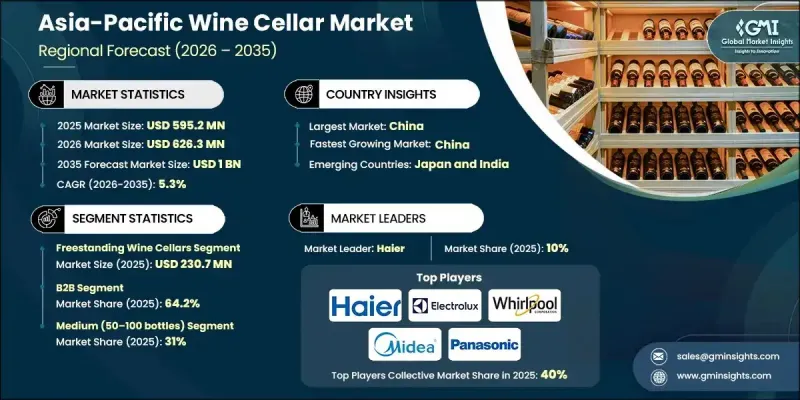
Asia-Pacific Wine Cellar Market was valued at USD 595.2 million in 2025 and is estimated to grow at a CAGR of 5.3% to reach USD 1 billion by 2035.
Rising disposable income levels, urban lifestyle shifts, and greater exposure to global wine culture are driving consistent demand for structured wine storage solutions. Consumers and commercial buyers alike are placing stronger emphasis on preserving wine quality through controlled environments. Growing awareness of proper storage conditions, supported by branding efforts and increased urban affluence, has fueled demand across residential and hospitality settings. The market also benefits from the growing popularity of premium wines and the increasing acceptance of wine as an integral part of everyday social and dining experiences. These factors collectively support the steady expansion of wine cellar installations throughout urban centers, reinforcing the market's long-term growth outlook across Asia-Pacific.
| Market Scope | |
|---|---|
| Start Year | 2025 |
| Forecast Year | 2026-2035 |
| Start Value | $595.2 Million |
| Forecast Value | $1 Billion |
| CAGR | 5.3% |
Manufacturers are responding to this demand by introducing innovative, space-efficient, and visually refined wine cellar solutions with precise temperature management. Consumer perception has shifted noticeably, as wine cellars are no longer viewed as niche luxury items but as practical additions to modern homes. Growth in the high-net-worth population further accelerates demand, as affluent buyers increasingly invest in customized, climate-controlled storage that aligns with the value of their collections. Wine collecting is widely perceived as both an investment and a symbol of status, encouraging higher spending on advanced storage systems. Integration of wine cellars into upscale residential projects further highlights their rising acceptance and market visibility.
In 2025, the B2B segment held a 64.2% share. Commercial buyers require reliable storage solutions that maintain optimal conditions for premium wine inventories. The need for advanced storage capabilities supports the dominance of this sales channel.
The medium-capacity segment, designed to store 50-100 bottles, accounts for 31% share in 2025. This category appeals to buyers seeking a balance between storage capacity and efficient use of space. Its practicality attracts both premium homeowners and commercial establishments, while rising disposable incomes across the region continue to support demand.
Japan Wine Cellar Market held an 18% share in 2025 and is expected to grow at a CAGR of 5% during 2026-2035. The market benefits from technological advancement, evolving consumer preferences, and strong purchasing power. Wine cellar solutions in the region are increasingly accessible and aligned with modern residential design trends.
Key companies operating in the Asia-Pacific Wine Cellar Market include Panasonic, Haier, Midea, Whirlpool, Electrolux, Liebherr, Miele, EuroCave, Perlick, Viking, Kadeka, Smad, Dunavo, Thermador, and Groupe Frio. Companies in the Asia-Pacific Wine Cellar Market strengthen their market position through product innovation, customization, and strategic expansion across urban centers. Manufacturers focus on advanced temperature control, energy efficiency, and sleek design to appeal to modern consumers. Partnerships with real estate developers and hospitality providers improve market penetration. Brands also invest in premium positioning and after-sales support to build customer loyalty. Expanding distribution networks and localized product offerings help address diverse regional preferences. Competitive pricing strategies combined with technology-driven differentiation enable companies to enhance visibility, increase adoption, and maintain a strong foothold in a competitive and evolving market landscape.
Table of Contents
Chapter 1 Methodology and Scope
- 1.1 Market scope and definition
- 1.2 Research design
- 1.2.1 Research approach
- 1.2.2 Data collection methods
- 1.3 Data mining sources
- 1.3.1 Regional/Country
- 1.4 Base estimates and calculations
- 1.4.1 Base year calculation
- 1.4.2 Key trends for market estimation
- 1.5 Primary research and validation
- 1.5.1 Primary sources
- 1.6 Forecast model
- 1.7 Research assumptions and limitations
Chapter 2 Executive Summary
- 2.1 Industry 360° synopsis
- 2.2 Key market trends
- 2.2.1 Country
- 2.2.2 Product Type
- 2.2.3 Capacity
- 2.2.4 Pricing
- 2.2.5 Application
- 2.2.6 Sales channel
- 2.3 CXO perspectives: Strategic imperatives
- 2.3.1 Key decision points for industry executives
- 2.3.2 Critical success factors for market players
- 2.4 Future outlook and strategic recommendations
Chapter 3 Industry Insights
- 3.1 Industry ecosystem analysis
- 3.1.1 Supplier landscape
- 3.1.2 Profit margin
- 3.1.3 Value addition at each stage
- 3.1.4 Factor affecting the value chain
- 3.2 Industry impact forces
- 3.2.1 Growth drivers
- 3.2.1.1 Rising Affluence and Premium Lifestyle Trends
- 3.2.1.2 Expansion of Wine Consumption Culture
- 3.2.1.3 Growth of Hospitality and Fine Dining Sector
- 3.2.2 Industry pitfalls & challenges
- 3.2.2.1 High Initial Investment and Maintenance Costs
- 3.2.2.2 Limited Awareness in Emerging Markets
- 3.2.3 Opportunities
- 3.2.3.1 Smart and Connected Wine Cellars
- 3.2.3.2 Growth in Residential Luxury Segment
- 3.2.1 Growth drivers
- 3.3 Growth potential analysis
- 3.4 Future market trends
- 3.5 Technology and innovation landscape
- 3.5.1 Current technological trends
- 3.5.2 Emerging technologies
- 3.6 Price trends
- 3.6.1 By Region
- 3.6.2 By Product type
- 3.7 Regulatory landscape
- 3.7.1 Standards and compliance requirements
- 3.7.2 Regional regulatory frameworks
- 3.7.3 Certification standards
- 3.8 Porter's analysis
- 3.9 PESTEL analysis
Chapter 4 Competitive Landscape, 2025
- 4.1 Introduction
- 4.2 Company market share analysis
- 4.3 Company matrix analysis
- 4.4 Competitive analysis of major market players
- 4.5 Competitive positioning matrix
- 4.6 Key developments
- 4.6.1 Mergers & acquisitions
- 4.6.2 Partnerships & collaborations
- 4.6.3 New product launches
- 4.6.4 Expansion plans
Chapter 5 Market Estimates and Forecast, By Product Type, 2022 - 2034 (USD Million) (Thousand Units)
- 5.1 Key trends
- 5.2 Freestanding wine cellars
- 5.3 Built-in wine cellars
- 5.4 Walk-in wine cellars
- 5.5 Wine walls
- 5.6 Wine cabinets
- 5.7 Others
Chapter 6 Market Estimates and Forecast, By Capacity, 2022 - 2034 (USD Million) (Thousand Units)
- 6.1 Key trends
- 6.2 Small (under 50 bottles)
- 6.3 Medium (50-100 bottles)
- 6.4 Large (100-200 bottles)
- 6.5 Extra-large (over 200 bottles)
Chapter 7 Market Estimates and Forecast, By Price, 2022 - 2034 (USD Million) (Thousand Units)
- 7.1 Key trends
- 7.2 Low-cost
- 7.3 Mass
- 7.4 Premium
Chapter 8 Market Estimates and Forecast, By Application, 2022 - 2034 (USD Million) (Thousand Units)
- 8.1 Key trends
- 8.2 Residential
- 8.3 Commercial
- 8.3.1 HoReCa
- 8.3.2 Wineries
- 8.3.3 Retailers
- 8.3.4 Others (Casino, Expo, etc.)
Chapter 9 Market Estimates and Forecast, By Sales channel , 2022 - 2034 (USD Million) (Thousand Units)
- 9.1 Key trends
- 9.2 B2B
- 9.3 B2C
Chapter 10 Market Estimates and Forecast, By Country, 2022 - 2034 (USD Million) (Thousand Units)
- 10.1 Key trends
- 10.2 China
- 10.3 Japan
- 10.4 Singapore
- 10.5 South Korea
- 10.6 Thailand
- 10.7 Australia
- 10.8 Indonesia
Chapter 11 Company Profiles
- 11.1 Haier
- 11.2 Electrolux
- 11.3 Miele
- 11.4 Liebherr
- 11.5 Whirlpool
- 11.6 Perlick
- 11.7 Viking
- 11.8 Kadeka
- 11.9 Smad
- 11.10 Dunavo
- 11.11 EuroCave
- 11.12 Thermador
- 11.13 Groupe Frio
- 11.14 Midea
- 11.15 Panasonic

