
PUBLISHER: Global Market Insights Inc. | PRODUCT CODE: 1913299

PUBLISHER: Global Market Insights Inc. | PRODUCT CODE: 1913299
Potato Processing Market Opportunity, Growth Drivers, Industry Trend Analysis, and Forecast 2026 - 2035
The Global Potato Processing Market was valued at USD 41.6 billion in 2025 and is estimated to grow at a CAGR of 5.6% to reach USD 70.5 billion by 2035.
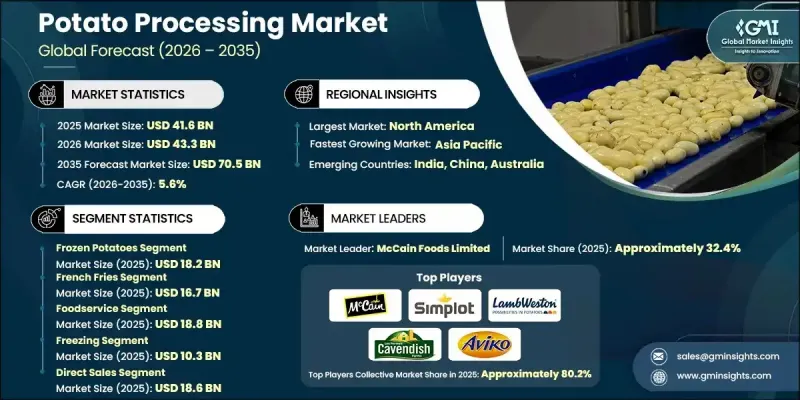
Growth is associated with rising preference for convenient and time-efficient food solutions as consumers increasingly adopt faster-paced lifestyles, particularly in urban environments. Higher purchasing power and the wider presence of organized retail channels are improving product availability and accessibility, further accelerating adoption. Demand is also being supported by the steady expansion of the global foodservice sector, which continues to rely on processed potato formats for operational efficiency and consistency. In parallel, advancements in processing and packaging technologies are enhancing product stability, quality, and safety while minimizing losses across the supply chain. These improvements are strengthening consumer confidence and encouraging repeat purchases, reinforcing long-term market momentum.
| Market Scope | |
|---|---|
| Start Year | 2025 |
| Forecast Year | 2026-2035 |
| Start Value | $41.6 Billion |
| Forecast Value | $70.5 Billion |
| CAGR | 5.6% |
The frozen potatoes segment generated USD 18.2 billion in 2025 and is projected to grow at a CAGR of 5.4% from 2026 to 2035. This segment benefits from its suitability for large-scale distribution, storage efficiency, and ease of preparation across organized retail and foodservice channels. Dehydrated potato formats are also supporting market growth due to advantages related to logistics efficiency, extended usability, and formulation flexibility within industrial food production.
The french fries segment reached USD 16.7 billion in 2025 and is expected to grow at a CAGR of 5.8% during 2026-2035. Segment growth is driven by strong demand from foodservice operations and increasing acceptance of frozen meal solutions in retail environments. Snack-oriented potato products are gaining traction due to ongoing improvements in processing methods and evolving consumer taste preferences. Application-based demand highlights the versatility of processed potatoes across multiple consumption occasions, including direct consumption formats and industrial ingredient use.
North America Potato Processing Market accounted for USD 14.2 billion in 2025. Market expansion in the region is supported by high consumption levels across retail and foodservice channels, along with well-developed cold-chain infrastructure and advanced processing capabilities. Continued focus on product consistency, portion standardization, and operational efficiency remains a key driver of regional demand.
Key companies operating in the Global Potato Processing Market include Lamb Weston Holdings, Inc., McCain Foods Limited, Cavendish Farms Corporation, J.R. Simplot Company, Aviko B.V., and other established participants. Companies active in the Global Potato Processing Market are strengthening their competitive position through capacity expansion, product innovation, and supply chain optimization. Leading players are investing in advanced processing technologies to improve efficiency, reduce waste, and ensure consistent quality at scale. Strategic partnerships with foodservice operators and retailers are helping manufacturers secure stable demand and long-term contracts. Firms are also focusing on geographic expansion and localized production to improve responsiveness and reduce logistics costs.
Table of Contents
Chapter 1 Methodology
- 1.1 Market scope and definition
- 1.2 Research design
- 1.2.1 Research approach
- 1.2.2 Data collection methods
- 1.3 Data mining sources
- 1.3.1 Global
- 1.3.2 Regional/Country
- 1.4 Base estimates and calculations
- 1.4.1 Base year calculation
- 1.4.2 Key trends for market estimation
- 1.5 Primary research and validation
- 1.5.1 Primary sources
- 1.6 Forecast model
- 1.7 Research assumptions and limitations
Chapter 2 Executive Summary
- 2.1 Industry 360° synopsis
- 2.2 Key market trends
- 2.2.1 Regional
- 2.2.2 Product Type
- 2.2.3 Application
- 2.2.4 End Use
- 2.2.5 Processing Type
- 2.2.6 Distribution Channel
- 2.3 TAM Analysis, 2026-2035
- 2.4 CXO perspectives: Strategic imperatives
- 2.4.1 Executive decision points
- 2.4.2 Critical success factors
- 2.5 Future Outlook and Strategic Recommendations
Chapter 3 Industry Insights
- 3.1 Industry ecosystem analysis
- 3.1.1 Supplier Landscape
- 3.1.2 Profit Margin
- 3.1.3 Value addition at each stage
- 3.1.4 Factor affecting the value chain
- 3.1.5 Disruptions
- 3.2 Industry impact forces
- 3.2.1 Growth drivers
- 3.2.2 Industry pitfalls and challenges
- 3.2.3 Market opportunities
- 3.3 Growth potential analysis
- 3.4 Regulatory landscape
- 3.4.1 North America
- 3.4.2 Europe
- 3.4.3 Asia Pacific
- 3.4.4 Latin America
- 3.4.5 Middle East & Africa
- 3.5 Porter's analysis
- 3.6 PESTEL analysis
- 3.7 Price trends
- 3.7.1 By region
- 3.7.2 By product
- 3.8 Future market trends
- 3.9 Technology and Innovation landscape
- 3.9.1 Current technological trends
- 3.9.2 Emerging technologies
- 3.10 Patent Landscape
- 3.11 Trade statistics (Note: the trade statistics will be provided for key countries only)
- 3.11.1 Major importing countries
- 3.11.2 Major exporting countries
- 3.12 Sustainability and Environmental Aspects
- 3.12.1 Sustainable Practices
- 3.12.2 Waste Reduction Strategies
- 3.12.3 Energy Efficiency in Production
- 3.12.4 Eco-friendly Initiatives
- 3.13 Carbon Footprint Considerations
Chapter 4 Competitive Landscape, 2025
- 4.1 Introduction
- 4.2 Company market share analysis
- 4.2.1 By region
- 4.2.1.1 North America
- 4.2.1.2 Europe
- 4.2.1.3 Asia Pacific
- 4.2.1.4 LATAM
- 4.2.1.5 MEA
- 4.2.1 By region
- 4.3 Company matrix analysis
- 4.4 Competitive analysis of major market players
- 4.5 Competitive positioning matrix
- 4.6 Key developments
- 4.6.1 Mergers & acquisitions
- 4.6.2 Partnerships & collaborations
- 4.6.3 New Product Launches
- 4.6.4 Expansion Plans
Chapter 5 Market Estimates and Forecast, By Product Type, 2022-2035 (USD Billion, Kilo Tons)
- 5.1 Key trends
- 5.2 Frozen Potatoes
- 5.3 Dehydrated Potatoes
- 5.4 Fresh Potatoes
- 5.5 Others
Chapter 6 Market Estimates and Forecast, By Application, 2022-2035 (USD Billion, Kilo Tons)
- 6.1 Key trends
- 6.2 French Fries
- 6.3 Hash Browns
- 6.4 Potato Wedges
- 6.5 Potato Flakes
- 6.6 Potato Granules
- 6.7 Potato Powder
- 6.8 Snacks
- 6.9 Others
Chapter 7 Market Estimates and Forecast, By End Use, 2022-2035 (USD Billion, Kilo Tons)
- 7.1 Key trends
- 7.2 Foodservice
- 7.2.1 Quick Service Restaurants (QSR)
- 7.2.2 Full Service Restaurants
- 7.3 Retail
- 7.3.1 Supermarkets/Hypermarkets
- 7.3.2 Convenience Stores
- 7.3.3 Online Retail
- 7.4 Industrial Use
- 7.4.1 Ingredient for Packaged Foods
- 7.4.2 Bakery & Confectionery
Chapter 8 Market Estimates and Forecast, By Processing Type, 2022-2035 (USD Billion, Kilo Tons)
- 8.1 Key trends
- 8.2 Washing & Peeling
- 8.3 Cutting & Slicing
- 8.4 Blanching
- 8.5 Drying & Dehydration
- 8.6 Freezing
- 8.7 Packaging
Chapter 9 Market Estimates and Forecast, By Distribution Channel, 2022-2035 (USD Billion, Kilo Tons)
- 9.1 Key trends
- 9.2 Direct Sales
- 9.3 Distributors
- 9.4 Online Platforms
Chapter 10 Market Estimates and Forecast, By Region, 2022-2035 (USD Billion, Kilo Tons)
- 10.1 Key trends
- 10.2 North America
- 10.2.1 U.S.
- 10.2.2 Canada
- 10.3 Europe
- 10.3.1 Germany
- 10.3.2 UK
- 10.3.3 France
- 10.3.4 Italy
- 10.3.5 Spain
- 10.3.6 Rest of Europe
- 10.4 Asia Pacific
- 10.4.1 China
- 10.4.2 India
- 10.4.3 Japan
- 10.4.4 Australia
- 10.4.5 South Korea
- 10.4.6 Rest of Asia Pacific
- 10.5 Latin America
- 10.5.1 Brazil
- 10.5.2 Mexico
- 10.5.3 Argentina
- 10.5.4 Rest of Latin America
- 10.6 Middle East & Africa
- 10.6.1 Saudi Arabia
- 10.6.2 South Africa
- 10.6.3 UAE
- 10.6.4 Rest of Middle East & Africa
Chapter 11 Company Profiles
- 11.1 McCain Foods Limited
- 11.2 Lamb Weston Holdings, Inc.
- 11.3 J.R. Simplot Company
- 11.4 The Kraft Heinz Company
- 11.5 Aviko B.V.
- 11.6 Farm Frites International B.V.
- 11.7 Idahoan Foods, LLC
- 11.8 Agristo NV
- 11.9 Cavendish Farms Corporation
- 11.10 Bergia Frites S.A.S.
- 11.11 Intersnack Group GmbH & Co. KG
- 11.12 PepsiCo, Inc.
- 11.13 AGRANA Beteiligungs-AG
- 11.14 AVEBE U.A.
- 11.15 Emsland Group

