PUBLISHER: Global Market Insights Inc. | PRODUCT CODE: 1913301

PUBLISHER: Global Market Insights Inc. | PRODUCT CODE: 1913301
Road Safety Market Opportunity, Growth Drivers, Industry Trend Analysis, and Forecast 2026 - 2035
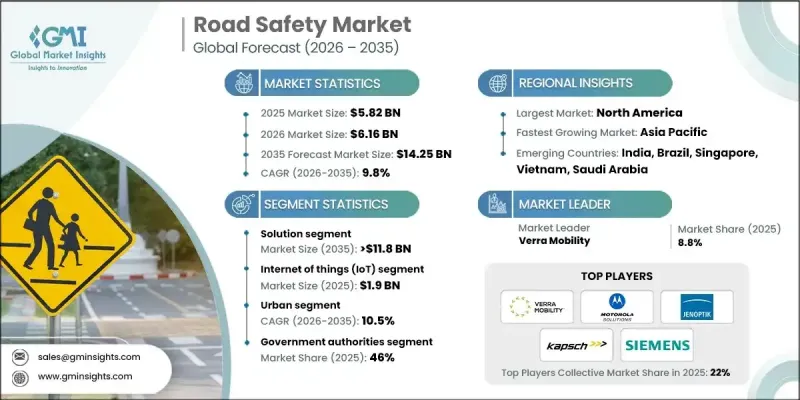
The Global Road Safety Market was valued at USD 5.82 billion in 2025 and is estimated to grow at a CAGR of 9.8% to reach USD 14.25 billion by 2035.
Market growth is supported by stronger regulatory frameworks introduced by governments worldwide, with an increasing emphasis on stricter compliance standards, improved enforcement, and long-term safety targets across road networks. Public authorities are prioritizing sustained investment in advanced road safety systems as part of broader transportation modernization programs. Rapid urban expansion, rising vehicle ownership, and increasingly congested roadways have intensified safety concerns, leading to higher demand for intelligent monitoring and data-driven risk management solutions. The growing complexity of traffic environments has increased the need for real-time visibility, automated response capabilities, and predictive safety technologies that improve traffic flow while reducing collision risks. Continuous progress in artificial intelligence, connected sensing technologies, and cloud-based platforms is enhancing the precision, scalability, and affordability of modern road safety systems. Market development is further reinforced by rising public awareness of safety, expanding urban infrastructure, and the need to manage higher traffic volumes efficiently while maintaining consistent safety standards.
| Market Scope | |
|---|---|
| Start Year | 2025 |
| Forecast Year | 2026-2035 |
| Start Value | $5.82 Billion |
| Forecast Value | $14.25 Billion |
| CAGR | 9.8% |
In 2025, the solutions segment accounted for 79% share and is projected to reach USD 11.8 billion by 2035. Road safety solutions are increasingly delivered through integrated platforms that combine monitoring, enforcement support, and analytics into cohesive systems. These platforms are enabling authorities to deploy interoperable and scalable technologies that support continuous monitoring, predictive risk evaluation, and alignment with broader smart mobility initiatives.
The internet of things segment held 33% share in 2025 and was valued at USD 1.9 billion. IoT-based road safety systems are expanding across transportation networks, enabling continuous data acquisition, connected infrastructure communication, and enhanced situational awareness to improve operational efficiency and roadway safety.
U.S. Road Safety Market was valued at USD 1.75 billion in 2025 and is expected to demonstrate strong growth between 2026 and 2035. Market expansion is supported by nationwide safety programs, increased public funding, and long-term mobility strategies that emphasize technology-enabled safety improvements across urban and intercity roads.
Key participants operating in the Global Road Safety Market include Siemens, Motorola Solutions, Kapsch TrafficCom, Verra Mobility, Conduent, Sensys Gatso, Cubic, IDEMIA, and Jenoptik. Companies active in the Road Safety Market are strengthening their competitive position by focusing on integrated technology development, large-scale deployment capability, and long-term partnerships with public authorities. Many players are investing in advanced analytics, connected platforms, and automation to deliver more accurate and proactive safety solutions. Emphasis is being placed on scalable system architectures that support expanding urban infrastructure. Firms are also pursuing geographic expansion and tailored solutions to meet regional regulatory requirements. Strategic collaborations, recurring service models, and strong post-deployment support are being used to build long-term client relationships. In addition, companies are prioritizing data security, system reliability, and compliance readiness to reinforce trust and sustain market leadership.
Table of Contents
Chapter 1 Methodology
- 1.1 Research approach
- 1.2 Quality commitments
- 1.2.1 GMI AI policy & data integrity commitment
- 1.3 Research trail & confidence scoring
- 1.3.1 Research trail components
- 1.3.2 Scoring components
- 1.4 Data collection
- 1.4.1 Partial list of primary sources
- 1.5 Data mining sources
- 1.5.1 Paid sources
- 1.6 Base estimates and calculations
- 1.6.1 Base year calculation
- 1.7 Forecast
- 1.8 Research transparency addendum
Chapter 2 Executive Summary
- 2.1 Industry 360° synopsis, 2022 - 2035
- 2.2 Key market trends
- 2.2.1 Regional
- 2.2.2 Component
- 2.2.3 Technology
- 2.2.4 Application
- 2.2.5 End Use
- 2.3 TAM Analysis, 2025-2034
- 2.4 CXO perspectives: Strategic imperatives
- 2.4.1 Executive decision points
- 2.4.2 Critical success factors
- 2.5 Future outlook & strategic recommendations
Chapter 3 Industry Insights
- 3.1 Industry ecosystem analysis
- 3.1.1 Supplier landscape
- 3.1.2 Profit margin analysis
- 3.1.3 Cost structure
- 3.1.4 Value addition at each stage
- 3.1.5 Factor affecting the value chain
- 3.1.6 Disruptions
- 3.2 Industry impact forces
- 3.2.1.1 Growth drivers
- 3.2.1.2 Regulatory enforcement expansion
- 3.2.1.3 Increasing road traffic fatalities
- 3.2.1.4 Urbanization and vehicle population growth
- 3.2.1.5 Technological advancements in AI and IoT
- 3.2.1.6 Smart city development initiatives
- 3.2.2 Industry pitfalls and challenges
- 3.2.2.1 High initial investment requirements
- 3.2.2.2 Data privacy and surveillance concerns
- 3.2.3 Market opportunities
- 3.2.3.1 Emerging Market Infrastructure Development
- 3.2.3.2 Public-Private Partnership Models
- 3.2.3.3 Integration with Autonomous and Connected Vehicles
- 3.2.3.4 Advanced Analytics and Big Data Utilization
- 3.3 Growth potential analysis
- 3.4 Regulatory landscape
- 3.4.1 North America
- 3.4.1.1 United States: SAE J328 Axle and Driveline Component Performance Requirements
- 3.4.1.2 Canada: SAE J328 Axle and Driveline Component Performance Requirements
- 3.4.2 Europe
- 3.4.2.1 United Kingdom: UNECE Regulation No. 13 Vehicle Braking and Stability Systems
- 3.4.2.2 Germany: ISO 26262 Functional Safety of Electrical and Electronic Systems in Road Vehicles
- 3.4.2.3 France: UNECE Regulation No. 79 Steering and Vehicle Control Systems
- 3.4.2.4 Italy: ISO 9001 Quality Management Systems for Differential Manufacturing
- 3.4.2.5 Spain: ISO 14001 Environmental Management Systems for Differential Production
- 3.4.3 Asia Pacific
- 3.4.3.1 China: GB/T Driveline and Axle Performance Standards for Automotive Differentials
- 3.4.3.2 Japan: ISO 26262 Functional Safety of Electrical and Electronic Systems in Road Vehicles
- 3.4.3.3 India: AIS Automotive Industry Standards for Axles and Differentials
- 3.4.4 Latin America
- 3.4.4.1 Brazil: ABNT NBR Automotive Driveline Performance Standards
- 3.4.4.2 Mexico: NOM Automotive Component Performance and Safety Standards
- 3.4.4.3 Argentina: ISO 9001 Quality Management Systems for Automotive Components
- 3.4.5 Middle East & Africa
- 3.4.5.1 United Arab Emirates: UNECE Regulation No. 13 Vehicle Braking and Stability Systems
- 3.4.5.2 South Africa: ISO 26262 Functional Safety of Electrical and Electronic Systems in Road Vehicles
- 3.4.5.3 Saudi Arabia: SASO Automotive Technical Regulations for Driveline Systems
- 3.4.1 North America
- 3.5 Porter's analysis
- 3.6 PESTEL analysis
- 3.7 Technology and innovation landscape
- 3.7.1 Current technological trends
- 3.7.2 Emerging technologies
- 3.8 Cost breakdown analysis
- 3.9 Patent analysis
- 3.10 Sustainability and environmental aspects
- 3.10.1 Sustainable practices
- 3.10.2 Waste reduction strategies
- 3.10.3 Energy efficiency in production
- 3.10.4 Eco-friendly Initiatives
- 3.11 Future market outlook & opportunities
- 3.12 Use cases
- 3.13 Road safety system architecture & deployment models
- 3.13.1 Fixed vs mobile vs temporary deployments
- 3.13.2 On-premise vs cloud-based architectures
- 3.13.3 Centralized vs decentralized command centers
- 3.13.4 Interoperability with existing ITS infrastructure
- 3.14 Procurement & contracting models
- 3.14.1 Traditional CAPEX procurement
- 3.14.2 Outcome-based / performance-linked contracts
- 3.14.3 Revenue-sharing & violation-based monetization models
- 3.14.4 Build-Operate-Transfer (BOT) and concession models
- 3.15 Economic impact & ROI assessment
- 3.16 Data governance, privacy & cybersecurity frameworks
Chapter 4 Competitive Landscape, 2025
- 4.1 Introduction
- 4.2 Company market share analysis
- 4.2.1 North America
- 4.2.2 Europe
- 4.2.3 Asia Pacific
- 4.2.4 LATAM
- 4.2.5 MEA
- 4.3 Competitive analysis of major market players
- 4.4 Competitive positioning matrix
- 4.5 Strategic outlook matrix
- 4.6 Key developments
- 4.6.1 Mergers & acquisitions
- 4.6.2 Partnerships & collaborations
- 4.6.3 New Product Launches
- 4.6.4 Expansion Plans and funding
Chapter 5 Market Estimates & Forecast, By Component, 2022 - 2035 ($Bn)
- 5.1 Key trends
- 5.2 Solutions
- 5.2.1 Enforcement
- 5.2.1.1 Red light enforcement
- 5.2.1.2 Speed enforcement
- 5.2.1.3 Bus lane enforcement
- 5.2.1.4 Section enforcement
- 5.2.2 Automatic license plate recognition (ALPR/ANPR)
- 5.2.3 Incident detection
- 5.2.4 Backoffice
- 5.2.5 Intelligent transport system
- 5.2.6 Traffic management system
- 5.2.7 Others
- 5.2.1 Enforcement
- 5.3 Services
- 5.3.1 Consulting
- 5.3.2 Support & maintenance
- 5.3.3 Integration
- 5.3.4 Deployment
Chapter 6 Market Estimates & Forecast, By Technology, 2022 - 2035 ($Bn)
- 6.1 Key trends
- 6.2 Artificial intelligence and machine learning
- 6.3 Internet of Things (IoT)
- 6.4 Computer vision
- 6.5 Radar and LiDAR
- 6.6 GPS and GNSS
- 6.7 Cloud and edge computing platforms
Chapter 7 Market Estimates & Forecast, By Application, 2022 - 2035 (USD Mn)
- 7.1 Key trends
- 7.2 Urban
- 7.3 Highway
- 7.4 Rural
- 7.5 Work zone safety
- 7.6 Others
Chapter 8 Market Estimates & Forecast, By End Use, 2022 - 2035 (USD Mn)
- 8.1 Key trends
- 8.2 Government authorities
- 8.3 Law enforcement agencies
- 8.4 Private operators
Chapter 9 Market Estimates & Forecast, By Region, 2022 - 2035 (USD Mn)
- 9.1 Key trends
- 9.2 North America
- 9.2.1 US
- 9.2.2 Canada
- 9.3 Europe
- 9.3.1 Germany
- 9.3.2 UK
- 9.3.3 France
- 9.3.4 Italy
- 9.3.5 Spain
- 9.3.6 Russia
- 9.3.7 Nordics
- 9.3.8 Portugal
- 9.3.9 Croatia
- 9.3.10 Benelux
- 9.4 Asia Pacific
- 9.4.1 China
- 9.4.2 India
- 9.4.3 Japan
- 9.4.4 Australia
- 9.4.5 South Korea
- 9.4.6 Singapore
- 9.4.7 Thailand
- 9.4.8 Indonesia
- 9.4.9 Vietnam
- 9.5 Latin America
- 9.5.1 Brazil
- 9.5.2 Mexico
- 9.5.3 Argentina
- 9.5.4 Colombia
- 9.6 MEA
- 9.6.1 South Africa
- 9.6.2 Saudi Arabia
- 9.6.3 UAE
- 9.6.4 Turkey
Chapter 10 Company Profiles
- 10.1 Global Players
- 10.1.1 Motorola Solutions
- 10.1.2 Siemens
- 10.1.3 Verra Mobility
- 10.1.4 Cubic
- 10.1.5 Jenoptik
- 10.1.6 Sensys Gatso
- 10.1.7 Conduent
- 10.1.8 FLIR Systems / Teledyne FLIR
- 10.1.9 SWARCO
- 10.1.10 VITRONIC
- 10.1.11 Kapsch TrafficCom
- 10.2 Regional Players
- 10.2.1 Redflex
- 10.2.2 Clearview Intelligence
- 10.2.3 Traffic Management Technologies
- 10.2.4 Kria
- 10.2.5 Truvelo Manufacturers
- 10.2.6 Optotraffic
- 10.2.7 Laser Technology
- 10.2.8 Syntell
- 10.2.9 Dahua Technology
- 10.2.10 Saferoad
- 10.3 Emerging / Disruptor Players
- 10.3.1 IDEMIA
- 10.3.2 INRIX
- 10.3.3 Acusensus
- 10.3.4 Nexar
- 10.3.5 Samsara
- 10.3.6 Clearpath Robotics / AMAG
- 10.3.7 Mobileye
- 10.3.8 Waycare Technologies
- 10.3.9 CARMERA

