PUBLISHER: Global Market Insights Inc. | PRODUCT CODE: 1913312

PUBLISHER: Global Market Insights Inc. | PRODUCT CODE: 1913312
Cinnamic Aldehyde Market Opportunity, Growth Drivers, Industry Trend Analysis, and Forecast 2026 - 2035
The Global Cinnamic Aldehyde Market was valued at USD 1.9 billion in 2025 and is estimated to grow at a CAGR of 5% to reach USD 3.2 billion by 2035.
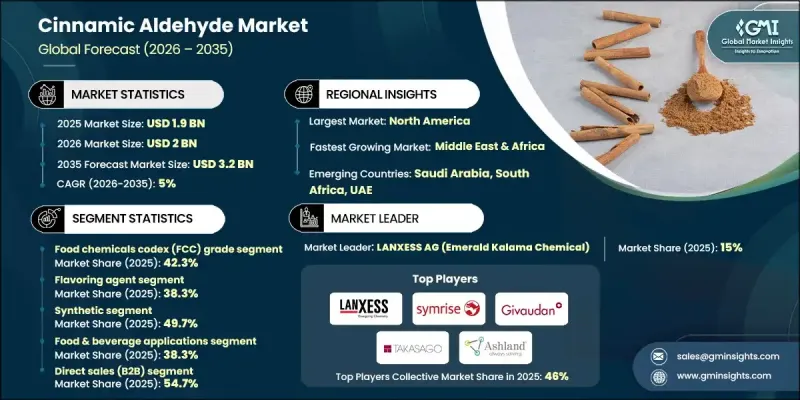
Market expansion is driven by its wide-ranging applications across food, fragrance, pharmaceutical, and industrial sectors. Both natural and synthetic varieties contribute to demand, with natural cinnamic aldehyde commanding a premium due to its extraction from plant sources. Consumers increasingly prefer natural ingredients in high-end applications, supporting steady growth. While the food and fragrance sectors remain primary contributors, emerging opportunities in pharmaceuticals, agriculture, and specialty chemicals are fostering diversification. Price variations across grades and sources provide suppliers with flexibility to meet different cost and performance requirements. Rapid adoption in Asia Pacific, fueled by growing industrial output and shifting consumer preferences, is expected to drive long-term growth, reinforced by innovation and evolving demand patterns.
| Market Scope | |
|---|---|
| Start Year | 2025 |
| Forecast Year | 2026-2035 |
| Start Value | $1.9 Billion |
| Forecast Value | $3.2 Billion |
| CAGR | 5% |
The Food Chemicals Codex (FCC) grade segment held 42.3% share in 2025 and is anticipated to grow at a CAGR of 5.2% through 2035. Its dominance is attributed to stringent purity and safety standards, making it the preferred choice for flavor applications in bakery, beverages, confectionery, and other food products. This grade ensures regulatory compliance and consistency, securing widespread adoption among global food manufacturers and flavor companies.
The flavoring agent segment held a 38.3% share in 2025 and is expected to grow at a CAGR of 5.2% from 2026 to 2035. This segment benefits from regulatory approvals, consumer preference for natural flavoring solutions, and innovation in flavor delivery technologies. Increasing demand for processed and convenient foods worldwide further supports growth in this category.
North America Cinnamic Aldehyde Market accounted for a 38.8% share in 2025. The region benefits from well-defined regulatory frameworks, enabling manufacturers to focus on innovation and compliance-driven product development. Growing consumer preference for natural, clean-label ingredients, the shift toward premium and organic food, and advances in food preservation technologies are key factors supporting market growth in the region.
Key players in the Global Cinnamic Aldehyde Market include Givaudan SA, LANXESS AG (Emerald Kalama Chemical), Aurochemicals (Group), Symrise AG, Wuxi Zhufeng Fine Chemical Co., Ltd., Vigon International, Inc., Takasago International Corporation, Ashland Global Holdings Inc., Cassia Co-op, and Advanced Biotech. Companies operating in the Global Cinnamic Aldehyde Market are adopting multiple strategies to strengthen their presence and expand their foothold. They are investing in research and development to improve extraction methods, increase purity, and develop innovative delivery systems. Strategic partnerships with flavor houses, food manufacturers, and pharmaceutical companies help broaden application areas. Firms are also expanding production capacities, entering emerging markets, and optimizing supply chains to meet global demand.
Table of Contents
Chapter 1 Methodology & Scope
- 1.1 Market scope and definition
- 1.2 Research design
- 1.2.1 Research approach
- 1.2.2 Data collection methods
- 1.3 Data mining sources
- 1.3.1 Global
- 1.3.2 Regional/Country
- 1.4 Base estimates and calculations
- 1.4.1 Base year calculation
- 1.4.2 Key trends for market estimation
- 1.5 Primary research and validation
- 1.5.1 Primary sources
- 1.6 Forecast model
- 1.7 Research assumptions and limitations
Chapter 2 Executive Summary
- 2.1 Industry 360° synopsis
- 2.2 Key market trends
- 2.2.1 Regional
- 2.2.2 Grade
- 2.2.3 Application
- 2.2.4 Source
- 2.2.5 End-use
- 2.2.6 Distribution channel
- 2.3 TAM Analysis, 2025-2035
- 2.4 CXO perspectives: Strategic imperatives
- 2.4.1 Executive decision points
- 2.4.2 Critical success factors
- 2.5 Future Outlook and Strategic Recommendations
Chapter 3 Industry Insights
- 3.1 Industry ecosystem analysis
- 3.1.1 Supplier landscape
- 3.1.2 Profit margin
- 3.1.3 Value addition at each stage
- 3.1.4 Factor affecting the value chain
- 3.1.5 Disruptions
- 3.2 Industry impact forces
- 3.2.1 Growth drivers
- 3.2.1.1 Increasing global demand for natural and clean-label food ingredients
- 3.2.1.2 Expanding use as natural antimicrobial agent in food preservation and packaging
- 3.2.1.3 Rising pharmaceutical applications and healthcare product development
- 3.2.2 Industry pitfalls and challenges
- 3.2.2.1 Skin sensitization concerns and regulatory restrictions in personal care applications
- 3.2.2.2 Price volatility of natural raw materials and supply chain constraints
- 3.2.3 Market opportunities
- 3.2.3.1 Accelerating shift toward natural and bio-based cinnamic aldehyde production
- 3.2.3.2 Expanding regulatory approval and application scope in food preservation
- 3.2.1 Growth drivers
- 3.3 Growth potential analysis
- 3.4 Regulatory landscape
- 3.4.1 North America
- 3.4.2 Europe
- 3.4.3 Asia Pacific
- 3.4.4 Latin America
- 3.4.5 Middle East & Africa
- 3.5 Porter's analysis
- 3.6 PESTEL analysis
- 3.7 Price trends
- 3.7.1 By region
- 3.7.2 By Grade
- 3.8 Future market trends
- 3.9 Technology and Innovation landscape
- 3.9.1 Current technological trends
- 3.9.2 Emerging technologies
- 3.10 Patent Landscape
- 3.11 Trade statistics (HS code)( Note: the trade statistics will be provided for key countries only)
- 3.11.1 Major importing countries
- 3.11.2 Major exporting countries
- 3.12 Sustainability and environmental aspects
- 3.12.1 Sustainable practices
- 3.12.2 Waste reduction strategies
- 3.12.3 Energy efficiency in production
- 3.12.4 Eco-friendly initiatives
- 3.13 Carbon footprint consideration
Chapter 4 Competitive Landscape, 2025
- 4.1 Introduction
- 4.2 Company market share analysis
- 4.2.1 By region
- 4.2.1.1 North America
- 4.2.1.2 Europe
- 4.2.1.3 Asia Pacific
- 4.2.1.4 LATAM
- 4.2.1.5 MEA
- 4.2.1 By region
- 4.3 Company matrix analysis
- 4.4 Competitive analysis of major market players
- 4.5 Competitive positioning matrix
- 4.6 Key developments
- 4.6.1 Mergers & acquisitions
- 4.6.2 Partnerships & collaborations
- 4.6.3 New Product Launches
- 4.6.4 Expansion Plans
Chapter 5 Market Estimates and Forecast, By Grade, 2022-2035 (USD Million) (Kilo Tons)
- 5.1 Key trends
- 5.2 Food chemicals codex (FCC) grade
- 5.3 Technical/industrial grade
- 5.4 Perfume Grade
- 5.5 Pharmaceutical/USP grade
Chapter 6 Market Estimates and Forecast, By Application, 2022-2035 (USD Million) (Kilo Tons)
- 6.1 Key trends
- 6.2 Flavoring agent
- 6.3 Fragrance agent
- 6.4 Antimicrobial/preservative agent
- 6.5 Pharmaceutical excipient
- 6.6 Industrial chemical
Chapter 7 Market Estimates and Forecast, By Source, 2022-2035 (USD Million) (Kilo Tons)
- 7.1 Key trends
- 7.2 Synthetic
- 7.3 Natural
- 7.4 Bio-based/fermentation
Chapter 8 Market Estimates and Forecast, By End Use, 2022-2035 (USD Million) (Kilo Tons)
- 8.1 Key trends
- 8.2 Food & beverage applications
- 8.2.1 Bakery & confectionery
- 8.2.2 Beverages (alcoholic & non-alcoholic)
- 8.2.3 Chewing gum
- 8.2.4 Breakfast cereals
- 8.2.5 Meat products & condiments
- 8.2.6 Others
- 8.3 Oral care & dental
- 8.3.1 Toothpaste
- 8.3.2 Mouthwash
- 8.3.3 Others
- 8.4 Fragrances & personal care
- 8.4.1 Fine fragrances
- 8.4.2 Soaps & detergents
- 8.4.3 Others
- 8.5 Agriculture & crop protection
- 8.5.1 Fungicides
- 8.5.2 Insecticides
- 8.5.3 Algaecides
- 8.5.4 Others
- 8.6 Pharmaceutical & healthcare
- 8.6.1 Drug formulations
- 8.6.2 Allergenic patch tests
- 8.7 Industrial applications
- 8.7.1 Rubber manufacturing
- 8.7.2 Electroplating
- 8.7.3 Oil & gas
- 8.7.4 Others
Chapter 9 Market Estimates and Forecast, By Distribution Channel, 2022-2035 (USD Million) (Kilo Tons)
- 9.1 Key trends
- 9.2 Direct sales (B2B)
- 9.3 Distributors & traders
- 9.4 Online B2B platforms
Chapter 10 Market Estimates and Forecast, By Region, 2022-2035 (USD Million) (Kilo Tons)
- 10.1 Key trends
- 10.2 North America
- 10.2.1 U.S.
- 10.2.2 Canada
- 10.3 Europe
- 10.3.1 Germany
- 10.3.2 UK
- 10.3.3 France
- 10.3.4 Spain
- 10.3.5 Italy
- 10.3.6 Rest of Europe
- 10.4 Asia Pacific
- 10.4.1 China
- 10.4.2 India
- 10.4.3 Japan
- 10.4.4 Australia
- 10.4.5 South Korea
- 10.4.6 Rest of Asia Pacific
- 10.5 Latin America
- 10.5.1 Brazil
- 10.5.2 Mexico
- 10.5.3 Argentina
- 10.5.4 Rest of Latin America
- 10.6 Middle East and Africa
- 10.6.1 Saudi Arabia
- 10.6.2 South Africa
- 10.6.3 UAE
- 10.6.4 Rest of Middle East and Africa
Chapter 11 Company Profiles
- 11.1 LANXESS AG (Emerald Kalama Chemical)
- 11.2 Takasago International Corporation
- 11.3 Aurochemicals (Group)
- 11.4 Symrise AG
- 11.5 Givaudan SA
- 11.6 Cassia Co-op
- 11.7 Wuxi Zhufeng Fine Chemical Co., Ltd.
- 11.8 Ashland Global Holdings Inc.
- 11.9 Vigon International, Inc.
- 11.10 Advanced Biotech
Table of Contents
Chapter 12 Methodology & Scope
- 1.1 Market scope and definition
- 1.2 Research design
- 1.2.1 Research approach
- 1.2.2 Data collection methods
- 1.3 Data mining sources
- 1.3.1 Global
- 1.3.2 Regional/Country
- 1.4 Base estimates and calculations
- 1.4.1 Base year calculation
- 1.4.2 Key trends for market estimation
- 1.5 Primary research and validation
- 1.5.1 Primary sources
- 1.6 Forecast model
- 1.7 Research assumptions and limitations
Chapter 13 Executive Summary
- 2.1 Industry 360° synopsis
- 2.2 Key market trends
- 2.2.1 Regional
- 2.2.2 Grade
- 2.2.3 Application
- 2.2.4 Source
- 2.2.5 End-use
- 2.2.6 Distribution channel
- 2.3 TAM Analysis, 2025-2035
- 2.4 CXO perspectives: Strategic imperatives
- 2.4.1 Executive decision points
- 2.4.2 Critical success factors
- 2.5 Future Outlook and Strategic Recommendations
Chapter 14 Industry Insights
- 3.1 Industry ecosystem analysis
- 3.1.1 Supplier landscape
- 3.1.2 Profit margin
- 3.1.3 Value addition at each stage
- 3.1.4 Factor affecting the value chain
- 3.1.5 Disruptions
- 3.2 Industry impact forces
- 3.2.1 Growth drivers
- 3.2.1.1 Increasing global demand for natural and clean-label food ingredients
- 3.2.1.2 Expanding use as natural antimicrobial agent in food preservation and packaging
- 3.2.1.3 Rising pharmaceutical applications and healthcare product development
- 3.2.2 Industry pitfalls and challenges
- 3.2.2.1 Skin sensitization concerns and regulatory restrictions in personal care applications
- 3.2.2.2 Price volatility of natural raw materials and supply chain constraints
- 3.2.3 Market opportunities
- 3.2.3.1 Accelerating shift toward natural and bio-based cinnamic aldehyde production
- 3.2.3.2 Expanding regulatory approval and application scope in food preservation
- 3.2.1 Growth drivers
- 3.3 Growth potential analysis
- 3.4 Regulatory landscape
- 3.4.1 North America
- 3.4.2 Europe
- 3.4.3 Asia Pacific
- 3.4.4 Latin America
- 3.4.5 Middle East & Africa
- 3.5 Porter's analysis
- 3.6 PESTEL analysis
- 3.7 Price trends
- 3.7.1 By region
- 3.7.2 By Grade
- 3.8 Future market trends
- 3.9 Technology and Innovation landscape
- 3.9.1 Current technological trends
- 3.9.2 Emerging technologies
- 3.10 Patent Landscape
- 3.11 Trade statistics (HS code)
( Note: the trade statistics will be provided for key countries only)
- 3.11.1 Major importing countries
- 3.11.2 Major exporting countries
- 3.12 Sustainability and environmental aspects
- 3.12.1 Sustainable practices
- 3.12.2 Waste reduction strategies
- 3.12.3 Energy efficiency in production
- 3.12.4 Eco-friendly initiatives
- 3.13 Carbon footprint consideration
Chapter 15 Competitive Landscape, 2025
- 4.1 Introduction
- 4.2 Company market share analysis
- 4.2.1 By region
- 4.2.1.1 North America
- 4.2.1.2 Europe
- 4.2.1.3 Asia Pacific
- 4.2.1.4 LATAM
- 4.2.1.5 MEA
- 4.2.1 By region
- 4.3 Company matrix analysis
- 4.4 Competitive analysis of major market players
- 4.5 Competitive positioning matrix
- 4.6 Key developments
- 4.6.1 Mergers & acquisitions
- 4.6.2 Partnerships & collaborations
- 4.6.3 New Product Launches
- 4.6.4 Expansion Plans
Chapter 16 Market Estimates and Forecast, By Grade, 2022-2035 (USD Million) (Kilo Tons)
- 5.1 Key trends
- 5.2 Food chemicals codex (FCC) grade
- 5.3 Technical/industrial grade
- 5.4 Perfume Grade
- 5.5 Pharmaceutical/USP grade
Chapter 17 Market Estimates and Forecast, By Application, 2022-2035 (USD Million) (Kilo Tons)
- 6.1 Key trends
- 6.2 Flavoring agent
- 6.3 Fragrance agent
- 6.4 Antimicrobial/preservative agent
- 6.5 Pharmaceutical excipient
- 6.6 Industrial chemical
Chapter 18 Market Estimates and Forecast, By Source, 2022-2035 (USD Million) (Kilo Tons)
- 7.1 Key trends
- 7.2 Synthetic
- 7.3 Natural
- 7.4 Bio-based/fermentation
Chapter 19 Market Estimates and Forecast, By End Use, 2022-2035 (USD Million) (Kilo Tons)
- 8.1 Key trends
- 8.2 Food & beverage applications
- 8.2.1 Bakery & confectionery
- 8.2.2 Beverages (alcoholic & non-alcoholic)
- 8.2.3 Chewing gum
- 8.2.4 Breakfast cereals
- 8.2.5 Meat products & condiments
- 8.2.6 Others
- 8.3 Oral care & dental
- 8.3.1 Toothpaste
- 8.3.2 Mouthwash
- 8.3.3 Others
- 8.4 Fragrances & personal care
- 8.4.1 Fine fragrances
- 8.4.2 Soaps & detergents
- 8.4.3 Others
- 8.5 Agriculture & crop protection
- 8.5.1 Fungicides
- 8.5.2 Insecticides
- 8.5.3 Algaecides
- 8.5.4 Others
- 8.6 Pharmaceutical & healthcare
- 8.6.1 Drug formulations
- 8.6.2 Allergenic patch tests
- 8.7 Industrial applications
- 8.7.1 Rubber manufacturing
- 8.7.2 Electroplating
- 8.7.3 Oil & gas
- 8.7.4 Others
Chapter 20 Market Estimates and Forecast, By Distribution Channel, 2022-2035 (USD Million) (Kilo Tons)
- 9.1 Key trends
- 9.2 Direct sales (B2B)
- 9.3 Distributors & traders
- 9.4 Online B2B platforms
Chapter 21 Market Estimates and Forecast, By Region, 2022-2035 (USD Million) (Kilo Tons)
- 10.1 Key trends
- 10.2 North America
- 10.2.1 U.S.
- 10.2.2 Canada
- 10.3 Europe
- 10.3.1 Germany
- 10.3.2 UK
- 10.3.3 France
- 10.3.4 Spain
- 10.3.5 Italy
- 10.3.6 Rest of Europe
- 10.4 Asia Pacific
- 10.4.1 China
- 10.4.2 India
- 10.4.3 Japan
- 10.4.4 Australia
- 10.4.5 South Korea
- 10.4.6 Rest of Asia Pacific
- 10.5 Latin America
- 10.5.1 Brazil
- 10.5.2 Mexico
- 10.5.3 Argentina
- 10.5.4 Rest of Latin America
- 10.6 Middle East and Africa
- 10.6.1 Saudi Arabia
- 10.6.2 South Africa
- 10.6.3 UAE
- 10.6.4 Rest of Middle East and Africa
Chapter 22 Company Profiles
- 11.1 LANXESS AG (Emerald Kalama Chemical)
- 11.2 Takasago International Corporation
- 11.3 Aurochemicals (Group)
- 11.4 Symrise AG
- 11.5 Givaudan SA
- 11.6 Cassia Co-op
- 11.7 Wuxi Zhufeng Fine Chemical Co., Ltd.
- 11.8 Ashland Global Holdings Inc.
- 11.9 Vigon International, Inc.
- 11.10 Advanced Biotech

