PUBLISHER: Global Market Insights Inc. | PRODUCT CODE: 1913329

PUBLISHER: Global Market Insights Inc. | PRODUCT CODE: 1913329
Train Seat Market Opportunity, Growth Drivers, Industry Trend Analysis, and Forecast 2026 - 2035
The Global Train Seat Market was valued at USD 2.98 billion in 2025 and is estimated to grow at a CAGR of 4.4% to reach USD 4.56 billion by 2035.
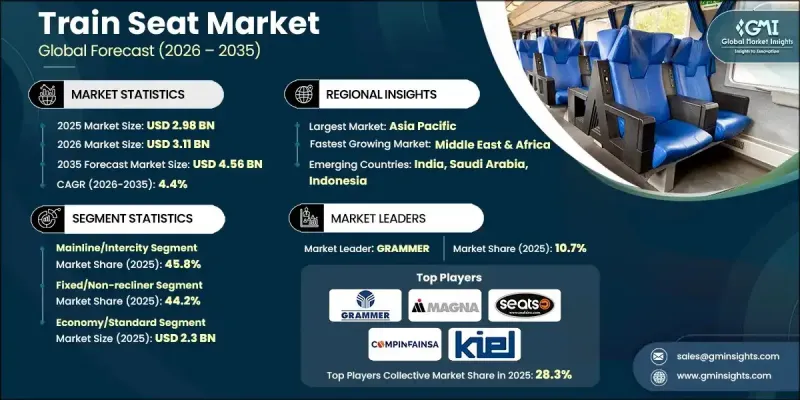
Increasing investments in high-speed rail, metro, and monorail systems are driving demand for train seats that combine comfort, durability, and advanced functionality. Although trains currently account for roughly 8% of global passenger transport, the development of modern rail networks and the replacement of aging locomotives and coaches is elevating seat requirements. The rising adoption of advanced train configurations such as bullet trains, double-deckers, and urban rapid transit has created demand for seats with integrated technology features, including USB charging ports, personal entertainment modules, and wireless connectivity. These innovations improve passenger experience and open opportunities for manufacturers to differentiate their offerings, expand product portfolios, and cater to evolving urban and intercity rail demands.
| Market Scope | |
|---|---|
| Start Year | 2025 |
| Forecast Year | 2026-2035 |
| Start Value | $2.98 Billion |
| Forecast Value | $4.56 Billion |
| CAGR | 4.4% |
The fixed/non-recliner segment held a 44.2% share in 2025 and is projected to reach USD 1.8 billion by 2035. Fixed seats dominate due to their cost-effectiveness and ability to accommodate high passenger volumes, particularly in urban and suburban commuter trains. This design ensures optimal space utilization per carriage while keeping operational costs manageable for rail operators.
The economy/standard segment reached USD 2.3 billion in 2025. Economy seats are designed for maximum capacity, featuring compact footprints and tighter seat pitches, allowing operators to meet peak-hour commuting demand efficiently while maintaining affordability. These seats are widely adopted in high-density rail networks where passenger volume is prioritized over luxury features.
North America Train Seat Market is expected to reach USD 737.5 million by 2035, growing at a CAGR of 2.2% between 2026 and 2035. The region's expansion of high-speed rail projects and urban transit systems is driving demand for seats capable of enduring high-speed travel while providing enhanced comfort and durability. Increasing investment in premium seating options is also fueling market growth as operators balance passenger comfort with performance requirements.
Leading companies operating in the Global Train Seat Market include GRAMMER, Magna, Kiel, Seats, Compin-Fainsa, Freedman Seating, Shanghai Tanda, Saira Seats, Transcal, and American Seating. Companies in the Global Train Seat Market are strengthening their foothold through innovation, strategic partnerships, and regional expansion. Manufacturers are developing ergonomic designs, lightweight materials, and technology-enabled seats with integrated charging, entertainment, and connectivity features. Collaboration with rail operators allows early adoption in new train models and retrofitting projects. Firms are also enhancing production capabilities and standardization to meet global quality and safety standards.
Table of Contents
Chapter 1 Methodology
- 1.1 Research approach
- 1.2 Quality commitments
- 1.2.1 GMI AI policy & data integrity commitment
- 1.3 Research trail & confidence scoring
- 1.3.1 Research trail components
- 1.3.2 Scoring components
- 1.4 Data collection
- 1.4.1 Partial list of primary sources
- 1.5 Data mining sources
- 1.5.1 Paid sources
- 1.6 Base estimates and calculations
- 1.6.1 Base year calculation
- 1.7 Forecast model
- 1.8 Research transparency addendum
Chapter 2 Executive Summary
- 2.1 Industry 360° synopsis
- 2.2 Key market trends
- 2.2.1 Regional
- 2.2.2 Train
- 2.2.3 Seat
- 2.2.4 Class
- 2.2.5 Ownership
- 2.2.6 Distribution Channel
- 2.3 TAM analysis, 2026-2035
- 2.4 CXO perspectives: Strategic imperatives
- 2.4.1 Executive decision points
- 2.4.2 Critical success factors
- 2.5 Future outlook and recommendations
Chapter 3 Industry Insights
- 3.1 Industry ecosystem analysis
- 3.1.1 Supplier landscape
- 3.1.2 Profit margin
- 3.1.3 Cost structure
- 3.1.4 Value addition at each stage
- 3.1.5 Factor affecting the value chain
- 3.1.6 Disruptions
- 3.2 Industry impact forces
- 3.2.1 Growth drivers
- 3.2.1.1 Growing urbanization and daily commuter rail demand
- 3.2.1.2 Expansion of high-speed and metro rail networks
- 3.2.1.3 Rising investment in rail infrastructure modernization
- 3.2.1.4 Increasing focus on passenger comfort & safety
- 3.2.2 Industry pitfalls and challenges
- 3.2.2.1 Lengthy railway procurement and approval cycles
- 3.2.2.2 Stringent certification and compliance requirements
- 3.2.3 Market opportunities
- 3.2.3.1 Increasing demand for smart and connected train seats
- 3.2.3.2 Growth of high-speed rail projects in emerging economies
- 3.2.3.3 Custom seating solutions for urban transit and metro systems
- 3.2.3.4 Retrofit opportunities in mature rail markets
- 3.2.1 Growth drivers
- 3.3 Growth potential analysis
- 3.4 Regulatory landscape
- 3.4.1 North America
- 3.4.1.1 FRA Interior Occupant Protection Guidelines
- 3.4.1.2 Americans with Disabilities Act (ADA) Accessibility Requirements
- 3.4.1.3 APTA (American Public Transportation Association) Standards
- 3.4.1.4 Federal Railroad Administration (FRA) Safety Appliance Standards
- 3.4.2 Europe
- 3.4.2.1 TSI (Technical Specifications for Interoperability)
- 3.4.2.2 Railway Vehicle Crashworthiness Standard
- 3.4.2.3 EN 12299 - Ride Comfort for Passengers Standard
- 3.4.3 Asia Pacific
- 3.4.3.1 Indian Railways Act, 1989
- 3.4.3.2 China Regulation on the Administration of Railway Safety
- 3.4.3.3 Rail Safety Act / Safety Management System Regulations
- 3.4.4 Latin America
- 3.4.4.1 Agencia Reguladora del Transporte Ferroviario (ARTF) Standards
- 3.4.4.2 Agencia Nacional de Transportes Terrestres (ANTT)
- 3.4.4.3 National Infrastructure Agency (ANI) Railway Norms
- 3.4.5 Middle East & Africa
- 3.4.5.1 Gulf Cooperation Council Railways Authority Guidelines
- 3.4.5.2 UIC (International Union of Railways) Standards
- 3.4.5.3 Urban Metro Technical Standards in Gulf States
- 3.4.1 North America
- 3.5 Porter's analysis
- 3.6 PESTEL analysis
- 3.7 Technology and innovation landscape
- 3.7.1 Current technological trends
- 3.7.2 Emerging technologies
- 3.8 Price trends
- 3.8.1 By region
- 3.8.2 By product
- 3.9 Production statistics
- 3.9.1 Production hubs
- 3.9.2 Consumption hubs
- 3.9.3 Export and import
- 3.10 Cost breakdown analysis
- 3.11 Sustainability and environmental impact
- 3.11.1 Sustainable practices
- 3.11.2 Waste reduction strategies
- 3.11.3 Energy efficiency in production
- 3.11.4 Eco-friendly initiatives
- 3.11.5 Carbon footprint considerations
- 3.12 Case studies
- 3.13 Capacity and utilization metrics
- 3.13.1 Global installed capacity vs. utilization rates
- 3.13.2 Capacity expansions by key hubs
- 3.13.3 Bottlenecks in high-speed seat manufacturing
- 3.13.4 Inventory and order backlog trends
- 3.14 Segment penetration metrics
- 3.14.1 Recliner seat penetration in intercity routes
- 3.14.2 Folding seat adoption in light rail/trams
- 3.14.3 Premium class penetration in emerging markets
- 3.14.4 Smart seat uptake by urban transit operators
- 3.14.5 High-speed vs. metro seat replacement cycles
- 3.15 Comfort metrics (ergonomics, spacing, cushioning)
- 3.15.1 Ride quality impact by seat design
- 3.15.2 Passenger satisfaction and ridership linkage
- 3.15.3 Differentiation in premium vs commuter services
- 3.16 Future outlook & opportunities
Chapter 4 Competitive Landscape, 2025
- 4.1 Introduction
- 4.2 Company market share analysis
- 4.2.1 North America
- 4.2.2 Europe
- 4.2.3 Asia Pacific
- 4.2.4 LATAM
- 4.2.5 MEA
- 4.3 Competitive analysis of major market players
- 4.4 Competitive positioning matrix
- 4.5 Strategic outlook matrix
- 4.6 Key developments
- 4.6.1 Mergers & acquisitions
- 4.6.2 Partnerships & collaborations
- 4.6.3 New product launches
- 4.6.4 Expansion plans and funding
Chapter 5 Market Estimates & Forecast, By Train, 2022 - 2035 ($Bn, Units)
- 5.1 Key trends
- 5.2 Mainline/Intercity
- 5.2.1 Sleeper Seats/Berths
- 5.2.1.1 First Class Sleepers (private cabins)
- 5.2.1.2 Second Class Sleepers (shared compartments)
- 5.2.1.3 Couchette seats
- 5.2.2 Chair car
- 5.2.2.1 Executive/First Class
- 5.2.2.2 AC Chair Car
- 5.2.2.3 Second Class Seating
- 5.2.1 Sleeper Seats/Berths
- 5.3 High-speed/bullet trains
- 5.3.1 Business/First Class
- 5.3.2 Standard Class
- 5.3.3 Green Car/Premium Economy
- 5.4 Metropolitan/Urban
- 5.4.1 Metro/Subway Seats
- 5.4.2 Light Rail/Tram Seats
Chapter 6 Market Estimates & Forecast, By Seat, 2022 - 2035 ($Bn, Units)
- 6.1 Key trends
- 6.2 Fixed/non-recliner
- 6.3 Recliner
- 6.4 Folding
- 6.5 Sleeper/Couchette
Chapter 7 Market Estimates & Forecast, By Class, 2022 - 2035 ($Bn, Units)
- 7.1 Key trends
- 7.2 Economy/standard
- 7.3 Premium/luxury
Chapter 8 Market Estimates & Forecast, By Ownership, 2022 - 2035 ($Bn, Units)
- 8.1 Key trends
- 8.2 Public
- 8.3 Private
Chapter 9 Market Estimates & Forecast, By Distribution Channel, 2022 - 2035 ($Bn, Units)
- 9.1 Key trends
- 9.2 OEM
- 9.3 Aftermarket
Chapter 10 Market Estimates & Forecast, By Region, 2022 - 2035 ($Bn, Units)
- 10.1 Key trends
- 10.2 North America
- 10.2.1 US
- 10.2.2 Canada
- 10.3 Europe
- 10.3.1 Germany
- 10.3.2 UK
- 10.3.3 France
- 10.3.4 Italy
- 10.3.5 Spain
- 10.3.6 Russia
- 10.3.7 Nordics
- 10.3.8 Benelux
- 10.4 Asia Pacific
- 10.4.1 China
- 10.4.2 India
- 10.4.3 Japan
- 10.4.4 South Korea
- 10.4.5 ANZ
- 10.4.6 Singapore
- 10.4.7 Malaysia
- 10.4.8 Indonesia
- 10.4.9 Vietnam
- 10.4.10 Thailand
- 10.5 Latin America
- 10.5.1 Brazil
- 10.5.2 Mexico
- 10.5.3 Argentina
- 10.5.4 Colombia
- 10.6 MEA
- 10.6.1 South Africa
- 10.6.2 Saudi Arabia
- 10.6.3 UAE
Chapter 11 Company Profiles
- 11.1 Global companies
- 11.1.1 GRAMMER
- 11.1.2 Compin-Fainsa
- 11.1.3 Kiel
- 11.1.4 Freedman Seating Company
- 11.1.5 Magna International
- 11.1.6 Seats
- 11.1.7 Transcal
- 11.1.8 American Seating
- 11.1.9 Lazzerini
- 11.1.10 Saira Seats
- 11.1.11 Fisa
- 11.1.12 Sears Seating
- 11.1.13 Fenix
- 11.1.14 Harita Seating System
- 11.1.15 Quantum Seating
- 11.1.16 Forvia
- 11.2 Regional companies
- 11.2.1 Pinnacle Industries
- 11.2.2 Oriental Rail Infrastructure
- 11.2.3 McConnell
- 11.2.4 Styleride Seating
- 11.2.5 Shanghai Tanda
- 11.3 Emerging companies
- 11.3.1 KTK
- 11.3.2 GINYO Transport
- 11.3.3 Aisin Shiroki
- 11.3.4 Delta Furniture
- 11.3.5 Rescroft

