PUBLISHER: Global Market Insights Inc. | PRODUCT CODE: 1913336

PUBLISHER: Global Market Insights Inc. | PRODUCT CODE: 1913336
Plant-Based Bars Market Opportunity, Growth Drivers, Industry Trend Analysis, and Forecast 2026 - 2035
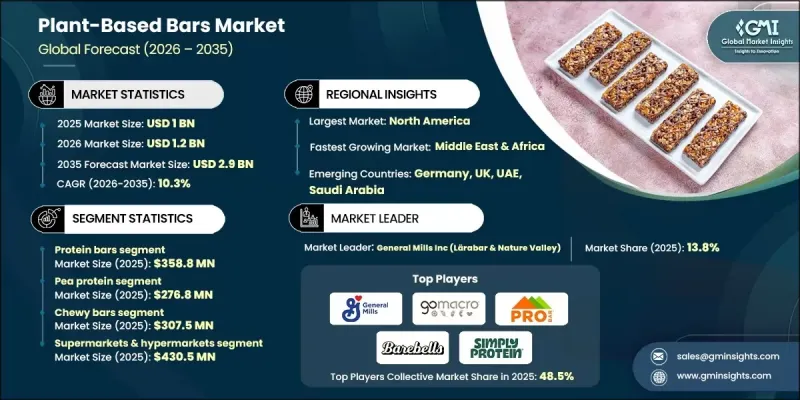
The Global Plant-Based Bars Market was valued at USD 1 billion in 2025 and is estimated to grow at a CAGR of 10.3% to reach USD 2.9 billion by 2035.
The market is gaining steady momentum as consumers increasingly gravitate toward plant-based nutrition and flexitarian eating patterns. Growing understanding of the health and sustainability benefits associated with plant-focused diets is encouraging a gradual reduction in animal protein intake, which is broadening the consumer base for plant-based bars. Demand is further supported by the rising preference for portable, allergen-friendly, clean-label, and easy-to-consume snack options among both health-driven and mainstream buyers. Heightened focus on personal wellness is also shaping purchasing behavior, with consumers actively seeking functional snack options that support cardiovascular health, weight management, and overall physical balance. Plant-based bars positioned as protein-rich, fiber-dense, and naturally sourced products align well with evolving lifestyle priorities centered on preventive health. Increasing participation in fitness-oriented routines and physically active lifestyles continues to stimulate demand, as plant-based bars are widely chosen for convenient protein intake, energy replenishment, and muscle support. Manufacturers are responding by developing formulations centered on performance-focused and functional nutrition benefits.
| Market Scope | |
|---|---|
| Start Year | 2025 |
| Forecast Year | 2026-2035 |
| Start Value | $1 Billion |
| Forecast Value | $2.9 Billion |
| CAGR | 10.3% |
The protein bars segment reached USD 358.8 million in 2025. This product category leads the overall segmentation due to its strong alignment with consumer demand for nutrition-forward and lifestyle-oriented snack products. Protein bars are widely perceived as practical options for consumption between meals, post-activity recovery, and prolonged satiety, which has strengthened their appeal among fitness-focused individuals as well as flexitarian consumers seeking non-animal protein alternatives.
The pea protein segment generated USD 276.8 million in 2025. Its widespread adoption is driven by its favorable nutritional profile, neutral sensory characteristics, and broad consumer acceptance. High digestibility and a well-balanced amino acid composition make pea protein suitable for individuals with dietary sensitivities, particularly those avoiding common allergens. Its formulation versatility allows producers to achieve desirable texture and consistency while supporting clean-label positioning and non-GMO claims, reinforcing its role in plant-based, protein-enriched snack products.
North America Plant-Based Bars Market represented 42% share in 2025, with the United States accounting for the majority share within the region. The U.S. market benefits from a large population of wellness-focused consumers, a mature packaged snack ecosystem, and strong distribution through both physical retail and digital channels. High awareness of plant-based eating patterns, coupled with a deeply ingrained fitness and wellness culture, continues to support product adoption. Expanding product assortments, frequent new launches, and strong visibility across online platforms further strengthen market penetration in the U.S., making it a key growth engine for plant-based bar manufacturers.
Key companies active in the Global Plant-Based Bars Market include PROBAR, Inc, BHU Foods, Barebells, Simply Protein, General Mills Inc., through its Larabar and Nature Valley brands, Rise Bar, NuGo Nutrition, Raw Rev, Orgain, GoMacro, No Cow, Numix, Nutree Life, and others operating across global and regional markets. Companies operating in the Global Plant-Based Bars Market are strengthening their market position by prioritizing product innovation focused on protein quality, functional benefits, and ingredient transparency. Many brands are investing in research to refine formulations that enhance taste, texture, and nutritional density while maintaining clean-label standards. Expansion across U.S. retail formats, including specialty health stores and direct-to-consumer platforms, remains a core strategy. Firms are also leveraging targeted marketing that emphasizes lifestyle alignment, fitness support, and everyday convenience. Strategic pricing, sustainable sourcing narratives, and portfolio diversification aimed at different consumer needs are being used to deepen brand loyalty and expand reach across the U.S. market.
Table of Contents
Chapter 1 Methodology & Scope
- 1.1 Market scope and definition
- 1.2 Research design
- 1.2.1 Research approach
- 1.2.2 Data collection methods
- 1.3 Data mining sources
- 1.3.1 Global
- 1.3.2 Regional/Country
- 1.4 Base estimates and calculations
- 1.4.1 Base year calculation
- 1.4.2 Key trends for market estimation
- 1.5 Primary research and validation
- 1.5.1 Primary sources
- 1.6 Forecast model
- 1.7 Research assumptions and limitations
Chapter 2 Executive Summary
- 2.1 Industry 3600 synopsis
- 2.2 Key market trends
- 2.2.1 Regional
- 2.2.2 Product Type
- 2.2.3 Source
- 2.2.4 Processing Method
- 2.2.5 Distribution Channel
- 2.3 TAM Analysis, 2026-2035
- 2.4 CXO perspectives: Strategic imperatives
- 2.4.1 Executive decision points
- 2.4.2 Critical success factors
- 2.5 Future Outlook and Strategic Recommendations
Chapter 3 Industry Insights
- 3.1 Industry ecosystem analysis
- 3.1.1 Supplier Landscape
- 3.1.2 Profit Margin
- 3.1.3 Value addition at each stage
- 3.1.4 Factor affecting the value chain
- 3.1.5 Disruptions
- 3.2 Industry impact forces
- 3.2.1 Growth drivers
- 3.2.1.1 Rising consumer demand for plant-based nutrition & flexitarian diets
- 3.2.1.2 Growing health & wellness consciousness
- 3.2.1.3 Sports nutrition & active lifestyle market expansion
- 3.2.2 Industry pitfalls and challenges
- 3.2.2.1 Shelf life & stability issues with clean label formulations
- 3.2.2.2 Supply chain volatility for specialty plant proteins
- 3.2.3 Market opportunities
- 3.2.3.1 Institutional & foodservice channel expansion
- 3.2.3.2 Sustainable packaging innovation & premium positioning
- 3.2.1 Growth drivers
- 3.3 Growth potential analysis
- 3.4 Regulatory landscape
- 3.4.1 North America
- 3.4.2 Europe
- 3.4.3 Asia Pacific
- 3.4.4 Latin America
- 3.4.5 Middle East & Africa
- 3.5 Porter's analysis
- 3.6 PESTEL analysis
- 3.7 Price trends
- 3.7.1 By region
- 3.7.2 Product type
- 3.8 Future market trends
- 3.9 Technology and Innovation Landscape
- 3.9.1 Current technological trends
- 3.9.2 Emerging technologies
- 3.10 Patent Landscape
- 3.11 Trade statistics (HS code) (Note: the trade statistics will be provided for key countries only)
- 3.11.1 Major importing countries
- 3.11.2 Major exporting countries
- 3.12 Sustainability and environmental aspects
- 3.12.1 Sustainable practices
- 3.12.2 Waste reduction strategies
- 3.12.3 Energy efficiency in production
- 3.12.4 Eco-friendly initiatives
- 3.13 Carbon footprint considerations
Chapter 4 Competitive Landscape, 2025
- 4.1 Introduction
- 4.2 Company market share analysis
- 4.2.1 By region
- 4.2.1.1 North America
- 4.2.1.2 Europe
- 4.2.1.3 Asia Pacific
- 4.2.1.4 LATAM
- 4.2.1.5 MEA
- 4.2.1 By region
- 4.3 Company matrix analysis
- 4.4 Competitive analysis of major market players
- 4.5 Competitive positioning matrix
- 4.6 Key developments
- 4.6.1 Mergers & acquisitions
- 4.6.2 Partnerships & collaborations
- 4.6.3 New product launches
- 4.6.4 Expansion plans
Chapter 5 Market Estimates and Forecast, By Product Type, 2022 - 2035 (USD Million) (Units)
- 5.1 Key trends
- 5.2 Cereal & granola bars
- 5.3 Protein bars
- 5.4 Energy bars
- 5.5 Meal replacement bars
- 5.6 Fruits & nuts bars
- 5.7 Others
Chapter 6 Market Estimates and Forecast, By Source, 2022 - 2035 (USD Million) (Units)
- 6.1 Key trends
- 6.2 Soy protein
- 6.3 Pea protein
- 6.4 Rice protein
- 6.5 Wheat protein
- 6.6 Nut proteins
- 6.6.1 Almond
- 6.6.2 Cashew
- 6.6.3 Peanut
- 6.7 Others
Chapter 7 Market Estimates and Forecast, By Processing Method, 2022 - 2035 (USD Million) (Units)
- 7.1 Key trends
- 7.2 Chewy bars
- 7.3 Crunchy bars
- 7.4 Soft-baked bars
- 7.5 Raw & cold-pressed bars
- 7.6 Extruded bars
- 7.7 Binder-free bars
Chapter 8 Market Estimates and Forecast, By Distribution Channel, 2022 - 2035 (USD Million) (Units)
- 8.1 Key trends
- 8.2 Supermarkets & hypermarkets
- 8.3 Convenience stores
- 8.4 Specialty & health food stores
- 8.5 Online retail & e-commerce
- 8.6 Others
Chapter 9 Market Estimates and Forecast, By Region, 2022 - 2035 (USD Million) (Units)
- 9.1 Key trends
- 9.2 North America
- 9.2.1 U.S.
- 9.2.2 Canada
- 9.3 Europe
- 9.3.1 Germany
- 9.3.2 UK
- 9.3.3 France
- 9.3.4 Spain
- 9.3.5 Italy
- 9.3.6 Rest of Europe
- 9.4 Asia Pacific
- 9.4.1 China
- 9.4.2 India
- 9.4.3 Japan
- 9.4.4 Australia
- 9.4.5 South Korea
- 9.4.6 Rest of Asia Pacific
- 9.5 Latin America
- 9.5.1 Brazil
- 9.5.2 Mexico
- 9.5.3 Rest of Latin America
- 9.6 Middle East and Africa
- 9.6.1 Saudi Arabia
- 9.6.2 South Africa
- 9.6.3 UAE
- 9.6.4 Rest of Middle East and Africa
Chapter 10 Company Profiles
- 10.1 BHU Foods
- 10.2 PROBAR, Inc
- 10.3 Barebells
- 10.4 General Mills Inc (Larabar & Nature Valley)
- 10.5 Simply Protein
- 10.6 NuGo Nutrition
- 10.7 Rise Bar
- 10.8 Raw Rev
- 10.9 GoMacro
- 10.10 Orgain
- 10.11 No Cow
- 10.12 Nutree Life
- 10.13 Numix

