
PUBLISHER: Global Market Insights Inc. | PRODUCT CODE: 1913346

PUBLISHER: Global Market Insights Inc. | PRODUCT CODE: 1913346
Shipping Containers Market Opportunity, Growth Drivers, Industry Trend Analysis, and Forecast 2026 - 2035
The Global Shipping Containers Market was valued at USD 11.2 billion in 2025 and is estimated to grow at a CAGR of 4.1% to reach USD 16.7 billion by 2035.
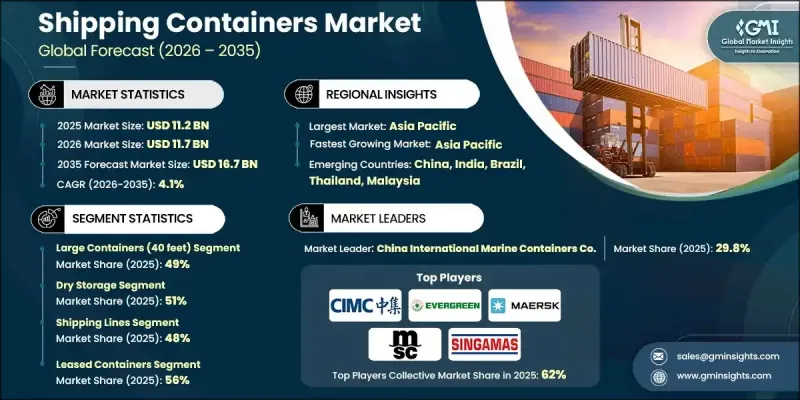
The growth is driven by sustained expansion in international trade involving consumer merchandise, industrial outputs, and raw materials. Strong manufacturing output across Asian economies, rising reliance on imports among developed nations, and the growing complexity of global supply chains are contributing to higher volumes of containerized freight. These dynamics are supporting ongoing demand for new container production, replacement of aging fleets, and increased container leasing activity worldwide. Global containerized trade volumes in 2025 demonstrated solid momentum, recording growth in the range of 3.5% to 4.2%, which reinforced long-term confidence in container demand across shipping networks.
| Market Scope | |
|---|---|
| Start Year | 2025 |
| Forecast Year | 2026-2035 |
| Start Value | $11.2 Billion |
| Forecast Value | $16.7 Billion |
| CAGR | 4.1% |
Rapid expansion of global e-commerce has significantly increased container-based transportation, particularly for high-volume retail and technology-driven goods. The acceleration of online cross-border trade has intensified the need for flexible and scalable logistics solutions, encouraging wider adoption of dry and high-cube containers across maritime, rail, and intermodal transport systems. In response to fluctuating freight demand, shipping operators are increasingly favoring container leasing models to limit capital exposure and improve operational agility. Leasing enables faster fleet adjustments, better cost control, and improved cash flow efficiency.
The large containers measuring 40 feet segment held 49% share in 2025 and is forecast to grow at a CAGR of 3% from 2026 to 2035. These containers remain the global standard due to their higher cargo capacity compared to 20-foot units, making them suitable for transporting bulk consumer and industrial shipments. Their ability to carry larger loads improves cost efficiency and supports economies of scale in long-distance and intermodal transportation.
The dry storage containers segment held 51% share in 2025 and is expected to grow at a CAGR of 3% through 2035. These containers are widely used for transporting general cargo and are favored for their durability, cost-effectiveness, and ability to protect goods from environmental exposure. Their compatibility with sea, rail, and land transport continues to make them essential to global logistics operations.
US Shipping Containers Market reached USD 1.51 billion in 2025. Growth is being fueled by higher retail imports and expanding e-commerce activity, which are increasing demand for both leased and owned containers. Investments in port infrastructure and improved intermodal connectivity are enhancing container throughput. Companies operating across domestic and international supply chains are increasingly deploying higher-capacity containers to improve logistics efficiency, shorten transit times, and reduce overall transportation costs.
Key companies operating in the Global Shipping Containers Market include Mediterranean Shipping, Maersk, CARU Containers, Evergreen Marine, Sea Box, China International Marine Containers Co, COSCO Shipping Lines, W&K Container, Singamas Container, and CMA CGM. Companies in the Global Shipping Containers Market are strengthening their competitive position through a combination of capacity optimization, fleet modernization, and expanded leasing services. Many players are investing in durable, standardized containers to support long-term fleet efficiency while addressing replacement demand. Strategic partnerships with logistics providers and port operators are being used to improve network reach and service reliability. Firms are also expanding leasing portfolios to attract cost-sensitive customers seeking flexibility.
Table of Contents
Chapter 1 Methodology
- 1.1 Research approach
- 1.2 Quality commitments
- 1.2.1 GMI AI policy & data integrity commitment
- 1.2.2 Research trail & confidence scoring
- 1.2.2.1 Research trail components
- 1.2.2.2 Scoring components
- 1.3 Data collection
- 1.3.1 Partial list of primary sources
- 1.4 Data mining sources
- 1.4.1 Paid sources
- 1.5 Base estimates and calculations
- 1.5.1 Base year calculation
- 1.6 Forecast model
- 1.7 Research transparency addendum
Chapter 2 Executive Summary
- 2.1 Industry 360° synopsis
- 2.2 Key market trends
- 2.2.1 Regional
- 2.2.2 Size
- 2.2.3 Container
- 2.2.4 Customer
- 2.2.5 End Use
- 2.2.6 Ownership
- 2.3 TAM analysis, 2026-2035
- 2.4 CXO perspectives: Strategic imperatives
- 2.4.1 Executive decision points
- 2.4.2 Critical success factors
- 2.5 Future outlook
- 2.6 Strategic recommendations
Chapter 3 Industry Insights
- 3.1 Industry ecosystem analysis
- 3.1.1 Supplier landscape
- 3.1.2 Profit margin
- 3.1.3 Cost structure
- 3.1.4 Value addition at each stage
- 3.1.5 Factor affecting the value chain
- 3.1.6 Disruptions
- 3.2 Industry impact forces
- 3.2.1 Growth drivers
- 3.2.1.1 Growth in global trade volumes
- 3.2.1.2 Expansion of e-commerce and retail logistics
- 3.2.1.3 Rising preference for container leasing
- 3.2.1.4 Infrastructure development at ports and terminals
- 3.2.2 Industry pitfalls and challenges
- 3.2.2.1 High exposure to trade cyclicality
- 3.2.2.2 Volatility in steel prices and manufacturing costs
- 3.2.3 Market opportunities
- 3.2.3.1 Growth in emerging trade corridors
- 3.2.3.2 Rising cold chain and reefer container demand
- 3.2.3.3 Container refurbishment and resale market
- 3.2.3.4 Digitalization of container fleet management
- 3.2.1 Growth drivers
- 3.3 Growth potential analysis
- 3.4 Regulatory landscape
- 3.4.1 North America
- 3.4.1.1 U.S. Department of Transportation (DOT) Standards
- 3.4.1.2 Occupational Safety and Health Administration (OSHA) Guidelines
- 3.4.1.3 U.S. Environmental Protection Agency (EPA)
- 3.4.2 Europe
- 3.4.2.1 EN ISO Container Standards
- 3.4.2.2 European Union Customs and Safety Regulations
- 3.4.2.3 BS EN / CEN Standards
- 3.4.2.4 National Standards (UNE, DIN, etc.)
- 3.4.3 Asia Pacific
- 3.4.3.1 China GB (Guobiao) Standards
- 3.4.3.2 Japan JIS Requirements
- 3.4.3.3 Korea KS Certification
- 3.4.3.4 Indian BIS Standards
- 3.4.3.5 Thai Industrial Standards Institute (TISI)
- 3.4.4 Latin America
- 3.4.4.1 INMETRO (National Institute of Metrology)
- 3.4.4.2 INTI certification (Instituto Nacional de Tecnologia Industrial)
- 3.4.4.3 NOM standards (Norma Official Mexicana)
- 3.4.5 Middle East & Africa
- 3.4.5.1 ESMA / Emirates Conformity Assessment Scheme (ECAS)
- 3.4.5.2 GCC technical regulations
- 3.4.5.3 SABS certification
- 3.4.1 North America
- 3.5 Porter's analysis
- 3.6 PESTEL analysis
- 3.7 Technology and innovation landscape
- 3.7.1 Current technological trends
- 3.7.2 Emerging technologies
- 3.8 Pricing analysis
- 3.8.1 By product
- 3.8.2 By region
- 3.9 Production statistics
- 3.9.1 Production hubs
- 3.9.2 Consumption hubs
- 3.9.3 Export and import
- 3.10 Cost breakdown analysis
- 3.11 Patent analysis
- 3.12 Sustainability and environmental aspects
- 3.12.1 Sustainable practices
- 3.12.2 Waste reduction strategies
- 3.12.3 Energy efficiency in production
- 3.12.4 Eco-friendly initiatives
- 3.12.5 Carbon footprint considerations
- 3.13 Container fleet dynamics & utilization analysis
- 3.13.1 Container fleet size and active utilization rates
- 3.13.2 Container availability and imbalance trends
- 3.13.3 Impact of trade cycles on fleet utilization
- 3.14 Container leasing cycle & rate structure analysis
- 3.15 Container lifecycle & residual value analysis
- 3.16 Digitalization, tracking & smart container adoption
- 3.17 Investment, financing & asset-backed container models
Chapter 4 Competitive Landscape, 2025
- 4.1 Introduction
- 4.2 Company market share analysis
- 4.2.1 North America
- 4.2.2 Europe
- 4.2.3 Asia Pacific
- 4.2.4 LATAM
- 4.2.5 MEA
- 4.3 Competitive analysis of major market players
- 4.4 Competitive positioning matrix
- 4.5 Strategic outlook matrix
- 4.6 Key developments
- 4.6.1 Mergers & acquisitions
- 4.6.2 Partnerships & collaborations
- 4.6.3 New product launches
- 4.6.4 Expansion plans and funding
Chapter 5 Market Estimates & Forecast, By Size, 2022 - 2035 ($Mn, Units)
- 5.1 Key trends
- 5.2 Small containers (20 feet)
- 5.3 Large containers (40 feet)
- 5.4 High cube containers
- 5.5 Others
Chapter 6 Market Estimates & Forecast, By Container, 2022 - 2035 ($Mn, Units)
- 6.1 Key trends
- 6.2 Dry storage
- 6.3 Flat rack
- 6.4 Refrigerated
- 6.5 Special purpose
- 6.6 Others
Chapter 7 Market Estimates & Forecast, By Customer, 2022 - 2035 ($Mn, Units)
- 7.1 Key trends
- 7.2 Freight forwarders
- 7.3 Shipping lines
- 7.4 Logistics companies
- 7.5 Retailers
- 7.6 Manufacturers
Chapter 8 Market Estimates & Forecast, By End Use, 2022 - 2035 ($Mn, Units)
- 8.1 Key trends
- 8.2 Food & beverages
- 8.3 Consumer goods
- 8.4 Healthcare
- 8.5 Industrial products
- 8.6 Oil & gas
- 8.7 Chemicals
- 8.8 Others
Chapter 9 Market Estimates & Forecast, By Ownership, 2022 - 2035 ($Mn, Units)
- 9.1 Key trends
- 9.2 Leased containers
- 9.3 Owned containers
Chapter 10 Market Estimates & Forecast, By Region, 2022 - 2035 ($Mn, Units)
- 10.1 Key trends
- 10.2 North America
- 10.2.1 US
- 10.2.2 Canada
- 10.3 Europe
- 10.3.1 Germany
- 10.3.2 UK
- 10.3.3 France
- 10.3.4 Italy
- 10.3.5 Spain
- 10.3.6 Nordics
- 10.3.7 Russia
- 10.3.8 Poland
- 10.3.9 Romania
- 10.4 Asia Pacific
- 10.4.1 China
- 10.4.2 India
- 10.4.3 Japan
- 10.4.4 South Korea
- 10.4.5 ANZ
- 10.4.6 Vietnam
- 10.4.7 Indonesia
- 10.5 Latin America
- 10.5.1 Brazil
- 10.5.2 Mexico
- 10.5.3 Argentina
- 10.6 MEA
- 10.6.1 South Africa
- 10.6.2 Saudi Arabia
- 10.6.3 UAE
Chapter 11 Company Profiles
- 11.1 Global companies
- 11.1.1 CAI International
- 11.1.2 China International Marine Containers
- 11.1.3 CMA CGM
- 11.1.4 COSCO Shipping Lines
- 11.1.5 Evergreen Marine
- 11.1.6 Hapag-Lloyd
- 11.1.7 Maersk (A.P. Moller-Maersk)
- 11.1.8 Mediterranean Shipping Company (MSC)
- 11.1.9 Ocean Network Express (ONE)
- 11.2 Regional players
- 11.2.1 Beacon Intermodal Leasing
- 11.2.2 Blue Sky Intermodal
- 11.2.3 CARU Containers
- 11.2.4 CXIC Group Containers
- 11.2.5 Dong Fang International Containers
- 11.2.6 Raffles Lease
- 11.2.7 Sea Box
- 11.2.8 Singamas Container
- 11.2.9 Touax Container Solutions
- 11.3 Emerging players
- 11.3.1 Bulkhaul
- 11.3.2 Jindo
- 11.3.3 TLS Offshore Containers International
- 11.3.4 W&K Container
- 11.3.5 YMC Container Solutions

