
PUBLISHER: Global Market Insights Inc. | PRODUCT CODE: 1913350

PUBLISHER: Global Market Insights Inc. | PRODUCT CODE: 1913350
Medical Gas Equipment Market Opportunity, Growth Drivers, Industry Trend Analysis, and Forecast 2026 - 2035
The Global Medical Gas Equipment Market was valued at USD 3.3 billion in 2025 and is estimated to grow at a CAGR of 7.2% to reach USD 6.6 billion by 2035.
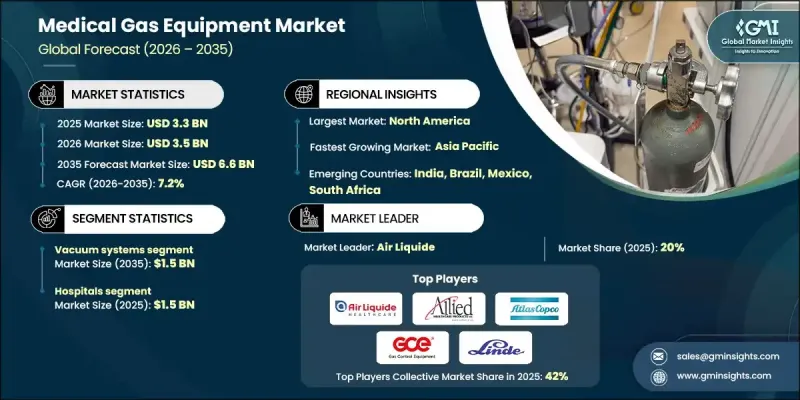
The market is experiencing steady expansion, driven by advancements in medical gas technologies, rising demand for home healthcare and oxygen therapy, supportive government initiatives, and increasing surgical and ICU admissions. The shift toward home-based care, due to its affordability, convenience, and potential to reduce hospital readmissions, combined with innovations such as portable oxygen concentrators and lightweight cylinders, is making oxygen therapy widely accessible. Favorable reimbursement frameworks and the transition toward value-based care are further boosting demand for medical gas delivery systems, regulators, and monitoring equipment. Hospitals and home healthcare providers are increasingly relying on these systems to ensure patient safety. Additionally, the rising volume of surgical procedures and ICU admissions necessitates dependable medical gas infrastructure for anesthesia, ventilation, and patient monitoring, supporting market growth.
| Market Scope | |
|---|---|
| Start Year | 2025 |
| Forecast Year | 2026-2035 |
| Start Value | $3.3 Billion |
| Forecast Value | $6.6 Billion |
| CAGR | 7.2% |
The vacuum systems segment was valued at USD 745.7 million in 2025 and is anticipated to reach USD 1.5 billion by 2035. These systems are essential for suction applications in surgical theaters, intensive care units, and emergency care, creating negative pressure to remove fluids, secretions, and gases, maintaining a clear operative field, and supporting life-saving interventions.
The hospitals segment held USD 1.5 billion in 2025 owing to their extensive demand for reliable gas supply systems across operating rooms, ICUs, emergency wards, and general patient care areas. Medical gases, including oxygen, nitrous oxide, medical air, and vacuum systems, are critical for life support, anesthesia, and respiratory therapy. The increasing number of surgeries, ICU admissions, and chronic respiratory disease cases is driving the demand for advanced gas infrastructure in hospitals.
U.S. Medical Gas Equipment Market reached USD 1.28 billion in 2025. Growth is supported by rising surgical procedures and ICU admissions, alongside early adoption of automation and digital technologies in healthcare facilities. IoT-enabled sensors, centralized control panels, and advanced alarm systems allow real-time monitoring, predictive maintenance, and compliance with NFPA 99 and FDA regulations, enhancing operational efficiency and patient safety.
Key players operating in the Global Medical Gas Equipment Market include Allied Healthcare Products, Air Liquide, Amico Corporation, Atlas Copco Group, Dragerwerk, GCE Group, Gentec Corporation, Linde, Mediquip International, Novair Medical, Ohio Medical, Precision UK, Rotarex, Silbermann Medical Gas Systems, and Taiyo Nippon Sanso Corporation. Companies in the Global Medical Gas Equipment Market are employing several strategies to strengthen their market presence and competitive positioning. They are investing heavily in research and development to create innovative, compact, and energy-efficient equipment suitable for both hospitals and home healthcare. Strategic partnerships and acquisitions allow expansion into new geographies and access to complementary technologies.
Table of Contents
Chapter 1 Methodology and Scope
- 1.1 Market scope and definition
- 1.2 Research design
- 1.2.1 Research approach
- 1.2.2 Data collection methods
- 1.3 Data mining sources
- 1.3.1 Global
- 1.3.2 Regional/country
- 1.4 Base estimates and calculations
- 1.4.1 Base year calculation
- 1.4.2 Key trends for market estimation
- 1.5 Primary research and validation
- 1.5.1 Primary sources
- 1.6 Forecast model
- 1.7 Research assumptions and limitations
Chapter 2 Executive Summary
- 2.1 Industry 360° synopsis
- 2.2 Key market trends
- 2.2.1 Regional trends
- 2.2.2 Product trends
- 2.2.3 End Use trends
- 2.3 CXO perspectives: Strategic imperatives
- 2.3.1 Key decision points for industry executives
- 2.3.2 Critical success factors for market players
- 2.4 Future outlook and strategic recommendations
Chapter 3 Industry Insights
- 3.1 Industry ecosystem analysis
- 3.2 Industry impact forces
- 3.2.1 Growth drivers
- 3.2.1.1 Increasing technological advancements in medical gas equipment
- 3.2.1.2 Growth in home healthcare and oxygen therapy
- 3.2.1.3 Rising favorable initiatives undertaken by government organizations
- 3.2.1.4 Increasing surgical and ICU admissions
- 3.2.2 Industry pitfalls and challenges
- 3.2.2.1 Complex and stringent regulatory process
- 3.2.2.2 Maintenance and compliance burden
- 3.2.3 Market opportunities
- 3.2.3.1 Growing expansion in emerging markets
- 3.2.1 Growth drivers
- 3.3 Growth potential analysis
- 3.4 Regulatory landscape
- 3.4.1 North America
- 3.4.2 Europe
- 3.4.3 Asia Pacific
- 3.5 Technological advancements
- 3.5.1 Current technological trends
- 3.5.2 Emerging technologies
- 3.6 Future market trends
- 3.7 Porter's analysis
- 3.8 PESTEL analysis
Chapter 4 Competitive Landscape, 2025
- 4.1 Introduction
- 4.2 Company market share analysis
- 4.3 Company matrix analysis
- 4.4 Competitive analysis of major market players
- 4.5 Competitive positioning matrix
- 4.6 Key developments
- 4.6.1 Mergers and acquisitions
- 4.6.2 Partnerships and collaborations
- 4.6.3 New product launches
- 4.6.4 Expansion plans
Chapter 5 Market Estimates and Forecast, By Product, 2022 - 2035 ($ Mn)
- 5.1 Key trends
- 5.2 Manifolds
- 5.3 Outlets
- 5.4 Hose assemblies and valves
- 5.5 Alarm systems
- 5.6 Cylinders
- 5.7 Flowmeters
- 5.8 Regulators
- 5.9 Medical air compressors
- 5.10 Vacuum systems
- 5.11 Other products
Chapter 6 Market Estimates and Forecast, By End Use, 2022 - 2035 ($ Mn)
- 6.1 Key trends
- 6.2 Hospitals
- 6.3 Clinics
- 6.4 Ambulatory surgical centers
- 6.5 Other end users
Chapter 7 Market Estimates and Forecast, By Region, 2022 - 2035 ($ Mn)
- 7.1 Key trends
- 7.2 North America
- 7.2.1 U.S.
- 7.2.2 Canada
- 7.3 Europe
- 7.3.1 Germany
- 7.3.2 UK
- 7.3.3 France
- 7.3.4 Spain
- 7.3.5 Italy
- 7.3.6 Netherlands
- 7.4 Asia Pacific
- 7.4.1 China
- 7.4.2 India
- 7.4.3 Japan
- 7.4.4 Australia
- 7.4.5 South Korea
- 7.5 Latin America
- 7.5.1 Brazil
- 7.5.2 Mexico
- 7.5.3 Argentina
- 7.6 Middle East and Africa
- 7.6.1 Saudi Arabia
- 7.6.2 South Africa
- 7.6.3 UAE
Chapter 8 Company Profiles
- 8.1 Allied Healthcare Products
- 8.2 Air Liquide
- 8.3 Amico Corporation
- 8.4 Atlas Copco Group
- 8.5 Dragerwerk
- 8.6 GCE Group
- 8.7 Gentec Corporation
- 8.8 Linde
- 8.9 Mediquip International
- 8.10 Novair Medical
- 8.11 Ohio Medical
- 8.12 Precision UK
- 8.13 Rotarex
- 8.14 Silbermann Medical Gas Systems
- 8.15 Taiyo Nippon Sanso Corporation

