PUBLISHER: Global Market Insights Inc. | PRODUCT CODE: 1913356

PUBLISHER: Global Market Insights Inc. | PRODUCT CODE: 1913356
Dimethyl Carbonate Market Opportunity, Growth Drivers, Industry Trend Analysis, and Forecast 2026 - 2035
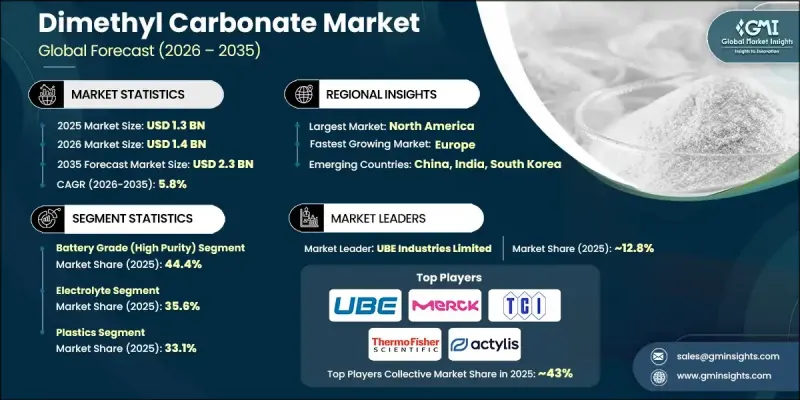
The Global Dimethyl Carbonate Market was valued at USD 1.3 billion in 2025 and is estimated to grow at a CAGR of 5.8% to reach USD 2.3 billion by 2035.
Dimethyl carbonate is a versatile organic carbonate (C3H6O3) produced through processes such as phosgenation, transesterification, and oxidative carbonylation. Available in battery-grade, pharmaceutical-grade, and industrial-grade variants with purity levels ranging from 98% to above 99.9%, this environmentally sustainable chemical is essential in lithium-ion battery electrolytes, pharmaceutical synthesis, polycarbonate production, and as a green solvent alternative. The rapid growth of electric vehicle adoption, expanding energy storage installations, and rising pharmaceutical applications are creating strong demand across global markets. Manufacturers are investing in advanced purification methods, sustainable production processes, and capacity expansion to meet the surging need for high-purity battery-grade DMC. Innovations in ultra-high purity production now allow purity levels exceeding 99.95%, moisture content below 20 ppm, and consistent quality that meets stringent specifications for lithium-ion batteries, enhancing electrochemical performance and reducing impurity-related degradation.
| Market Scope | |
|---|---|
| Start Year | 2025 |
| Forecast Year | 2026-2035 |
| Start Value | $1.3 Billion |
| Forecast Value | $2.3 Billion |
| CAGR | 5.8% |
The battery-grade dimethyl carbonate segment held 44.4% share in 2025 and is expected to grow at a CAGR of 5.5% from 2026 to 2035. Its dominance is driven by its essential role in lithium-ion battery electrolyte formulations, superior electrochemical stability, and high purity standards above 99.9%, ensuring reliable performance in energy storage and electric vehicle applications.
The electrolyte applications segment held 35.6% share in 2025 and is projected to grow at a CAGR of 6.3% through 2035. DMC is a critical co-solvent in lithium-ion battery electrolytes, balancing dielectric constant, viscosity, and electrochemical stability for efficient battery operation across temperature ranges. This segment benefits from the rising adoption of electric vehicles, consumer electronics, and grid storage systems, with DMC typically comprising 20-40% of electrolyte solvent mixtures.
U.S. Dimethyl Carbonate Market accounted for USD 296.2 million in 2025. Strong demand in North America is fueled by expanding lithium-ion battery manufacturing, pharmaceutical production utilizing DMC as a green methylating agent and solvent, and a well-established chemical industry increasingly adopting sustainable practices.
Key players in the Global Dimethyl Carbonate Market include Thermo Fisher Scientific Inc., Tokyo Chemical Industry Co., Ltd., UBE Industries Limited, Merck KGaA, Aarsha Chemicals Private Limited, Actylis, Cymit Quimica S.L., Dongying City Longxing, Emco Dyestuff Pvt Ltd, Hefei TNJ Chemical Industry Co., Ltd., Jinan Qinmu Fine Chemical Co., Ltd., SHANTI CHEMICAL WORKS, and SMC GLOBAL. Companies in the Global Dimethyl Carbonate Market are strengthening their positions by investing in high-purity production technologies, expanding manufacturing capacities, and enhancing R&D for sustainable solutions. Strategic partnerships and acquisitions are being leveraged to access new geographic markets and industrial applications. Businesses focus on marketing initiatives that highlight eco-friendly properties and regulatory compliance, while continuous process innovation ensures cost efficiency and product consistency, helping them maintain a competitive advantage and meet growing demand in battery, pharmaceutical, and chemical sectors.
Table of Contents
Chapter 1 Methodology & Scope
- 1.1 Market scope and definition
- 1.2 Research design
- 1.2.1 Research approach
- 1.2.2 Data collection methods
- 1.3 Data mining sources
- 1.3.1 Global
- 1.3.2 Regional/Country
- 1.4 Base estimates and calculations
- 1.4.1 Base year calculation
- 1.4.2 Key trends for market estimation
- 1.5 Primary research and validation
- 1.5.1 Primary sources
- 1.6 Forecast model
- 1.7 Research assumptions and limitations
Chapter 2 Executive Summary
- 2.1 Industry 360° synopsis
- 2.2 Key market trends
- 2.2.1 Grade
- 2.2.2 Application
- 2.2.3 End use
- 2.2.4 Regional
- 2.3 TAM Analysis, 2025-2035
- 2.4 CXO perspectives: Strategic imperatives
- 2.4.1 Executive decision points
- 2.4.2 Critical success factors
- 2.5 Future outlook and strategic recommendations
Chapter 3 Industry Insights
- 3.1 Industry ecosystem analysis
- 3.1.1 Supplier landscape
- 3.1.2 Profit margin
- 3.1.3 Value addition at each stage
- 3.1.4 Factor affecting the value chain
- 3.1.5 Disruptions
- 3.2 Industry impact forces
- 3.2.1 Growth drivers
- 3.2.2 Industry pitfalls and challenges
- 3.2.3 Market opportunities
- 3.3 Growth potential analysis
- 3.4 Regulatory landscape
- 3.4.1 North America
- 3.4.2 Europe
- 3.4.3 Asia Pacific
- 3.4.4 Latin America
- 3.4.5 Middle East & Africa
- 3.5 Porter's analysis
- 3.6 PESTEL analysis
- 3.7 Technology and innovation landscape
- 3.7.1 Current technological trends
- 3.7.2 Emerging technologies
- 3.8 Price trends
- 3.8.1 By region
- 3.8.2 By grade
- 3.9 Future market trends
- 3.10 Technology and innovation landscape
- 3.10.1 Current technological trends
- 3.10.2 Emerging technologies
- 3.11 Patent landscape
- 3.12 Trade statistics (HS code) (Note: the trade statistics will be provided for key countries only)
- 3.12.1 Major importing countries
- 3.12.2 Major exporting countries
- 3.13 Sustainability and environmental aspects
- 3.13.1 Sustainable practices
- 3.13.2 Waste reduction strategies
- 3.13.3 Energy efficiency in production
- 3.13.4 Eco-friendly initiatives
- 3.14 Carbon footprint consideration
Chapter 4 Competitive Landscape, 2025
- 4.1 Introduction
- 4.2 Company market share analysis
- 4.2.1 By region
- 4.2.1.1 North America
- 4.2.1.2 Europe
- 4.2.1.3 Asia Pacific
- 4.2.1.4 LATAM
- 4.2.1.5 MEA
- 4.2.1 By region
- 4.3 Company matrix analysis
- 4.4 Competitive analysis of major market players
- 4.5 Competitive positioning matrix
- 4.6 Key developments
- 4.6.1 Mergers & acquisitions
- 4.6.2 Partnerships & collaborations
- 4.6.3 New product launches
- 4.6.4 Expansion plans
Chapter 5 Market Estimates and Forecast, By Grade, 2022-2035 (USD Million) (Kilo Tons)
- 5.1 Key trends
- 5.2 Battery grade (high purity)
- 5.3 Pharmaceutical grade
- 5.4 Industrial grade
Chapter 6 Market Estimates and Forecast, By Application, 2022-2035 (USD Million) (Kilo Tons)
- 6.1 Key trends
- 6.2 Electrolyte
- 6.3 Solvent
- 6.4 Polycarbonate synthesis
- 6.5 Fuel additives
- 6.6 Pesticide
- 6.7 Others
Chapter 7 Market Estimates and Forecast, By End Use, 2022-2035 (USD Million) (Kilo Tons)
- 7.1 Key trends
- 7.2 Battery
- 7.3 Pharmaceutical
- 7.4 Plastics
- 7.5 Electronics
- 7.6 Agrochemicals
- 7.7 Paints & coating
- 7.8 Adhesives & sealants
- 7.9 Others
Chapter 8 Market Estimates and Forecast, By Region, 2022-2035 (USD Million) (Kilo Tons)
- 8.1 Key trends
- 8.2 North America
- 8.2.1 U.S.
- 8.2.2 Canada
- 8.3 Europe
- 8.3.1 Germany
- 8.3.2 UK
- 8.3.3 France
- 8.3.4 Spain
- 8.3.5 Italy
- 8.3.6 Rest of Europe
- 8.4 Asia Pacific
- 8.4.1 China
- 8.4.2 India
- 8.4.3 Japan
- 8.4.4 Australia
- 8.4.5 South Korea
- 8.4.6 Rest of Asia Pacific
- 8.5 Latin America
- 8.5.1 Brazil
- 8.5.2 Mexico
- 8.5.3 Argentina
- 8.5.4 Rest of Latin America
- 8.6 Middle East and Africa
- 8.6.1 Saudi Arabia
- 8.6.2 South Africa
- 8.6.3 UAE
- 8.6.4 Rest of Middle East and Africa
Chapter 9 Company Profiles
- 9.1 Thermo Fisher Scientific Inc.
- 9.2 Tokyo Chemical Industry Co., Ltd.
- 9.3 UBE Industries Limited
- 9.4 Merck KGaA
- 9.5 Aarsha Chemicals Private Limited
- 9.6 Actylis
- 9.7 Cymit Quimica S.L.
- 9.8 Dongying City Longxing
- 9.9 Emco Dyestuff Pvt Ltd
- 9.10 Hefei TNJ Chemical Industry Co., Ltd.
- 9.11 Jinan Qinmu Fine Chemical Co., Ltd.
- 9.12 SHANTI CHEMICAL WORKS
- 9.13 SMC GLOBAL

