PUBLISHER: Global Market Insights Inc. | PRODUCT CODE: 1913357

PUBLISHER: Global Market Insights Inc. | PRODUCT CODE: 1913357
Barcode Printers Market Opportunity, Growth Drivers, Industry Trend Analysis, and Forecast 2026 - 2035
The Global Barcode Printers Market was estimated at USD 4.56 billion in 2025 and is estimated to grow at a CAGR of 5.8% to reach USD 7.89 billion by 2035.
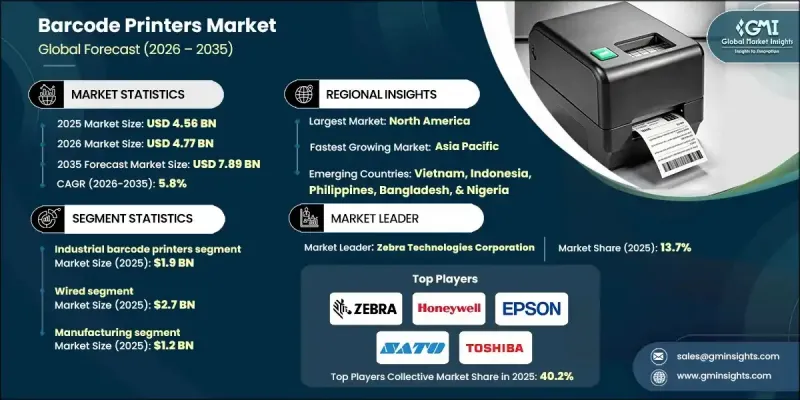
Market growth is driven by the rapid expansion of online commerce, which has significantly increased the need for accurate labeling, shipment processing, and inventory visibility across supply chains. As businesses scale manufacturing, warehousing, and distribution operations to manage higher order volumes, barcode printing systems are becoming essential infrastructure tools. Printer manufacturers are increasingly prioritizing the integration of RFID and smart-label capabilities into their offerings, enabling combined barcode and RFID functionality within a single platform. These hybrid systems support real-time tracking, serialization, and enhanced supply chain transparency. Another major trend shaping the market is the rising focus on sustainability. Companies are aligning with ESG targets and regulatory expectations by adopting printers and consumables that reduce energy usage while supporting recyclable and biodegradable label materials without compromising print quality or operational efficiency.
| Market Scope | |
|---|---|
| Start Year | 2025 |
| Forecast Year | 2026-2035 |
| Start Value | $4.56 Billion |
| Forecast Value | $7.89 Billion |
| CAGR | 5.8% |
The industrial barcode printers segment reached USD 1.9 billion in 2025. These systems are designed for high-volume and continuous-duty environments and are widely deployed across large-scale production, warehousing, and fulfillment operations. Their durability, speed, and compatibility with automated inventory and tracking systems make them a preferred choice for complex operational settings that demand consistent performance.
The wired connectivity segment generated USD 2.7 billion in 2025. Barcode printers using wired connections continue to be favored where uninterrupted performance, stable data transmission, and minimal signal disruption are critical. These systems are commonly implemented in fixed operational environments where reliability and constant uptime are operational priorities.
U.S. Barcode Printers Market reached USD 1.5 billion in 2025 and is forecast to grow at a CAGR of 6.3% from 2026 to 2035. Accelerated e-commerce activity, warehouse automation, and supply chain digitalization are driving adoption across the country. Retailers and logistics providers are increasingly deploying advanced labeling technologies to improve shipment accuracy and traceability. Manufacturers are responding by investing in high-speed, thermal, and mobile printing solutions tailored to logistics, warehousing, and fulfillment operations that support omnichannel retail growth.
Key companies operating in the Global Barcode Printers Market include Zebra Technologies Corporation, Honeywell International Inc., Toshiba Corporation, Canon Inc., Seiko Epson Corporation, Avery Dennison Corporation, Sato Holdings Corporation, TSC Auto ID Technology Co., Ltd., Citizen Systems Europe GmbH, Godex International Co., Ltd., Dascom Holdings Ltd., Wasp Barcode Technologies, Primera Technology, Inc., Airtrack, Cognitive TPG LLC, Linx Printing Technologies Ltd, Printek L.L.C., Labeltac, and Toshiba Tec. Companies in the Global Barcode Printers Market are strengthening their competitive position by focusing on technology innovation, product diversification, and strategic partnerships. Manufacturers are investing heavily in R&D to develop printers with integrated RFID, IoT connectivity, and smart-label compatibility to support advanced tracking requirements. Sustainability-driven product development, including energy-efficient printers and eco-friendly consumables, is gaining prominence. Firms are also expanding regional manufacturing and distribution networks to improve supply reliability and reduce lead times.
Table of Contents
Chapter 1 Methodology & Scope
- 1.1 Market scope and definition
- 1.2 Research design
- 1.2.1 Research approach
- 1.2.2 Data collection methods
- 1.3 Data mining sources
- 1.3.1 Global
- 1.3.2 Regional/Country
- 1.4 Base estimates and calculations
- 1.4.1 Base year calculation
- 1.4.2 Key trends for market estimation
- 1.5 Primary research and validation
- 1.5.1 Primary sources
- 1.6 Forecast model
- 1.7 Research assumptions and limitations
Chapter 2 Executive Summary
- 2.1 Industry 3600 synopsis
- 2.2 Key market trends
- 2.2.1 Product type trends
- 2.2.2 Technology type trends
- 2.2.3 Connectivity trends
- 2.2.4 End use industry trends
- 2.2.5 Regional trends
- 2.3 TAM Analysis, 2026-2035 (USD Billion)
- 2.4 CXO perspectives: Strategic imperatives
- 2.4.1 Executive decision points
- 2.4.2 Critical Success Factors
- 2.5 Future Outlook and Strategic Recommendations
Chapter 3 Industry Insights
- 3.1 Industry ecosystem analysis
- 3.1.1 Factor affecting the value chain
- 3.1.2 Profit margin analysis
- 3.1.3 Disruptions
- 3.1.4 Future outlook
- 3.1.5 Manufacturers
- 3.1.6 Distributors
- 3.2 Impact forces
- 3.2.1 Growth drivers
- 3.2.1.1 Expansion of e-commerce and retail sectors
- 3.2.1.2 Increasing adoption of printers by manufacturing, logistics and retail sectors
- 3.2.1.3 Continuous innovations in barcode printing technology
- 3.2.1.4 Growth of the IoT and smart labeling solutions
- 3.2.1.5 Growing demand for supply chain transparency and traceability
- 3.2.2 Industry pitfalls & challenges
- 3.2.2.1 Integration challenges with legacy systems
- 3.2.2.2 Limited standardization across industries
- 3.2.1 Growth drivers
- 3.3 Growth potential analysis
- 3.4 Regulatory landscape
- 3.4.1 North America
- 3.4.2 Europe
- 3.4.3 Asia Pacific
- 3.4.4 Latin America
- 3.4.5 Middle East & Africa
- 3.5 Porter's analysis
- 3.6 PESTEL analysis
- 3.7 Technology and Innovation landscape
- 3.7.1 Current technological trends
- 3.7.2 Emerging technologies
- 3.8 Emerging Business Models
- 3.9 Compliance Requirements
- 3.10 Sustainability Measures
- 3.11 Consumer Sentiment Analysis
- 3.12 Patent and IP analysis
- 3.13 Geopolitical and trade dynamics
Chapter 4 Competitive Landscape, 2025
- 4.1 Introduction
- 4.2 Company market share analysis
- 4.2.1 By region
- 4.2.1.1 North America
- 4.2.1.2 Europe
- 4.2.1.3 Asia Pacific
- 4.2.1.4 Latin America
- 4.2.1.5 Middle East & Africa
- 4.2.2 Market Concentration Analysis
- 4.2.1 By region
- 4.3 Competitive Benchmarking of key Players
- 4.3.1 Financial Performance Comparison
- 4.3.1.1 Revenue
- 4.3.1.2 Profit Margin
- 4.3.1.3 R&D
- 4.3.2 Product Portfolio Comparison
- 4.3.2.1 Product Range Breadth
- 4.3.2.2 Technology
- 4.3.2.3 Innovation
- 4.3.3 Geographic Presence Comparison
- 4.3.3.1 Global Footprint Analysis
- 4.3.3.2 Service Network Coverage
- 4.3.3.3 Market Penetration by Region
- 4.3.4 Competitive Positioning Matrix
- 4.3.4.1 Leaders
- 4.3.4.2 Challengers
- 4.3.4.3 Followers
- 4.3.4.4 Niche Players
- 4.3.5 Strategic outlook matrix
- 4.3.1 Financial Performance Comparison
- 4.4 Key developments, 2022-2025
- 4.4.1 Mergers and Acquisitions
- 4.4.2 Partnerships and Collaborations
- 4.4.3 Technological Advancements
- 4.4.4 Expansion and Investment Strategies
- 4.4.5 Sustainability Initiatives
- 4.4.6 Digital Transformation Initiatives
- 4.5 Emerging/ Startup Competitors Landscape
Chapter 5 Market Estimates & Forecast, By Product Type, 2022-2035 (USD Billion)
- 5.1 Key trends
- 5.2 Desktop barcode printers
- 5.3 Industrial barcode printers
- 5.4 Mobile barcode printers
Chapter 6 Market Estimates & Forecast, By Technology Type, 2022-2035 (USD Billion)
- 6.1 Key trends
- 6.2 Direct thermal
- 6.3 Thermal transfer
- 6.4 Laser
- 6.5 Inkjet
Chapter 7 Market Estimates & Forecast, By Connectivity, 2022-2035 (USD Billion)
- 7.1 Key trends
- 7.2 Wired
- 7.3 Wireless
Chapter 8 Market Estimates & Forecast, By End Use Industry, 2022-2035 (USD Billion)
- 8.1 Key trends
- 8.2 Manufacturing
- 8.3 Retail & E-commerce
- 8.4 Healthcare
- 8.5 Transportation and logistics
- 8.6 Government
- 8.7 Others
Chapter 9 Market Estimates & Forecast, By Region, 2022-2035 (USD Billion)
- 9.1 Key trends
- 9.2 North America
- 9.2.1 U.S.
- 9.2.2 Canada
- 9.3 Europe
- 9.3.1 UK
- 9.3.2 Germany
- 9.3.3 France
- 9.3.4 Italy
- 9.3.5 Spain
- 9.3.6 Russia
- 9.4 Asia Pacific
- 9.4.1 China
- 9.4.2 India
- 9.4.3 Japan
- 9.4.4 South Korea
- 9.4.5 Australia
- 9.5 Latin America
- 9.5.1 Brazil
- 9.5.2 Mexico
- 9.6 MEA
- 9.6.1 South Africa
- 9.6.2 Saudi Arabia
- 9.6.3 UAE
Chapter 10 Company Profiles
- 10.1 Global Key Players
- 10.1.1 Avery Dennison Corporation
- 10.1.2 Canon Inc.
- 10.1.3 Honeywell International Inc.
- 10.1.4 Seiko Epson Corporation
- 10.1.5 Toshiba Corporation
- 10.1.6 Zebra Technologies Corporation
- 10.2 Regional Key Players
- 10.2.1 North America
- 10.2.1.1 Cognitive TPG LLC
- 10.2.1.2 Primera Technology, Inc.
- 10.2.1.3 Printek L.L.C
- 10.2.1.4 Wasp Barcode Technologies
- 10.2.2 Europe
- 10.2.2.1 Citizen Systems Europe GmbH
- 10.2.2.2 Linx Printing Technologies Ltd (Linx)
- 10.2.2.3 Dascom Holdings Ltd.
- 10.2.3 Asia Pacific
- 10.2.3.1 Sato Holdings Corporation
- 10.2.3.2 TSC Auto ID Technology Co., Ltd.
- 10.2.3.3 Godex International Co. Ltd.
- 10.2.1 North America
- 10.3 Niche / Disruptors
- 10.3.1 Airtrack
- 10.3.2 Labeltac

