
PUBLISHER: Global Market Insights Inc. | PRODUCT CODE: 1913359

PUBLISHER: Global Market Insights Inc. | PRODUCT CODE: 1913359
Marine Energy Market Opportunity, Growth Drivers, Industry Trend Analysis, and Forecast 2026 - 2035
The Global Marine Energy Market was valued at USD 2.11 billion in 2025 and is estimated to grow at a CAGR of 9.7% to reach USD 4.94 billion by 2035.
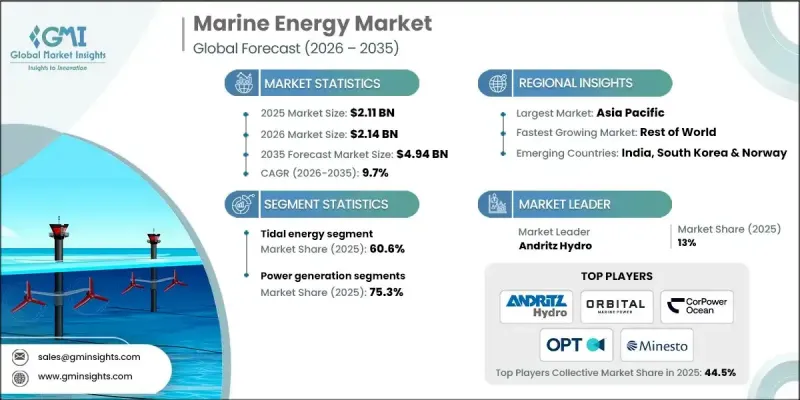
Market growth is supported by rising public-sector funding mechanisms that encourage research, pilot deployment, and early commercialization of ocean-based renewable power systems. Marine energy represents electricity generated from ocean resources such as tidal movements, wave motion, water currents, and thermal differences, offering a sustainable alternative to conventional energy sources. These systems convert the kinetic and thermal potential of seawater into usable power with minimal emissions. Marine energy is increasingly valued for its predictability, long operating life, and contribution to decarbonization goals. Growing interest in renewable solutions with lower environmental impact continues to strengthen demand. The market also benefits from the need for energy sources that provide stable output and resilience against climate variability. Integration of marine energy projects with existing offshore renewable infrastructure improves cost efficiency and grid connectivity. Hybrid renewable configurations further enhance utilization rates and support uninterrupted electricity generation, reinforcing the long-term role of marine energy within diversified clean power portfolios.
| Market Scope | |
|---|---|
| Start Year | 2025 |
| Forecast Year | 2026-2035 |
| Start Value | $2.11 Billion |
| Forecast Value | $4.94 Billion |
| CAGR | 9.7% |
The salinity gradient power segment is projected to reach USD 500 million by 2035. Increased investment in advanced membrane development improves energy conversion efficiency while reducing system costs, which enhances commercial readiness and supports wider deployment in regions with suitable water resources.
The marine energy-powered desalination applications segment will grow at a CAGR of 10.7% through 2035. Rising freshwater demand in coastal and island regions accelerates interest in clean power solutions that reduce operating costs, improve energy efficiency, and support long-term water security.
U.S. Marine Energy Market held 89.9% share in 2025 and is expected to generate USD 200 million by 2035. Strong renewable energy targets, growing institutional interest, and increasing private investment continue to reinforce regional leadership and long-term market potential.
Key companies active in the Global Marine Energy Market include Orbital Marine Power, Ocean Power Technologies, Carnegie Clean Energy, Verdant Power, Andritz Hydro, Minesto, SSE Renewables, CorPower Ocean, SINN Power, Mocean Energy, Nova Innovations, Sabella SAS, Seabased AB, Oscilla Power, Havkraft AS, BioPower Systems, Eco Wave Power, Marine Energy Group, AWS Ocean Energy, and Ocean Renewable Power Company. Companies strengthen their position by prioritizing technology optimization, cost reduction, and scalable project development. Many players focus on improving device durability and energy efficiency to enhance long-term performance in harsh marine environments. Strategic partnerships with utilities, infrastructure developers, and research institutions support faster commercialization and risk sharing. Firms also emphasize modular designs and standardized components to simplify deployment and maintenance.
Table of Contents
Chapter 1 Methodology & Scope
- 1.1 Research design
- 1.1.1 Research approach
- 1.1.2 Data collection methods
- 1.2 Base estimates and calculations
- 1.2.1 Base year calculation
- 1.2.2 Market estimates & forecast parameters
- 1.3 Forecast
- 1.3.1 Key trends for market estimates
- 1.3.1.1 Quantified market impact analysis
- 1.3.2 Mathematical impact of growth parameters on forecast
- 1.3.3 Scenario analysis framework
- 1.3.1 Key trends for market estimates
- 1.4 Primary research and validation
- 1.4.1 Some of the primary sources (but not limited to)
- 1.5 Data mining sources
- 1.5.1 Paid Sources
- 1.5.2 Sources, by region
- 1.6 Research trail & scoring components
- 1.6.1 Research trail components
- 1.6.2 Scoring components
- 1.7 Research transparency addendum
- 1.7.1 Source attribution framework
- 1.7.2 Quality assurance metrics
- 1.7.3 Our commitment to trust
- 1.8 Market definitions
Chapter 2 Executive Summary
- 2.1 Industry synopsis, 2022 - 2035
- 2.2 Business trends
- 2.3 Type trends
- 2.4 Application trends
- 2.5 Regional trends
Chapter 3 Industry Insights
- 3.1 Industry ecosystem
- 3.1.1 Raw material availability & sourcing analysis
- 3.1.2 Manufacturing capacity assessment
- 3.1.3 Supply chain resilience & risk factors
- 3.1.4 Distribution network analysis
- 3.2 Regulatory landscape
- 3.3 Industry impact forces
- 3.3.1 Growth drivers
- 3.3.2 Industry pitfalls & challenges
- 3.4 Growth potential analysis
- 3.5 Cost structure analysis
- 3.6 Porter's analysis
- 3.6.1 Bargaining power of suppliers
- 3.6.2 Bargaining power of buyers
- 3.6.3 Threat of new entrants
- 3.6.4 Threat of substitutes
- 3.7 PESTEL analysis
- 3.7.1 Political factors
- 3.7.2 Economic factors
- 3.7.3 Social factors
- 3.7.4 Technological factors
- 3.7.5 Legal factors
- 3.7.6 Environmental factors
- 3.8 Emerging opportunities & trends
- 3.8.1 Digitalization & IoT integration
- 3.8.2 Emerging market penetration
- 3.9 Investment analysis and future outlook
Chapter 4 Competitive landscape, 2025
- 4.1 Introduction
- 4.2 Company market share analysis, by region, 2025
- 4.2.1 North America
- 4.2.2 Europe
- 4.2.3 Asia Pacific
- 4.2.4 Rest of World
- 4.3 Strategic dashboard
- 4.4 Strategic initiatives
- 4.5 Company benchmarking
- 4.6 Innovation & technology landscape
Chapter 5 Market Size and Forecast, By Type, 2022 - 2035 (USD Million & MW)
- 5.1 Key trends
- 5.2 Wave energy
- 5.3 Tidal energy
- 5.4 Ocean thermal energy conversion (OTEC)
- 5.5 Salinity gradient power (SGP)
Chapter 6 Market Size and Forecast, By Application, 2022 - 2035 (USD Million & MW)
- 6.1 Key trends
- 6.2 Power generation
- 6.3 Desalination
- 6.4 Others
Chapter 7 Market Size and Forecast, By Region, 2022 - 2035 (USD Million & MW)
- 7.1 Key trends
- 7.2 North America
- 7.2.1 U.S.
- 7.2.2 Canada
- 7.3 Europe
- 7.3.1 France
- 7.3.2 Spain
- 7.3.3 UK
- 7.3.4 Norway
- 7.4 Asia Pacific
- 7.4.1 China
- 7.4.2 India
- 7.4.3 South Korea
- 7.5 Rest of World
Chapter 8 Company Profiles
- 8.1 Andritz Hydro
- 8.2 AWS Ocean Energy
- 8.3 BioPower Systems
- 8.4 Carnegie Clean Energy
- 8.5 CorPower Ocean
- 8.6 Eco Wave Power
- 8.7 Havkraft AS
- 8.8 Marine Energy Group
- 8.9 Minesto
- 8.10 Mocean Energy
- 8.11 Nova Innovations
- 8.12 Ocean Power Technologies (OPT)
- 8.13 Ocean Renewable Power Company
- 8.14 Orbital Marine Power
- 8.15 Oscilla Power
- 8.16 Sabella SAS
- 8.17 Seabased AB
- 8.18 SINN Power
- 8.19 SSE Renewables
- 8.20 Verdant Power

