
PUBLISHER: Global Market Insights Inc. | PRODUCT CODE: 1913415

PUBLISHER: Global Market Insights Inc. | PRODUCT CODE: 1913415
Wood Pellets Market Opportunity, Growth Drivers, Industry Trend Analysis, and Forecast 2026 - 2035
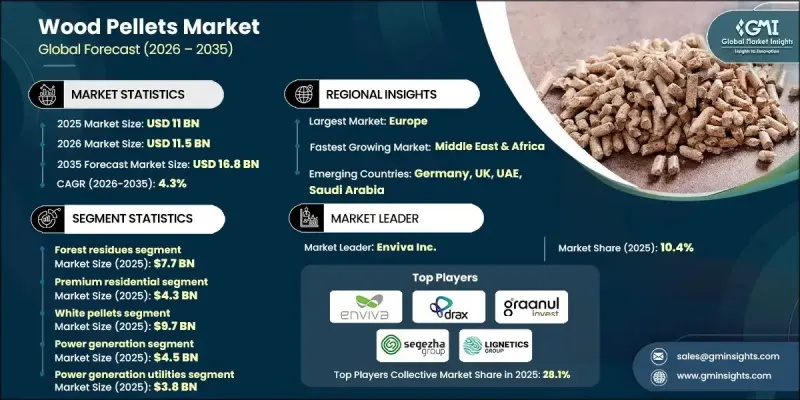
The Global Wood Pellets Market was valued at USD 11 billion in 2025 and is estimated to grow at a CAGR of 4.3% to reach USD 16.8 billion by 2035.
Market development is closely tied to the rising adoption of biomass-based energy solutions across power generation and large-scale heating applications. Utilities and industrial operators are increasingly turning to wood pellets as a substitute for conventional fossil fuels to reduce emissions and meet environmental compliance targets. High energy-consuming industries are also incorporating pellet-based systems due to their need for standardized fuel with consistent performance and lower emission output. Policy frameworks and regulatory mandates promoting renewable energy usage continue to act as strong growth enablers. Government incentives, renewable energy obligations, and sustainability targets are supporting wider biomass adoption, improving the cost competitiveness of wood pellets and reinforcing their role within the global energy transition.
| Market Scope | |
|---|---|
| Start Year | 2025 |
| Forecast Year | 2026-2035 |
| Start Value | $11 Billion |
| Forecast Value | $16.8 Billion |
| CAGR | 4.3% |
The forest residue-based pellets segment accounted for USD 7.7 billion in 2025, representing a major share of the feedstock mix. This segment benefits from reliable availability and suitability for large-scale pellet manufacturing. The consistency in material characteristics and energy output supports efficient processing and cost-effective production. Established forestry supply chains across developed regions further strengthen this segment by ensuring traceable and sustainable sourcing that meets industrial and utility procurement standards.
The premium residential pellets segment held USD 4.3 billion in 2025. This grade aligns closely with household heating requirements and quality regulations, offering efficient combustion, minimal residue, and stable system performance. Ongoing investment in energy-efficient residential heating solutions and supportive clean energy policies across developed economies continue to sustain demand.
North America Wood Pellets Market accounted for 16.4% share in 2025. The region benefits from strong production capacity and significant export activity, largely supported by the United States. Abundant forest resources, established pellet manufacturing infrastructure, and advanced logistics capabilities enable the region to serve international markets efficiently.
Key companies operating in the Global Wood Pellets Market include Drax Group PLC, Enviva Inc., Lignetics Group, Graanul Invest, Segezha Group, Highland Pellets LLC, Fram Fuels, Rentech Inc., Viridis Energy Inc., Energex, Buhler, Wood & Energy, and Pfeifer Group. Companies active in the Global Wood Pellets Market are reinforcing their market position through capacity expansion, supply chain integration, and long-term offtake agreements. Leading producers are investing in efficient processing technologies to improve yield consistency and reduce operational costs. Strategic partnerships with utilities and industrial buyers are helping secure stable demand and revenue visibility. Firms are also expanding export infrastructure and logistics capabilities to strengthen access to international markets.
Table of Contents
Chapter 1 Methodology & Scope
- 1.1 Market scope and definition
- 1.2 Research design
- 1.2.1 Research approach
- 1.2.2 Data collection methods
- 1.3 Data mining sources
- 1.3.1 Global
- 1.3.2 Regional/Country
- 1.4 Base estimates and calculations
- 1.4.1 Base year calculation
- 1.4.2 Key trends for market estimation
- 1.5 Primary research and validation
- 1.5.1 Primary sources
- 1.6 Forecast model
- 1.7 Research assumptions and limitations
Chapter 2 Executive Summary
- 2.1 Industry 360° synopsis
- 2.2 Key market trends
- 2.2.1 Regional
- 2.2.2 Feedstock
- 2.2.3 Pellet type
- 2.2.4 Grade
- 2.2.5 Application
- 2.2.6 End Use
- 2.3 TAM Analysis, 2026-2035
- 2.4 CXO perspectives: Strategic imperatives
- 2.4.1 Executive decision points
- 2.4.2 Critical success factors
- 2.5 Future Outlook and Strategic Recommendations
Chapter 3 Industry Insights
- 3.1 Industry ecosystem analysis
- 3.1.1 Supplier Landscape
- 3.1.2 Profit Margin
- 3.1.3 Value addition at each stage
- 3.1.4 Factor affecting the value chain
- 3.1.5 Disruptions
- 3.2 Industry impact forces
- 3.2.1 Growth drivers
- 3.2.1.1 Increasing demand from food and beverage industry
- 3.2.1.2 Government regulations promoting eco-friendly materials
- 3.2.1.3 Increasing adoption in the retail and FMCG sectors
- 3.2.2 Industry pitfalls and challenges
- 3.2.2.1 Volatility in raw material prices
- 3.2.2.2 Environmental concerns related to deforestation
- 3.2.3 Market opportunities
- 3.2.3.1 Rising demand for renewable energy and carbon-neutral solutions
- 3.2.3.2 Expansion in industrial applications and co-firing with coal
- 3.2.1 Growth drivers
- 3.3 Growth potential analysis
- 3.4 Regulatory landscape
- 3.4.1 North America
- 3.4.2 Europe
- 3.4.3 Asia Pacific
- 3.4.4 Latin America
- 3.4.5 Middle East & Africa
- 3.5 Porter's analysis
- 3.6 PESTEL analysis
- 3.7 Price trends
- 3.7.1 By region
- 3.7.2 Feedstock
- 3.8 Future market trends
- 3.9 Technology and Innovation Landscape
- 3.9.1 Current technological trends
- 3.9.2 Emerging technologies
- 3.10 Patent Landscape
- 3.11 Trade statistics (HS code) (Note: the trade statistics will be provided for key countries only)
- 3.11.1 Major importing countries
- 3.11.2 Major exporting countries
- 3.12 Sustainability and environmental aspects
- 3.12.1 Sustainable practices
- 3.12.2 Waste reduction strategies
- 3.12.3 Energy efficiency in production
- 3.12.4 Eco-friendly initiatives
- 3.13 Carbon footprint considerations
Chapter 4 Competitive Landscape, 2025
- 4.1 Introduction
- 4.2 Company market share analysis
- 4.2.1 By region
- 4.2.1.1 North America
- 4.2.1.2 Europe
- 4.2.1.3 Asia Pacific
- 4.2.1.4 LATAM
- 4.2.1.5 MEA
- 4.2.1 By region
- 4.3 Company matrix analysis
- 4.4 Competitive analysis of major market players
- 4.5 Competitive positioning matrix
- 4.6 Key developments
- 4.6.1 Mergers & acquisitions
- 4.6.2 Partnerships & collaborations
- 4.6.3 New product launches
- 4.6.4 Expansion plans
Chapter 5 Market Estimates and Forecast, By Feedstock, 2022 - 2035 (USD billion) (Kilo Tons)
- 5.1 Key trends
- 5.2 Forest residues
- 5.2.1 Softwood
- 5.2.2 Hardwood
- 5.2.3 Roundwood & pulpwood
- 5.3 Agricultural residues
- 5.4 Recycled wood
Chapter 6 Market Estimates and Forecast, By Grade, 2022 - 2035 (USD billion) (Kilo Tons)
- 6.1 Key trends
- 6.2 Premium (A1)
- 6.3 Standard (A2)
- 6.4 Industrial grade (B)
- 6.5 Others
Chapter 7 Market Estimates and Forecast, By Pellet Types, 2022 - 2035 (USD billion) (Kilo Tons)
- 7.1 Key trends
- 7.2 White pellets
- 7.3 Black pellets
Chapter 8 Market Estimates and Forecast, By Application, 2022 - 2035 (USD billion) (Kilo Tons)
- 8.1 Key trends
- 8.2 Heating
- 8.3 Power generation
- 8.4 Combined Heat & Power (CHP)
- 8.5 Others
Chapter 9 Market Estimates and Forecast, By End Use, 2022 - 2035 (USD billion) (Kilo Tons)
- 9.1 Key trends
- 9.2 Residential / Household
- 9.3 Commercial establishments
- 9.4 Power generation utilities
- 9.5 Industrial manufacturing
- 9.6 District heating operators
- 9.7 Agriculture & Livestock
- 9.8 Food Service & Hospitality
Chapter 10 Market Estimates and Forecast, By Region, 2022 - 2035 (USD billion) (Kilo Tons)
- 10.1 Key trends
- 10.2 North America
- 10.2.1 U.S.
- 10.2.2 Canada
- 10.3 Europe
- 10.3.1 Germany
- 10.3.2 UK
- 10.3.3 France
- 10.3.4 Spain
- 10.3.5 Italy
- 10.3.6 Rest of Europe
- 10.4 Asia Pacific
- 10.4.1 China
- 10.4.2 India
- 10.4.3 Japan
- 10.4.4 Australia
- 10.4.5 South Korea
- 10.4.6 Rest of Asia Pacific
- 10.5 Latin America
- 10.5.1 Brazil
- 10.5.2 Mexico
- 10.5.3 Rest of Latin America
- 10.6 Middle East and Africa
- 10.6.1 Saudi Arabia
- 10.6.2 South Africa
- 10.6.3 UAE
- 10.6.4 Rest of Middle East and Africa
Chapter 11 Company Profiles
- 11.1 Enviva Inc
- 11.2 Drax Group PLC
- 11.3 Graanul Invest
- 11.4 Lignetics Group
- 11.5 Segezha Group
- 11.6 Fram Fuels
- 11.7 Viridis Energy Inc.
- 11.8 Rentech Inc.
- 11.9 Wood & Energy
- 11.10 Buhler
- 11.11 Energex
- 11.12 Highland Pellets LLC
- 11.13 Pfeifer Group

