
PUBLISHER: Global Market Insights Inc. | PRODUCT CODE: 1913425

PUBLISHER: Global Market Insights Inc. | PRODUCT CODE: 1913425
Water Taxi Market Opportunity, Growth Drivers, Industry Trend Analysis, and Forecast 2026 - 2035
The Global Water Taxi Market was valued at USD 24.6 billion in 2025 and is estimated to grow at a CAGR of 3.6% to reach USD 34.7 billion by 2035.
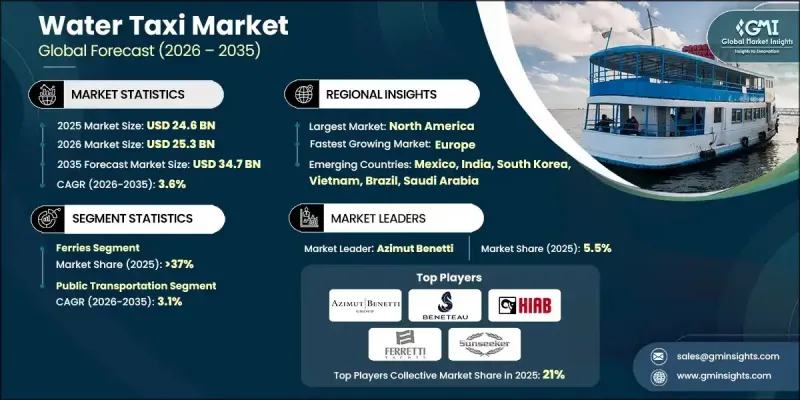
Market expansion is driven by rising urban congestion and the increasing need for alternative mobility solutions in densely populated cities. Water taxis are increasingly recognized as an effective option for reducing travel time by bypassing road traffic and utilizing underused waterways within urban and intercity networks. Rapid urban development and persistent traffic bottlenecks are encouraging public authorities and transport planners to integrate water-based mobility into existing transit ecosystems. Compared with land-based infrastructure expansion, water transport requires lower capital investment and shorter development timelines, making it an attractive option for cities seeking efficient mobility solutions. Water taxis also offer cost advantages through lower fuel consumption and reduced long-term maintenance requirements while supporting sustainability objectives. Their ability to transport a high volume of passengers with fewer operational disruptions strengthens their appeal. Growing policy support, incentive programs, and private sector participation are further enhancing the market's visibility as a reliable, economical, and environmentally conscious transportation mode.
| Market Scope | |
|---|---|
| Start Year | 2025 |
| Forecast Year | 2026-2035 |
| Start Value | $24.6 Billion |
| Forecast Value | $34.7 Billion |
| CAGR | 3.6% |
The public transportation segment is forecast to grow at a CAGR of 3.1% from 2026 to 2035, owing to its suitability for routine commuting and urban travel needs. Demand is supported by passengers prioritizing faster transit options within cities and tourism-driven locations. Government-backed initiatives promoting water-based mobility as a substitute for traditional land transport are reinforcing adoption and supporting long-term industry growth.
The diesel-powered water taxis accounted for the largest share in 2025. Diesel propulsion remains widely adopted due to its operational efficiency and cost-effectiveness for high-frequency operations and longer routes. While alternative propulsion technologies continue to evolve, diesel systems currently provide a practical solution for operators seeking dependable performance and manageable operating expenses, particularly for vessels handling higher passenger volumes.
North America Water Taxi Market is projected to reach USD 9.9 billion by 2035, growing at a CAGR of 2.1% between 2026 and 2035. The region benefits from extensive inland and coastal waterways that support passenger transport services. Market growth is primarily driven by steady demand in the United States and Canada, where water taxis are increasingly viewed as a complementary mode of transportation within urban and coastal mobility frameworks.
Key companies active in the Global Water Taxi Market include Austal, Brunswick, Ferretti, Azimut Benetti, Hornblower, Bavaria Yachts, Beneteau, Sunseeker, Catalina Yachts, and Hiab. Companies operating in the Global Water Taxi Market are focusing on fleet modernization, operational efficiency, and strategic partnerships to strengthen their market position. Manufacturers and operators are investing in fuel-efficient vessel designs and exploring alternative propulsion technologies to align with sustainability goals. Expansion into high-potential urban corridors and tourism-centric locations remains a core growth strategy. Firms are also enhancing passenger experience through improved vessel comfort, digital ticketing systems, and integrated route planning. Collaboration with municipal authorities and private infrastructure developers is helping secure long-term operating contracts.
Table of Contents
Chapter 1 Methodology
- 1.1 Market scope and definition
- 1.2 Research design
- 1.2.1 Research approach
- 1.2.2 Data collection methods
- 1.3 Data mining sources
- 1.3.1 Global
- 1.3.2 Regional/Country
- 1.4 Base estimates and calculations
- 1.4.1 Base year calculation
- 1.4.2 Key trends for market estimation
- 1.5 Primary research and validation
- 1.5.1 Primary sources
- 1.6 Forecast
- 1.7 Research assumptions and limitations
Chapter 2 Executive Summary
- 2.1 Industry 3600 synopsis
- 2.2 Key market trends
- 2.2.1 Regional
- 2.2.2 Product
- 2.2.3 Propulsion
- 2.2.4 Service
- 2.2.5 Passenger Capacity
- 2.2.6 Booking Mode
- 2.2.7 Operation
- 2.2.8 Application
- 2.3 TAM analysis, 2026-2035
- 2.4 CXO perspectives: Strategic imperatives
- 2.4.1 Executive decision points
- 2.4.2 Critical success factors
- 2.5 Future outlook and recommendations
Chapter 3 Industry Insights
- 3.1 Industry ecosystem analysis
- 3.1.1 Supplier landscape
- 3.1.2 Profit margin
- 3.1.3 Cost structure
- 3.1.4 Value addition at each stage
- 3.1.5 Factor affecting the value chain
- 3.1.6 Disruptions
- 3.2 Industry impact forces
- 3.2.1 Growth drivers
- 3.2.1.1 Urban waterfront congestion reduction
- 3.2.1.2 Growth in coastal and inland tourism
- 3.2.1.3 Expansion of smart city water transport initiatives
- 3.2.1.4 Rising demand for sustainable and low-emission mobility
- 3.2.2 Industry pitfalls and challenges
- 3.2.2.1 High initial capital and vessel procurement costs
- 3.2.2.2 Weather dependency and seasonal operations
- 3.2.3 Market opportunities
- 3.2.3.1 Adoption of electric and autonomous water taxis
- 3.2.3.2 Integration with multimodal urban transport systems
- 3.2.3.3 Expansion in emerging coastal and riverfront cities
- 3.2.3.4 Public-private partnerships for urban water mobility
- 3.2.1 Growth drivers
- 3.3 Growth potential analysis
- 3.4 Regulatory landscape
- 3.4.1 North America
- 3.4.1.1 Ports and Waterways Safety Act
- 3.4.1.2 Jones Act (for domestic trade)
- 3.4.1.3 Hawaii Administrative Rule Code - Water taxi operations
- 3.4.2 Europe
- 3.4.2.1 Schiffssicherheitsverordnung (Ship Safety Ordinance)
- 3.4.2.2 German Traffic Regulations for Inland Water ways
- 3.4.2.3 Maritime Shipping Responsibilities Act
- 3.4.3 Asia Pacific
- 3.4.3.1 Inland Vessels Act, 2021
- 3.4.3.2 Maritime Traffic Safety Law
- 3.4.3.3 Vietnam's Maritime Transport Laws
- 3.4.3.4 Regulation on the Administration of Domestic Water Transport
- 3.4.4 Latin America
- 3.4.4.1 BR do Mar (Law 14.301/2022)
- 3.4.4.2 National Maritime Authority (DPC)
- 3.4.4.3 FMM (Forma Migratoria Multiple)
- 3.4.5 Middle East & Africa
- 3.4.5.1 Dubai's RTA (Roads & Transport Authority)
- 3.4.5.2 Marine Tourism Watercraft Classification Regulation
- 3.4.1 North America
- 3.5 Porter's analysis
- 3.6 PESTEL analysis
- 3.7 Technology and innovation landscape
- 3.7.1 Current technological trends
- 3.7.2 Emerging technologies
- 3.8 Price trends
- 3.8.1 By region
- 3.8.2 By product
- 3.9 Production statistics
- 3.9.1 Production hubs
- 3.9.2 Consumption hubs
- 3.9.3 Export and import
- 3.10 Cost breakdown analysis
- 3.11 Sustainability and environmental impact
- 3.11.1 Environmental impact assessment
- 3.11.2 Social impact & community benefits
- 3.11.3 Governance & corporate responsibility
- 3.11.4 Sustainable finance & investment trends
- 3.12 Electrification & Alternative Propulsion Impact Analysis
- 3.12.1 Total cost of ownership comparison: electric vs diesel vs hybrid
- 3.12.2 Charging infrastructure constraints and solutions
- 3.12.3 Battery range, downtime, and route planning impact
- 3.12.4 Government incentives and subsidies for electric vessels
- 3.12.5 Long-term decarbonization roadmap for water taxis
- 3.13 Fleet Economics & Total Cost of Ownership (TCO) Analysis
- 3.13.1 CAPEX vs OPEX comparison by vessel type and propulsion
- 3.13.2 TCO comparison: electric vs diesel vs hybrid water taxis
- 3.13.3 Maintenance, battery replacement, and lifecycle cost impact
- 3.13.4 Payback period and ROI drivers for operators
- 3.13.5 Design levers OEMs can pull to reduce ownership cost
- 3.14 Case studies
- 3.15 Future outlook & opportunities
Chapter 4 Competitive Landscape, 2025
- 4.1 Introduction
- 4.2 Company market share analysis
- 4.2.1 North America
- 4.2.2 Europe
- 4.2.3 Asia Pacific
- 4.2.4 LATAM
- 4.2.5 MEA
- 4.3 Competitive analysis of major market players
- 4.4 Competitive positioning matrix
- 4.5 Strategic outlook matrix
- 4.6 Key developments
- 4.6.1 Mergers & acquisitions
- 4.6.2 Partnerships & collaborations
- 4.6.3 New product launches
- 4.6.4 Expansion plans and funding
Chapter 5 Market Estimates & Forecast, By Product, 2022 - 2035 ($Bn, Units)
- 5.1 Key trends
- 5.2 Yachts
- 5.3 Cruise
- 5.4 Sailboats
- 5.5 Ferries
- 5.6 Catamarans
Chapter 6 Market Estimates & Forecast, By Propulsion, 2022 - 2035 ($Bn, Units)
- 6.1 Key trends
- 6.2 Electric
- 6.3 Diesel
- 6.4 Hybrid
- 6.5 Others
Chapter 7 Market Estimates & Forecast, By Service, 2022 - 2035 ($Bn, Units)
- 7.1 Key trends
- 7.2 Scheduled services
- 7.3 On-demand services
Chapter 8 Market Estimates & Forecast, By Passenger Capacity, 2022 - 2035 ($Bn, Units)
- 8.1 Key trends
- 8.2 Up to 12 Passengers
- 8.3 Above 12 Passengers
Chapter 9 Market Estimates & Forecast, By Booking Mode, 2022 - 2035 ($Bn, Units)
- 9.1 Key trends
- 9.2 Online
- 9.3 Offline
Chapter 10 Market Estimates & Forecast, By Operation, 2022 - 2035 ($Bn, Units)
- 10.1 Key trends
- 10.2 Intercity
- 10.3 Intracity
Chapter 11 Market Estimates & Forecast, By Application, 2022 - 2035 ($Bn, Units)
- 11.1 Key trends
- 11.2 Public transportation
- 11.3 Leisure & tourism
- 11.4 Business & corporate transport
- 11.5 Personal use
- 11.6 Others
Chapter 12 Market Estimates & Forecast, By Region, 2022 - 2035 ($Bn, Units)
- 12.1 Key trends
- 12.2 North America
- 12.2.1 US
- 12.2.2 Canada
- 12.3 Europe
- 12.3.1 Germany
- 12.3.2 UK
- 12.3.3 France
- 12.3.4 Italy
- 12.3.5 Spain
- 12.3.6 Russia
- 12.3.7 Nordics
- 12.3.8 Benelux
- 12.4 Asia Pacific
- 12.4.1 China
- 12.4.2 India
- 12.4.3 Japan
- 12.4.4 South Korea
- 12.4.5 ANZ
- 12.4.6 Singapore
- 12.4.7 Malaysia
- 12.4.8 Indonesia
- 12.4.9 Vietnam
- 12.4.10 Thailand
- 12.5 Latin America
- 12.5.1 Brazil
- 12.5.2 Mexico
- 12.5.3 Argentina
- 12.5.4 Colombia
- 12.6 MEA
- 12.6.1 South Africa
- 12.6.2 Saudi Arabia
- 12.6.3 UAE
Chapter 13 Company Profiles
- 13.1 Global companies
- 13.1.1 Beneteau
- 13.1.2 Azimut Benetti
- 13.1.3 Brunswick
- 13.1.4 Ferretti
- 13.1.5 Sunseeker
- 13.1.6 Austal
- 13.1.7 Candela
- 13.1.8 Damen Shipyards
- 13.1.9 Fincantieri
- 13.1.10 Princess Yachts
- 13.1.11 Bavaria Yachtbau
- 13.1.12 American Sail
- 13.1.13 Catalina Yachts
- 13.1.14 Cargotec
- 13.1.15 Hiab
- 13.1.16 Hornblower
- 13.2 Regional companies
- 13.2.1 Thames Clippers
- 13.2.2 NY Waterway
- 13.2.3 Artemis
- 13.2.4 Seastreak
- 13.2.5 Greenline Yachts
- 13.2.6 Greenbay Marine
- 13.3 Emerging companies
- 13.3.1 E-lixr
- 13.3.2 Navier
- 13.3.3 Callboats
- 13.3.4 The Water Taxi Company
- 13.3.5 Flying Fish

