
PUBLISHER: Global Market Insights Inc. | PRODUCT CODE: 1913455

PUBLISHER: Global Market Insights Inc. | PRODUCT CODE: 1913455
Point of Care Ultrasound (POCUS) Market Opportunity, Growth Drivers, Industry Trend Analysis, and Forecast 2026 - 2035
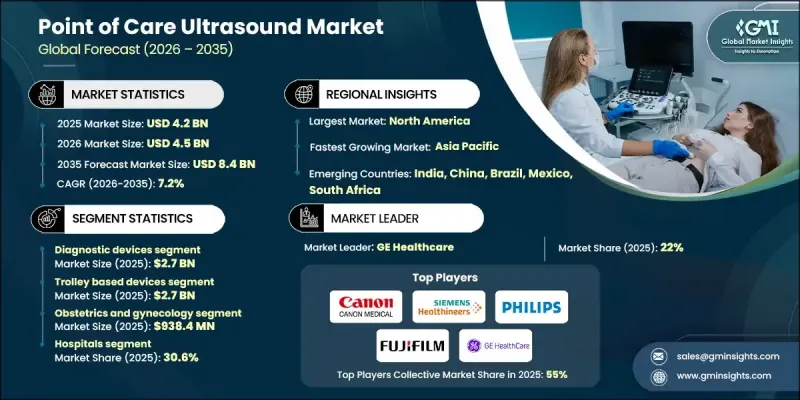
The Global Point of Care Ultrasound Market was valued at USD 4.2 billion in 2025 and is estimated to grow at a CAGR of 7.2% to reach USD 8.4 billion by 2035.
Market expansion is supported by the growing incidence of long-term health conditions, continuous innovation in portable ultrasound technologies, and the rapid increase in the aging population worldwide. The rising burden of non-communicable diseases is significantly increasing the need for fast, accessible, and reliable diagnostic solutions. Point of care ultrasound enables clinicians to perform immediate imaging at the bedside, improving decision-making speed for diagnosis, disease monitoring, and clinical interventions. Its ability to deliver real-time visualization without reliance on centralized imaging departments is improving workflow efficiency across healthcare settings. As healthcare systems focus on early detection, timely treatment, and improved patient outcomes, point of care ultrasound is becoming an integral diagnostic tool. Advancements in device portability, image quality, and ease of use are further strengthening adoption across hospitals, clinics, and emergency care environments.
| Market Scope | |
|---|---|
| Start Year | 2025 |
| Forecast Year | 2026-2035 |
| Start Value | $4.2 Billion |
| Forecast Value | $8.4 Billion |
| CAGR | 7.2% |
The expanding geriatric population continues to play a critical role in driving demand for point of care ultrasound solutions. Aging populations are more susceptible to chronic and degenerative conditions, increasing the need for frequent diagnostic evaluations. Point of care ultrasound refers to the use of compact imaging systems directly at the patient location to support immediate clinical assessment. These devices allow healthcare professionals to obtain diagnostic images and guide procedures without delays associated with traditional imaging workflows, enhancing patient care efficiency and responsiveness.
The diagnostic devices segment generated USD 2.7 billion in 2025 and accounted for a market share of 62.8%. These systems are widely used to support rapid evaluations across emergency, critical care, and outpatient settings. Their ability to provide instant visualization of internal structures enables timely clinical decisions and supports effective bedside care delivery.
The trolley-based devices segment was valued at USD 2.7 billion in 2025. These systems are commonly deployed in hospitals and large medical facilities where high-quality imaging and mobility within clinical spaces are required. Their design supports consistent performance across multiple care areas while maintaining operational flexibility.
US Point of Care Ultrasound Market reached USD 1.7 billion in 2025. Growth is being driven by increasing diagnostic demand linked to chronic disease prevalence and the need for rapid imaging solutions in high-volume care environments. The portability and operational efficiency of point of care ultrasound systems support their widespread use in emergency and intensive care settings, where timely diagnosis is critical.
Key companies operating in the Global Point of Care Ultrasound Market include GE Healthcare, Siemens Healthineers, Koninklijke Philips, SAMSUNG Healthcare, Fujifilm, Canon Medical Systems, Shenzhen Mindray, Esaote SpA, Butterfly Network, BenQ Medical Technology, Fukuda Denshi, Chison Medical Imaging, Clarius Mobile Health, Viatom Technology, and Vave Health. Companies in the Global Point of Care Ultrasound Market are strengthening their competitive position by investing heavily in product innovation, particularly in portable and wireless imaging technologies. Many players are focusing on improving image clarity, battery performance, and user-friendly interfaces to enhance clinical usability. Strategic collaborations with healthcare providers and digital health platforms are expanding adoption and integration into care workflows. Firms are also prioritizing affordability and scalable product lines to reach a wider range of healthcare settings.
Table of Contents
Chapter 1 Methodology and Scope
- 1.1 Market scope and definition
- 1.2 Research design
- 1.2.1 Research approach
- 1.2.2 Data collection methods
- 1.3 Data mining sources
- 1.3.1 Global
- 1.3.2 Regional/Country
- 1.4 Base estimates and calculations
- 1.4.1 Base year calculation
- 1.4.2 Key trends for market estimation
- 1.5 Primary research and validation
- 1.5.1 Primary sources
- 1.6 Forecast model
- 1.7 Research assumptions and limitations
Chapter 2 Executive Summary
- 2.1 Industry 360° synopsis
- 2.2 Key market trends
- 2.2.1 Regional trends
- 2.2.2 Type trends
- 2.2.3 Portability trends
- 2.2.4 Application trends
- 2.2.5 End use trends
- 2.3 CXO perspectives: Strategic imperatives
- 2.3.1 Key decision points for industry executives
- 2.3.2 Critical success factors for market players
- 2.4 Future outlook and strategic recommendations
Chapter 3 Industry Insights
- 3.1 Industry ecosystem analysis
- 3.2 Industry impact forces
- 3.2.1 Growth drivers
- 3.2.1.1 Increasing prevalence of chronic diseases
- 3.2.1.2 Rising demand for bedside diagnostics
- 3.2.1.3 Technological advancements in POCUS systems
- 3.2.1.4 Growing geriatric population base
- 3.2.2 Industry pitfalls and challenges
- 3.2.2.1 High cost of POCUS devices
- 3.2.2.2 Stringent regulatory scenario
- 3.2.3 Market opportunities
- 3.2.3.1 Growing healthcare expansion in emerging economies
- 3.2.1 Growth drivers
- 3.3 Growth potential analysis
- 3.4 Regulatory landscape
- 3.4.1 North America
- 3.4.2 Europe
- 3.4.3 Asia Pacific
- 3.5 Technological advancements
- 3.5.1 Current technological trends
- 3.5.2 Emerging technologies
- 3.6 Pricing analysis, 2024
- 3.7 Future market trends
- 3.8 Porter's analysis
- 3.9 PESTEL analysis
Chapter 4 Competitive Landscape, 2024
- 4.1 Introduction
- 4.2 Company market share analysis
- 4.3 Company matrix analysis
- 4.4 Competitive analysis of major market players
- 4.5 Competitive positioning matrix
- 4.6 Key developments
- 4.6.1 Mergers and acquisitions
- 4.6.2 Partnerships and collaborations
- 4.6.3 New product launches
- 4.6.4 Expansion plans
Chapter 5 Market Estimates and Forecast, By Type, 2022 - 2035 ($ Mn)
- 5.1 Key trends
- 5.2 Diagnostic devices
- 5.3 Therapeutic devices
Chapter 6 Market Estimates and Forecast, By Portability, 2022 - 2035 ($ Mn)
- 6.1 Key trends
- 6.2 Trolley based devices
- 6.3 Handheld devices
Chapter 7 Market Estimates and Forecast, By Application, 2022 - 2035 ($ Mn)
- 7.1 Key trends
- 7.2 Emergency medicine
- 7.3 Cardiology
- 7.4 Obstetrics and gynecology
- 7.5 Urology
- 7.6 Vascular surgery
- 7.7 Musculoskeletal
- 7.8 Other end users
Chapter 8 Market Estimates and Forecast, By End Use, 2022 - 2035 ($ Mn)
- 8.1 Key trends
- 8.2 Hospitals
- 8.3 Clinics
- 8.4 Maternity centers
- 8.5 Ambulatory surgical centers (ASCs)
- 8.6 Other end use
Chapter 9 Market Estimates and Forecast, By Region, 2022 - 2035 ($ Mn)
- 9.1 Key trends
- 9.2 North America
- 9.2.1 U.S.
- 9.2.2 Canada
- 9.3 Europe
- 9.3.1 Germany
- 9.3.2 UK
- 9.3.3 France
- 9.3.4 Spain
- 9.3.5 Italy
- 9.3.6 Netherlands
- 9.4 Asia Pacific
- 9.4.1 China
- 9.4.2 India
- 9.4.3 Japan
- 9.4.4 Australia
- 9.4.5 South Korea
- 9.5 Latin America
- 9.5.1 Brazil
- 9.5.2 Mexico
- 9.5.3 Argentina
- 9.6 Middle East and Africa
- 9.6.1 Saudi Arabia
- 9.6.2 South Africa
- 9.6.3 UAE
Chapter 10 Company Profiles
- 10.1 Butterfly Network
- 10.2 Canon Medical Systems
- 10.3 Clarius Mobile Health
- 10.4 Chison Medical Imaging
- 10.5 Esaote SpA
- 10.6 Fujifilm
- 10.7 Fukuda Denshi
- 10.8 BenQ Medical Technology
- 10.9 GE Healthcare
- 10.10 Koninklijke Philips
- 10.11 Shenzhen Mindray
- 10.12 Siemens Healthineers
- 10.13 SAMSUNG Healthcare
- 10.14 Viatom Technology
- 10.15 Vave Health

