
PUBLISHER: Global Market Insights Inc. | PRODUCT CODE: 1913466

PUBLISHER: Global Market Insights Inc. | PRODUCT CODE: 1913466
Vehicle RFID Tags Market Opportunity, Growth Drivers, Industry Trend Analysis, and Forecast 2026 - 2035
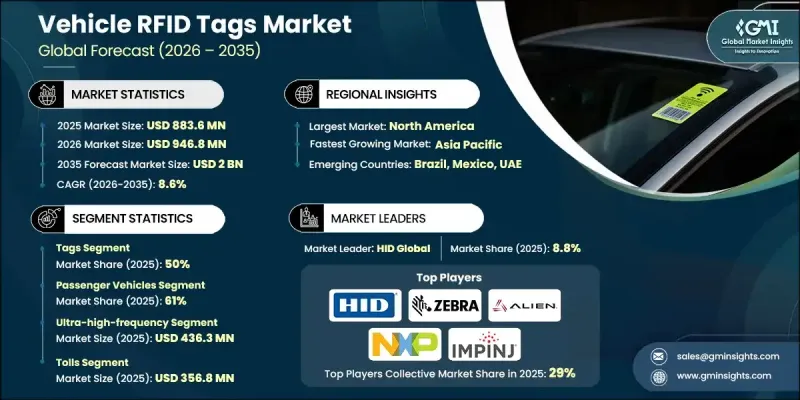
The Global Vehicle RFID Tags Market was valued at USD 883.6 million in 2025 and is estimated to grow at a CAGR of 8.6% to reach USD 2 billion by 2035.
Market expansion is described as supported by the rapid shift toward intelligent transportation frameworks, rising demand for automated vehicle recognition, and the growing importance of structured fleet and asset oversight across multiple industries. Public authorities, logistics operators, and private enterprises are increasingly emphasizing accurate vehicle monitoring, secure access management, and frictionless toll processing, which is positioning vehicle RFID tag solutions as a critical component of modern mobility systems. The market is evolving in response to the need for dependable, traceable, and automated vehicle identification that improves operational efficiency while reducing manual intervention. Continuous digital transformation across transportation networks is further reinforcing adoption, as stakeholders seek integrated systems that improve visibility, accountability, and compliance. As mobility ecosystems become more connected and data-driven, vehicle RFID tags are being recognized as foundational tools that support long-term scalability and operational optimization across both public and private transportation environments.
| Market Scope | |
|---|---|
| Start Year | 2025 |
| Forecast Year | 2026-2035 |
| Start Value | $883.6 Million |
| Forecast Value | $2 Billion |
| CAGR | 8.6% |
Ongoing technological progress is reshaping vehicle management by enabling connected, data-centric operational models. The market is increasingly characterized by integrated digital platforms that support real-time visibility, automated identification, and system-wide coordination. These advancements are described as improving accuracy, lowering error rates, and strengthening regulatory alignment while enhancing overall efficiency across transportation and logistics networks. Industry participants are prioritizing comprehensive RFID-based solutions that unify monitoring, access control, and operational oversight into a single, technology-driven framework.
The tags segment held 50% share in 2025 and is projected to grow at a CAGR of 8% from 2026 to 2035. This segment is described as forming the backbone of the market by enabling automated identification, vehicle tracking, access authorization, and toll-related functions. Broad adoption is supported by affordability, simplified deployment, and consistent performance, allowing organizations to scale contactless vehicle identification across diverse operational environments.
The passenger vehicles segment accounted for 61% share in 2025 and is expected to grow at a CAGR of 7.9% through 2035. Dominance of this segment is attributed to widespread implementation across road networks and mobility systems, supported by high vehicle volumes and policy-driven transportation modernization initiatives. Large-scale deployment within this segment is contributing to smoother traffic flow, reduced congestion, and improved system efficiency.
U.S. Vehicle RFID Tags Market held 78% share, generating USD 359.8 million in 2025. Regional leadership is associated with mature transportation infrastructure, early technology adoption, and strong system integration across major mobility corridors, reinforcing North America's position as a key market for automated vehicle identification solutions.
Major companies active in the Global Vehicle RFID Tags Market include NXP Semiconductors, HID Global, Zebra Technologies, Impinj, Alien Technology, Confidex, HARTING Technology, Brink's, G4S, and GardaWorld. Companies operating in the Global Vehicle RFID Tags Market are strengthening their market position through innovation, system integration, and strategic collaboration. Many players are investing in advanced product development to enhance tag durability, data accuracy, and interoperability with digital platforms. Expanding partnerships with transportation authorities and logistics operators is helping accelerate deployment at scale. Firms are also focusing on cloud connectivity and analytics capabilities to deliver greater operational insight and value-added services. Geographic expansion and localized solutions are being pursued to address regional infrastructure needs.
Table of Contents
Chapter 1 Methodology & Scope
- 1.1 Market scope and definition
- 1.2 Research design
- 1.2.1 Research approach
- 1.2.2 Data collection methods
- 1.3 Data mining sources
- 1.3.1 Global
- 1.3.2 Regional/Country
- 1.4 Base estimates and calculations
- 1.4.1 Base year calculation
- 1.4.2 Key trends for market estimation
- 1.5 Primary research and validation
- 1.5.1 Primary sources
- 1.6 Forecast
- 1.7 Research assumptions and limitations
Chapter 2 Executive Summary
- 2.1 Industry 360° synopsis, 2022 - 2035
- 2.2 Key market trends
- 2.2.1 Regional
- 2.2.2 Component
- 2.2.3 Vehicle
- 2.2.4 Frequency
- 2.2.5 Application
- 2.3 TAM Analysis, 2026-2035
- 2.4 CXO perspectives: Strategic imperatives
- 2.4.1 Executive decision points
- 2.4.2 Critical success factors
- 2.5 Future outlook and strategic recommendations
Chapter 3 Industry Insights
- 3.1 Industry ecosystem analysis
- 3.1.1 Supplier Landscape
- 3.1.2 Profit Margin
- 3.1.3 Cost structure
- 3.1.4 Value addition at each stage
- 3.1.5 Factor affecting the value chain
- 3.1.6 Disruptions
- 3.2 Industry impact forces
- 3.2.1 Growth drivers
- 3.2.1.1 Expansion of electronic toll collection (ETC) systems
- 3.2.1.2 Rising demand for fleet & asset management
- 3.2.1.3 Integration with smart transportation & IoT ecosystems
- 3.2.1.4 Regulatory compliance and security requirements
- 3.2.2 Industry pitfalls and challenges
- 3.2.2.1 Data privacy and security risks
- 3.2.2.2 Infrastructure costs and standardization issues
- 3.2.3 Market opportunities
- 3.2.3.1 Adoption of advanced analytics, AI, and cloud platforms
- 3.2.3.2 Expansion in emerging markets
- 3.2.3.3 Expansion into high-value and specialized transport
- 3.2.3.4 Integration with smart city initiatives
- 3.2.1 Growth drivers
- 3.3 Growth potential analysis
- 3.4 Regulatory landscape
- 3.4.1 North America
- 3.4.1.1 U.S. DOT & FMCSA Guidelines
- 3.4.1.2 OSHA Standards
- 3.4.1.3 Canada Transport of Valuable Goods Regulations & Labor Code
- 3.4.2 Europe
- 3.4.2.1 Germany BMAS & Bundespolizei Regulations
- 3.4.2.2 France CNIL & Ministry of the Interior Guidelines
- 3.4.2.3 United Kingdom ACPO & HSE Guidelines
- 3.4.2.4 Italy Ministry of the Interior & Ministry of Labor Compliance
- 3.4.3 Asia Pacific
- 3.4.3.1 China MOHURD & Public Security Bureau Guidelines
- 3.4.3.2 Japan MLIT Compliance
- 3.4.3.3 South Korea MOEL Regulations
- 3.4.3.4 India MoRTH Guidelines
- 3.4.4 Latin America
- 3.4.4.1 Brazil Ministry of Transport & MTE Guidelines
- 3.4.4.2 Mexico SCT & STPS Guidelines
- 3.4.5 Middle East and Africa
- 3.4.5.1 UAE Ministry of Human Resources & Emiratisation Guidelines
- 3.4.5.2 Saudi Arabia HRSD & Transport Ministry Regulations
- 3.4.1 North America
- 3.5 Porter's analysis
- 3.6 PESTEL analysis
- 3.7 Technology and Innovation Landscape
- 3.7.1 Current technological trends
- 3.7.2 Emerging technologies
- 3.8 Price trends
- 3.8.1 By region
- 3.8.2 By product
- 3.9 Cost breakdown analysis
- 3.10 Patent analysis
- 3.11 Sustainability and Environmental Aspects
- 3.11.1 Sustainable practices
- 3.11.2 Waste reduction strategies
- 3.11.3 Energy efficiency in production
- 3.11.4 Eco-friendly initiatives
- 3.11.5 Carbon footprint considerations
- 3.12 Use case scenarios
- 3.13 RFID tag technology benchmarking
- 3.13.1 Passive vs active vs semi-passive tag performance
- 3.13.2 Read range, durability, and latency comparison
- 3.13.3 Performance under harsh automotive environments
- 3.13.4 Cost vs performance trade-offs by application
- 3.14 Infrastructure readiness & deployment economics
- 3.15 Security, privacy & anti-cloning mechanisms
- 3.16 RFID vs competing vehicle identification technologies
Chapter 4 Competitive Landscape, 2025
- 4.1 Introduction
- 4.2 Company market share analysis
- 4.2.1 North America
- 4.2.2 Europe
- 4.2.3 Asia Pacific
- 4.2.4 Latin America
- 4.2.5 Middle East & Africa
- 4.3 Competitive analysis of major market players
- 4.4 Competitive positioning matrix
- 4.5 Strategic outlook matrix
- 4.6 Key developments
- 4.6.1 Mergers & acquisitions
- 4.6.2 Partnerships & collaborations
- 4.6.3 New product launches
- 4.6.4 Expansion plans and funding
Chapter 5 Market Estimates & Forecast, By Component, 2022 - 2035 ($ Mn, Units)
- 5.1 Key trends
- 5.2 Tags
- 5.2.1 Passive
- 5.2.2 Active
- 5.3 Readers
- 5.4 Software
- 5.5 Others
Chapter 6 Market Estimates & Forecast, By Vehicle, 2022 - 2035 ($ Mn, Units)
- 6.1 Key trends
- 6.2 Passenger vehicles
- 6.2.1 Hatchbacks
- 6.2.2 Sedans
- 6.2.3 SUV
- 6.3 Commercial vehicles
- 6.3.1 Light commercial vehicles (LCV)
- 6.3.2 Medium commercial vehicles (MCV)
- 6.3.3 Heavy commercial vehicles (HCV)
Chapter 7 Market Estimates & Forecast, By Frequency, 2022 - 2035 ($ Mn, Units)
- 7.1 Key trends
- 7.2 Ultra-High Frequency
- 7.3 High-Frequency
- 7.4 Low Frequency
- 7.5 Microwave
Chapter 8 Market Estimates & Forecast, By Application, 2022 - 2035 ($ Mn, Units)
- 8.1 Key trends
- 8.2 Tolls
- 8.3 Tracking
- 8.4 Fleet management
- 8.5 Smart parking systems
- 8.6 Keyless entry systems
Chapter 9 Market Estimates & Forecast, By Region, 2022 - 2035 ($ Mn, Units)
- 9.1 Key trends
- 9.2 North America
- 9.2.1 US
- 9.2.2 Canada
- 9.3 Europe
- 9.3.1 UK
- 9.3.2 Germany
- 9.3.3 France
- 9.3.4 Italy
- 9.3.5 Spain
- 9.3.6 Belgium
- 9.3.7 Netherlands
- 9.3.8 Sweden
- 9.4 Asia Pacific
- 9.4.1 China
- 9.4.2 India
- 9.4.3 Japan
- 9.4.4 Australia
- 9.4.5 Singapore
- 9.4.6 South Korea
- 9.4.7 Vietnam
- 9.4.8 Indonesia
- 9.5 Latin America
- 9.5.1 Brazil
- 9.5.2 Mexico
- 9.5.3 Argentina
- 9.6 MEA
- 9.6.1 UAE
- 9.6.2 South Africa
- 9.6.3 Saudi Arabia
Chapter 10 Company Profiles
- 10.1 Global Player
- 10.1.1 Alien Technology
- 10.1.2 Avery Dennison
- 10.1.3 GAO RFID
- 10.1.4 HID Global
- 10.1.5 Honeywell
- 10.1.6 Impinj
- 10.1.7 Invengo
- 10.1.8 NXP Semiconductors
- 10.1.9 Smartrac
- 10.1.10 Zebra Technologies
- 10.2 Regional Player
- 10.2.1 Checkpoint Systems
- 10.2.2 Identiv
- 10.2.3 Nedap
- 10.2.4 RFID Global Solution
- 10.2.5 RFID Solutions
- 10.2.6 SATO
- 10.2.7 Star Systems International
- 10.2.8 Tageos
- 10.2.9 Tagsys
- 10.2.10 TONNJES E.A.S.T.
- 10.3 Emerging Players
- 10.3.1 CAEN RFID
- 10.3.2 Matrix RFID
- 10.3.3 Mojix
- 10.3.4 Securitag Assembly
- 10.3.5 Xterprise RFID

