
PUBLISHER: Global Market Insights Inc. | PRODUCT CODE: 1928868

PUBLISHER: Global Market Insights Inc. | PRODUCT CODE: 1928868
Asia Pacific Heavy Equipment Market Opportunity, Growth Drivers, Industry Trend Analysis, and Forecast 2026 - 2035
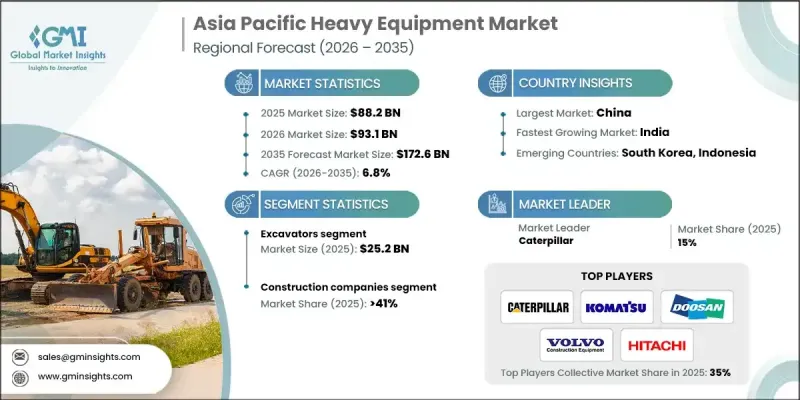
Asia Pacific Heavy Equipment Market was valued at USD 88.2 billion in 2025 and is estimated to grow at a CAGR of 6.8% to reach USD 172.6 billion by 2035.
This market plays a decisive role in enabling infrastructure growth and industrial progress across multiple economies. Heavy equipment supports large-scale development activity and facilitates the movement and handling of critical resources that sustain long-term economic performance. Rapid urban growth across emerging economies continues to fuel equipment demand, while advanced economies in the region focus on upgrading existing machinery with modern, efficient, and digitally enabled solutions. Sustainability objectives, cost optimization, and productivity improvement remain central priorities for fleet operators. The integration of advanced technologies is accelerating the shift toward smarter and cleaner operations, while alternative ownership models are gaining acceptance as companies seek flexibility and reduced upfront investment. Collectively, these dynamics position the Asia Pacific region as one of the most influential contributors to global heavy equipment demand.
| Market Scope | |
|---|---|
| Start Year | 2025 |
| Forecast Year | 2026-2035 |
| Start Value | $88.2 Billion |
| Forecast Value | $172.6 Billion |
| CAGR | 6.8% |
Economic expansion across Asia Pacific continues to stimulate strong demand for heavy equipment as governments and private developers commit significant capital toward long-term development programs. At the same time, developed economies within the region prioritize fleet renewal strategies aimed at improving efficiency and lowering operational costs. Adopting technology across equipment fleets supports enhanced productivity and improved environmental performance. The growing preference for rental and leasing solutions reflects changing procurement strategies and contributes to market expansion.
The excavators segment generated USD 25.2 billion in 2025. This category remains one of the most widely utilized equipment types across the region due to its adaptability and broad functional capability. Excavators serve as essential assets across multiple end-use environments and remain highly valued for their ability to operate efficiently under varied conditions while supporting diverse operational requirements.
The construction companies held 41% share in 2025. Demand from this segment remains strong as construction activity relies heavily on heavy machinery throughout project lifecycles. Equipment demand is generated through continuous use across development operations, reinforcing the construction sector's dominant role within the regional market.
China Heavy Equipment Market held 44% share in 2024 and is projected to grow at a CAGR of 6.9% between 2026 and 2035. Growth is driven by sustained industrial expansion, large-scale urban development, and ongoing infrastructure investment. Policy-driven development programs continue to support long-term equipment demand across the region. Strong manufacturing capacity, resource availability, and population growth further intensify the need for expanded development across both residential and commercial sectors.
Major companies active in the Asia Pacific Heavy Equipment Market include Komatsu Ltd., Caterpillar Inc., XCMG Group, Volvo Construction Equipment, Sany Heavy Industry, Hitachi Construction Machinery, JCB, Liebherr Group, Zoomlion Heavy Industry, Terex Corporation, John Deere, Tadano Ltd., Manitowoc Company, HD Hyundai Construction Equipment, and Develon. Companies operating in the Asia Pacific Heavy Equipment Market focus on strengthening their competitive position through product innovation, regional expansion, and strategic alliances. Manufacturers invest in advanced engineering to enhance efficiency, durability, and digital integration across equipment portfolios. Localization of manufacturing and supply chains helps companies reduce costs and respond faster to regional demand. Many players expand dealer networks and after-sales services to improve customer engagement and long-term retention. Flexible financing, rental solutions, and service-based business models are increasingly adopted to align with customer procurement preferences.
Table of Contents
Chapter 1 Methodology and Scope
- 1.1 Market scope and definition
- 1.2 Research design
- 1.2.1 Research approach
- 1.2.2 Data collection methods
- 1.3 Data mining sources
- 1.3.1 Regional/Country
- 1.4 Base estimates and calculations
- 1.4.1 Base year calculation
- 1.4.2 Key trends for market estimation
- 1.5 Primary research and validation
- 1.5.1 Primary sources
- 1.6 Forecast model
- 1.7 Research assumptions and limitations
Chapter 2 Executive Summary
- 2.1 Industry 360° synopsis
- 2.2 Key market trends
- 2.2.1 Country
- 2.2.2 Product type
- 2.2.3 Mobility
- 2.2.4 Power source
- 2.2.5 Application
- 2.2.6 End use industry
- 2.2.7 Distribution channel
- 2.3 CXO perspectives: Strategic imperatives
- 2.3.1 Key decision points for industry executives
- 2.3.2 Critical success factors for market players
- 2.4 Future outlook and strategic recommendations
Chapter 3 Industry Insights
- 3.1 Industry ecosystem analysis
- 3.1.1 Supplier landscape
- 3.1.2 Profit margin
- 3.1.3 Value addition at each stage
- 3.1.4 Factor affecting the value chain
- 3.2 Industry impact forces
- 3.2.1 Growth drivers
- 3.2.1.1 Infrastructure development and urbanization
- 3.2.1.2 Technological advancements and automation
- 3.2.1.3 Sustainability and emission regulations
- 3.2.2 Industry pitfalls & challenges
- 3.2.2.1 High initial investment and maintenance costs
- 3.2.2.2 Supply chain disruptions and raw material volatility
- 3.2.3 Opportunities
- 3.2.3.1 Electrification and green equipment solutions
- 3.2.3.2 Digitalization and predictive maintenance
- 3.2.1 Growth drivers
- 3.3 Growth potential analysis
- 3.4 Future market trends
- 3.5 Technology and innovation landscape
- 3.5.1 Current technological trends
- 3.5.2 Emerging technologies
- 3.6 Price trends
- 3.6.1 By Country
- 3.6.2 By Product type
- 3.7 Regulatory landscape
- 3.7.1 Standards and compliance requirements
- 3.7.2 Regional regulatory frameworks
- 3.7.3 Certification standards
- 3.8 Porter';s analysis
- 3.9 PESTEL analysis
Chapter 4 Competitive Landscape, 2025
- 4.1 Introduction
- 4.2 Company market share analysis
- 4.3 Company matrix analysis
- 4.4 Competitive analysis of major market players
- 4.5 Competitive positioning matrix
- 4.6 Key developments
- 4.6.1 Mergers & acquisitions
- 4.6.2 Partnerships & collaborations
- 4.6.3 New product launches
- 4.6.4 Expansion plans
Chapter 5 Market Estimates and Forecast, By Product Type, 2022 - 2035 (USD Billion) (Thousand Units)
- 5.1 Key trends
- 5.2 Excavators
- 5.3 Cranes
- 5.4 Backhoe loaders
- 5.5 Bulldozers/dozers
- 5.6 Wheel loaders
- 5.7 Motor graders
- 5.8 Dump trucks
- 5.9 Compactors/rollers
- 5.10 Others
Chapter 6 Market Estimates and Forecast, By Mobility, 2022 - 2035 (USD Billion) (Thousand Units)
- 6.1 Key trends
- 6.2 Mobile equipment
- 6.3 Stationary equipment
- 6.4 Semi-mobile equipment
Chapter 7 Market Estimates and Forecast, By Power Source, 2022 - 2035 (USD Billion) (Thousand Units)
- 7.1 Key trends
- 7.2 Diesel-powered
- 7.3 Electric-powered
- 7.4 Hybrid-powered
Chapter 8 Market Estimates and Forecast, By Application 2022 - 2035 (USD Billion) (Thousand Units)
- 8.1 Key trends
- 8.2 Construction Companies
- 8.3 Rental Service Providers
- 8.4 Mining Companies
- 8.5 Infrastructure development
- 8.6 Manufacturing Plants
- 8.7 Others
Chapter 9 Market Estimates and Forecast, By End Use, 2022 - 2035 (USD Billion) (Thousand Units)
- 9.1 Key trends
- 9.2 Construction
- 9.3 Mining
- 9.4 Infrastructure development
- 9.5 Industrial manufacturing
- 9.6 Material handling
- 9.7 Demolition
- 9.8 Others (agriculture, forestry, utilities, etc.)
Chapter 10 Market Estimates and Forecast, By Distribution Channel, 2022 - 2035 (USD Billion) (Thousand Units)
- 10.1 Key trends
- 10.2 Direct sales
- 10.3 Indirect sales
Chapter 11 Market Estimates and Forecast, By Region, 2022 - 2035 (USD Billion) (Thousand Units)
- 11.1 Key trends
- 11.2 China
- 11.3 Japan
- 11.4 India
- 11.5 Australia
- 11.6 South Korea
- 11.7 Indonesia
Chapter 12 Company Profiles
- 12.1 Caterpillar Inc.
- 12.2 Doosan Infracore
- 12.3 Hitachi Construction Machinery
- 12.4 Hyundai Construction Equipment
- 12.5 JCB
- 12.6 John Deere
- 12.7 Komatsu Ltd.
- 12.8 Liebherr Group
- 12.9 Manitowoc Company
- 12.10 Sany Heavy Industry
- 12.11 Tadano Ltd.
- 12.12 Terex Corporation
- 12.13 Volvo Construction Equipment
- 12.14 XCMG Group
- 12.15 Zoomlion Heavy Industry

