
PUBLISHER: Global Market Insights Inc. | PRODUCT CODE: 1928885

PUBLISHER: Global Market Insights Inc. | PRODUCT CODE: 1928885
Auto Collision Estimating Software Market Opportunity, Growth Drivers, Industry Trend Analysis, and Forecast 2026 - 2035
The Global Auto Collision Estimating Software Market was valued at USD 2.2 billion in 2025 and is estimated to grow at a CAGR of 8.4% to reach USD 4.8 billion by 2035.
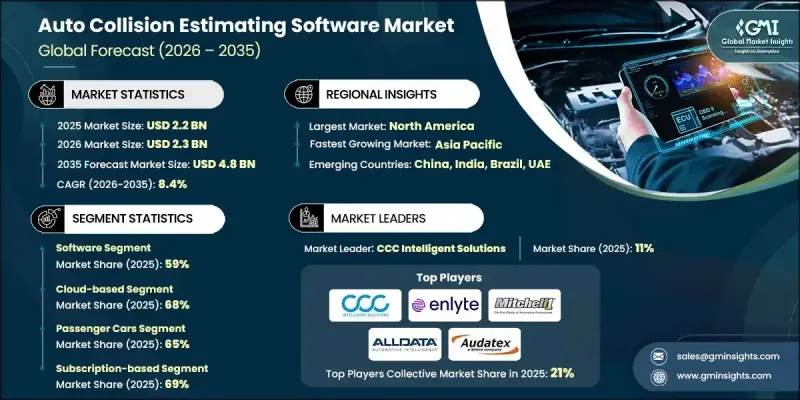
Growth is driven by the automotive industry's accelerated shift toward digital platforms that improve data handling, operational transparency, and efficiency. Cloud-based architectures are increasingly preferred as they support scalable operations, real-time updates, and seamless connectivity across repair, insurance, and claims ecosystems. Collision estimating solutions benefit significantly from cloud deployment, offering improved accessibility and reduced infrastructure costs. Artificial intelligence is also reshaping the market by enabling automated damage assessment, enhanced estimation accuracy, and faster decision-making. These technologies improve consistency by learning from historical repair and pricing data. Regulatory oversight continues to shape adoption by emphasizing transparency and consumer protection. Regions with strong insurance penetration and high vehicle ownership remain key contributors to demand. The transition from manual assessments to fully digital and hybrid claims workflows further strengthens adoption, as insurers and repair facilities prioritize speed, accuracy, and customer satisfaction across the repair lifecycle.
| Market Scope | |
|---|---|
| Start Year | 2025 |
| Forecast Year | 2026-2035 |
| Start Value | $2.2 Billion |
| Forecast Value | $4.8 Billion |
| CAGR | 8.4% |
The software segment accounted for 59% share in 2025 and is expected to grow at a CAGR of 8.6% from 2026 to 2035. Revenue from this segment includes subscription-based access, licensing models, and usage-based pricing. Core offerings cover estimation engines, pricing databases, labor standards, repair documentation, and user interfaces. Advanced automation and data-driven capabilities continue to support higher value adoption and sustained growth.
The services segment is forecast to grow at a CAGR of 8.1% between 2026 and 2035. This segment includes deployment support, configuration, user onboarding, training, system integration, regional customization, and workflow consulting. Services play a critical role for large organizations managing multiple locations, ensuring consistency, integration, and effective software utilization across operations.
United States Auto Collision Estimating Software Market is expected to grow at a CAGR of 6.8% from 2026 to 2035 and remains the leading contributor within North America. Market leadership is supported by a mature repair ecosystem, widespread digital adoption, and strong collaboration between insurers, repair facilities, and fleet operators seeking faster claims resolution and improved repair accuracy.
Key companies operating in the Global Auto Collision Estimating Software Market include CCC Intelligent Solutions, Mitchell Repair Information, Audatex Solutions, Enlyte, Alldata, Web-Est, Constellation R.O. Writer, Scott Systems, RepairShopr, and Smart Estimator App. Companies in the Global Auto Collision Estimating Software Market strengthen their competitive position through continuous platform innovation and cloud-first deployment strategies. Investment in artificial intelligence and analytics enhances estimation accuracy and automation. Vendors expand integration capabilities to connect seamlessly with insurance, repair, and parts ecosystems. Flexible pricing models support adoption across businesses of varying sizes. Strategic partnerships with insurers and repair networks help secure long-term contracts.
Table of Contents
Chapter 1 Methodology
- 1.1 Research approach
- 1.2 Quality commitments
- 1.3 Research trail and confidence scoring
- 1.3.1 Research trail components
- 1.3.2 Scoring components
- 1.4 Data collection
- 1.4.1 Partial list of primary sources
- 1.5 Data mining sources
- 1.5.1 Paid sources
- 1.6 Best estimates and calculations
- 1.6.1 Base year calculation for any one approach
- 1.7 Forecast model
- 1.8 Research transparency addendum
Chapter 2 Executive Summary
- 2.1 Industry 360° synopsis, 2022 - 2035
- 2.2 Key market trends
- 2.2.1 Regional
- 2.2.2 Component
- 2.2.3 Deployment Model
- 2.2.4 Vehicle
- 2.2.5 Pricing Model
- 2.2.6 End Use
- 2.3 TAM Analysis, 2026-2035
- 2.4 CXO perspectives: Strategic imperatives
- 2.4.1 Executive decision points
- 2.4.2 Critical success factors
- 2.5 Future outlook and strategic recommendations
Chapter 3 Industry Insights
- 3.1 Industry ecosystem analysis
- 3.1.1 Supplier landscape
- 3.1.2 Profit margin analysis
- 3.1.3 Cost structure
- 3.1.4 Value addition at each stage
- 3.1.5 Factor affecting the value chain
- 3.1.6 Disruptions
- 3.2 Industry impact forces
- 3.2.1.1 Growth drivers
- 3.2.1.2 Rising vehicle accidents and repair needs
- 3.2.1.3 Adoption of digital tools in repair shops
- 3.2.1.4 Insurance reliance on automated claims
- 3.2.1.5 AI and cloud-based software advancements
- 3.2.1.6 Regulations for standardized repair estimates
- 3.2.2 Industry pitfalls and challenges
- 3.2.2.1 High initial software costs for small repair shops
- 3.2.2.2 Integration challenges with existing systems
- 3.2.3 Market opportunities
- 3.2.3.1 Growth in emerging markets
- 3.2.3.2 AI and machine learning integration
- 3.2.3.3 Cloud-based scalable solutions
- 3.2.3.4 Partnerships with insurance companies
- 3.2.3.5 Mobile apps for on-site assessment
- 3.3 Growth potential analysis
- 3.4 Regulatory landscape
- 3.4.1 North America
- 3.4.1.1 United States - California Consumer Privacy Act (CCPA)
- 3.4.1.2 Canada - Personal Information Protection and Electronic Documents Act (PIPEDA)
- 3.4.2 Europe
- 3.4.2.1 Germany - General Data Protection Regulation (GDPR)
- 3.4.2.2 United Kingdom - UK GDPR
- 3.4.2.3 France - GDPR with CNIL national implementation
- 3.4.2.4 Russia - Federal Law on Personal Data (No. 152-FZ)
- 3.4.3 Asia Pacific
- 3.4.3.1 China - Personal Information Protection Law (PIPL)
- 3.4.3.2 India - Digital Personal Data Protection Act
- 3.4.3.3 Japan - Act on the Protection of Personal Information (APPI)
- 3.4.3.4 Australia - Privacy Act 1988
- 3.4.4 Latin America
- 3.4.4.1 Brazil - General Data Protection Law (LGPD)
- 3.4.4.2 Argentina - Personal Data Protection Law (Law No. 25,326)
- 3.4.5 MEA
- 3.4.5.1 South Africa - Protection of Personal Information Act (POPIA)
- 3.4.5.2 Saudi Arabia - Personal Data Protection Law (PDPL)
- 3.4.1 North America
- 3.5 Porter';s analysis
- 3.6 PESTEL analysis
- 3.7 Technology and innovation landscape
- 3.7.1 Current technological trends
- 3.7.2 Emerging technologies
- 3.8 Patent analysis
- 3.9 Use cases & success stories
- 3.10 Sustainability and environmental aspects
- 3.10.1 Sustainable practices
- 3.10.2 Waste reduction strategies
- 3.10.3 Energy efficiency in production
- 3.10.4 Eco-friendly Initiatives
- 3.10.5 Carbon footprint considerations
- 3.11 Future outlook and opportunities
Chapter 4 Competitive Landscape, 2025
- 4.1 Introduction
- 4.2 Company market share analysis
- 4.2.1 North America
- 4.2.2 Europe
- 4.2.3 Asia Pacific
- 4.2.4 LATAM
- 4.2.5 MEA
- 4.3 Competitive analysis of major market players
- 4.4 Competitive positioning matrix
- 4.5 Strategic outlook matrix
- 4.6 Key developments
- 4.6.1 Mergers & acquisitions
- 4.6.2 Partnerships & collaborations
- 4.6.3 New product launches
- 4.6.4 Expansion plans and funding
Chapter 5 Market Estimates & Forecast, By Component, 2022 - 2035 ($Bn)
- 5.1 Key trends
- 5.2 Software
- 5.2.1 Cloud-based estimating platforms
- 5.2.2 On-premise estimating systems
- 5.2.3 Mobile estimating applications
- 5.2.4 AI-driven image-based estimating tools
- 5.3 Services
- 5.3.1 Implementation & integration
- 5.3.2 Training & support
- 5.3.3 Consulting
- 5.3.4 Maintenance & upgrades
Chapter 6 Market Estimates & Forecast, By Deployment Model, 2022 - 2035 ($Bn)
- 6.1 Key trends
- 6.2 On-premises
- 6.3 Cloud-based
Chapter 7 Market Estimates & Forecast, By Vehicle, 2022 - 2035 ($Bn)
- 7.1 Key trends
- 7.2 Passenger vehicles
- 7.2.1 Hatchback
- 7.2.2 Sedan
- 7.2.3 SUVs
- 7.3 Commercial vehicles
- 7.3.1 Light commercial vehicles (LCVs)
- 7.3.2 Medium commercial vehicles (MCVs)
- 7.3.3 Heavy commercial vehicles (HCVs)
- 7.4 Electric vehicles
Chapter 8 Market Estimates & Forecast, By Pricing Model, 2022 - 2035 ($Bn)
- 8.1 Key trends
- 8.2 Subscription-based
- 8.3 License-based
- 8.4 Pay-per-estimate / usage-based
Chapter 9 Market Estimates & Forecast, By End Use, 2022 - 2035 ($Bn)
- 9.1 Key trends
- 9.2 Independent auto repair shops
- 9.3 Dealerships
- 9.4 Fleet management companies
- 9.5 Insurance companies
- 9.6 Others
Chapter 10 Market Estimates & Forecast, By Region, 2022 - 2035 ($Bn)
- 10.1 Key trends
- 10.2 North America
- 10.2.1 US
- 10.2.2 Canada
- 10.3 Europe
- 10.3.1 Germany
- 10.3.2 UK
- 10.3.3 France
- 10.3.4 Italy
- 10.3.5 Spain
- 10.3.6 Russia
- 10.3.7 Nordics
- 10.3.8 Benelux
- 10.4 Asia Pacific
- 10.4.1 China
- 10.4.2 India
- 10.4.3 Japan
- 10.4.4 Australia
- 10.4.5 South Korea
- 10.4.6 Singapore
- 10.4.7 Thailand
- 10.4.8 Indonesia
- 10.4.9 Vietnam
- 10.5 Latin America
- 10.5.1 Brazil
- 10.5.2 Mexico
- 10.5.3 Argentina
- 10.5.4 Colombia
- 10.6 MEA
- 10.6.1 South Africa
- 10.6.2 Saudi Arabia
- 10.6.3 UAE
Chapter 11 Company Profiles
- 11.1 Global Players
- 11.1.1 Alldata
- 11.1.2 Audatex Solutions
- 11.1.3 CCC Intelligent Solutions
- 11.1.4 Enlyte Group
- 11.1.5 Estify
- 11.1.6 Mitchell Repair Information
- 11.1.7 Shop Ware
- 11.1.8 Smart Estimator
- 11.1.9 Torque360
- 11.1.10 Web-Est
- 11.2 Regional Players
- 11.2.1 ABF System Software
- 11.2.2 Auto Repair Invoice
- 11.2.3 AutoLeap
- 11.2.4 AutoTraker
- 11.2.5 Constellation R.O. Writer
- 11.2.6 Genio
- 11.2.7 RepairShopr
- 11.2.8 Scott Systems
- 11.2.9 Utility Mobile
- 11.3 Emerging Technology Innovators
- 11.3.1 AutoServe1
- 11.3.2 Bodyshop Booster
- 11.3.3 DamageiD
- 11.3.4 Exzeo
- 11.3.5 Nexsyis Collision

