PUBLISHER: Global Market Insights Inc. | PRODUCT CODE: 1928886

PUBLISHER: Global Market Insights Inc. | PRODUCT CODE: 1928886
Mold Release Agents Market Opportunity, Growth Drivers, Industry Trend Analysis, and Forecast 2026 - 2035
The Global Mold Release Agents Market was valued at USD 2.5 billion in 2025 and is estimated to grow at a CAGR of 4.8% to reach USD 4 billion by 2035.
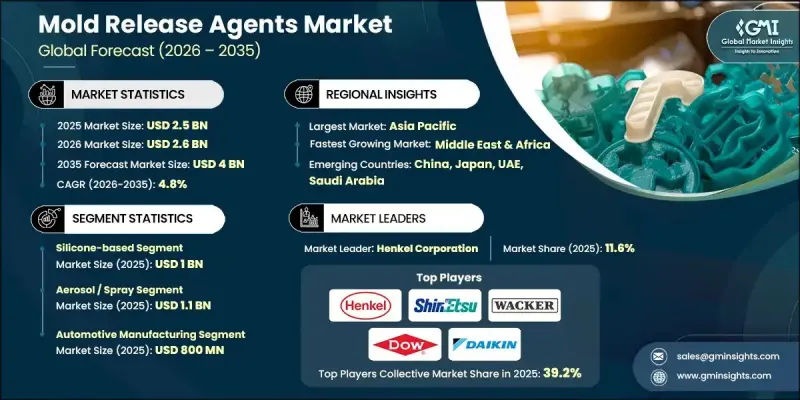
The demand for mold release agents is being driven by the automotive sector's push for lighter vehicles and improved fuel efficiency, which has increased the use of plastics, rubber, and composite components. Advanced materials such as reinforced plastics and composites require high-performance release solutions to ensure defect-free surfaces and precise dimensional accuracy, particularly in high-volume manufacturing. The adoption of lightweight components in commercial and passenger vehicles supports sustained demand for specialty mold release products. Rising aerospace production, coupled with the increasing incorporation of composites in airframes and structural components, is also driving the need for advanced release agents that can handle complex geometries without defects. Additionally, the miniaturization of electronics and sophisticated semiconductor packaging is creating a growing need for release agents capable of ultra-fine, high-precision molding.
| Market Scope | |
|---|---|
| Start Year | 2025 |
| Forecast Year | 2026-2035 |
| Start Value | $2.5 Billion |
| Forecast Value | $4 Billion |
| CAGR | 4.8% |
The silicone-based agents segment reached USD 1 billion in 2025. These products are widely preferred in automotive, plastics, rubber, and composite production due to their high thermal stability, excellent release performance, and broad compatibility with molding materials, making them ideal for high-volume, precision manufacturing.
The aerosol and spray formulations segment generated USD 1.1 billion in 2025. The popularity of these forms is driven by their ability to provide uniform coverage, precise application, and lower labor intensity, making them suitable for automated and large-scale production lines. Their consistent performance on intricate mold surfaces makes them highly versatile across multiple industries.
North America Mold Release Agents Market accounted for 39.2% share in 2025, supported by a mature manufacturing ecosystem. The United States is the leading regional consumer, driven by automotive production, aerospace composites, high-precision plastics, and rubber molding industries, where uniform demolding and surface quality are critical. Growth is further bolstered by the adoption of water-based, low-VOC, and PFAS-free formulations under stringent environmental and workplace safety regulations.
Key players in the Mold Release Agents Market include Henkel Corporation, Wacker Chemie AG, Daikin Industries Ltd., Chem-Trend L.P., DOW, Shin-Etsu Chemical Co. Ltd., Michelman, Cresset Chemical Company, Marbocote Ltd., AXEL Plastics Research Laboratories, LORD Corporation, Croda International Plc, Grignard Company LLC, and REXCO. Companies in the Mold Release Agents Market are strengthening their foothold by investing in R&D to develop high-performance, environmentally friendly formulations that meet global compliance standards. Strategic partnerships with automotive, aerospace, and electronics manufacturers help expand the adoption of specialized agents. Firms are also focusing on geographic expansion, targeting regions with growing automotive, aerospace, and semiconductor industries.
Table of Contents
Chapter 1 Methodology & Scope
- 1.1 Market scope and definition
- 1.2 Research design
- 1.2.1 Research approach
- 1.2.2 Data collection methods
- 1.3 Data mining sources
- 1.3.1 Global
- 1.3.2 Regional/Country
- 1.4 Base estimates and calculations
- 1.4.1 Base year calculation
- 1.4.2 Key trends for market estimation
- 1.5 Primary research and validation
- 1.5.1 Primary sources
- 1.6 Forecast model
- 1.7 Research assumptions and limitations
Chapter 2 Executive Summary
- 2.1 Industry 3600 synopsis
- 2.2 Key market trends
- 2.2.1 Regional
- 2.2.2 Product Type
- 2.2.3 Form
- 2.2.4 End Use Industry
- 2.3 TAM Analysis, 2026-2035
- 2.4 CXO perspectives: Strategic imperatives
- 2.4.1 Executive decision points
- 2.4.2 Critical success factors
- 2.5 Future Outlook and Strategic Recommendations
Chapter 3 Industry Insights
- 3.1 Industry ecosystem analysis
- 3.1.1 Supplier Landscape
- 3.1.2 Profit Margin
- 3.1.3 Value addition at each stage
- 3.1.4 Factor affecting the value chain
- 3.1.5 Disruptions
- 3.2 Industry impact forces
- 3.2.1 Growth drivers
- 3.2.1.1 Rapid growth in automotive manufacturing & lightweighting
- 3.2.1.2 Aerospace industry expansion & composite material adoption
- 3.2.1.3 Electronics miniaturization & semiconductor packaging growth
- 3.2.2 Industry pitfalls and challenges
- 3.2.2.1 Stringent VOC emission regulations
- 3.2.2.2 Raw material price volatility
- 3.2.3 Market opportunities
- 3.2.3.1 Growing demand from automotive and aerospace industries
- 3.2.3.2 Shift toward eco-friendly and water-based formulations
- 3.2.1 Growth drivers
- 3.3 Growth potential analysis
- 3.4 Regulatory landscape
- 3.4.1 North America
- 3.4.2 Europe
- 3.4.3 Asia Pacific
- 3.4.4 Latin America
- 3.4.5 Middle East & Africa
- 3.5 Porter';s analysis
- 3.6 PESTEL analysis
- 3.7 Price trends
- 3.7.1 By region
- 3.7.2 Product type
- 3.8 Future market trends
- 3.9 Technology and Innovation Landscape
- 3.9.1 Current technological trends
- 3.9.2 Emerging technologies
- 3.10 Patent Landscape
- 3.11 Trade statistics (HS code) (Note: the trade statistics will be provided for key countries only)
- 3.11.1 Major importing countries
- 3.11.2 Major exporting countries
- 3.12 Sustainability and environmental aspects
- 3.12.1 Sustainable practices
- 3.12.2 Waste reduction strategies
- 3.12.3 Energy efficiency in production
- 3.12.4 Eco-friendly initiatives
- 3.13 Carbon footprint considerations
Chapter 4 Competitive Landscape, 2025
- 4.1 Introduction
- 4.2 Company market share analysis
- 4.2.1 By region
- 4.2.1.1 North America
- 4.2.1.2 Europe
- 4.2.1.3 Asia Pacific
- 4.2.1.4 LATAM
- 4.2.1.5 MEA
- 4.2.1 By region
- 4.3 Company matrix analysis
- 4.4 Competitive analysis of major market players
- 4.5 Competitive positioning matrix
- 4.6 Key developments
- 4.6.1 Mergers & acquisitions
- 4.6.2 Partnerships & collaborations
- 4.6.3 New product launches
- 4.6.4 Expansion plans
Chapter 5 Market Estimates and Forecast, By Product Type, 2022 - 2035 (USD Billion) (Kilo Tons)
- 5.1 Key trends
- 5.2 Silicone-based
- 5.2.1 Polydimethylsiloxane (PDMS)
- 5.2.2 Silicone emulsions (Water-Based)
- 5.3 Wax-based
- 5.3.1 Paraffin wax
- 5.3.2 Metallic stearates
- 5.3.2.1 Zinc
- 5.3.2.2 Calcium
- 5.3.2.3 Magnesium
- 5.3.3 Fatty acids
- 5.4 Natural/bio-based
- 5.4.1 Vegetable oil-based
- 5.4.2 Animal fat-based
- 5.5 Petroleum/mineral oil-based
- 5.5.1 Mineral spirits
- 5.5.2 Specialty petroleum lubricants
- 5.6 Nanotechnology-based
- 5.6.1 Hydrophobic nanoparticle
- 5.6.2 Fumed silica-based
- 5.7 Hybrid/specialty formulations
- 5.7.1 Silicone-fluoropolymer hybrids
- 5.7.2 Wax-silicone blends
- 5.7.3 Multi-functional
Chapter 6 Market Estimates and Forecast, By Form, 2022 - 2035 (USD Billion) (Kilo Tons)
- 6.1 Key trends
- 6.2 Liquid
- 6.2.1 Water-based
- 6.2.2 Solvent-based
- 6.3 Aerosol / spray
- 6.4 Powder / paste
- 6.5 Emulsion
Chapter 7 Market Estimates and Forecast, By End Use Industry, 2022 - 2035 (USD Billion) (Kilo Tons)
- 7.1 Key trends
- 7.2 Automotive manufacturing
- 7.3 Aerospace manufacturing
- 7.3.1 Composite molding
- 7.3.2 Structural components
- 7.3.3 Interior parts
- 7.4 Construction & precast concrete
- 7.4.1 Concrete formwork
- 7.4.2 Precast concrete products
- 7.4.3 Architectural concrete
- 7.4.4 Stamped/decorative concrete
- 7.4.5 Self-consolidating concrete (SCC)
- 7.4.6 Ultra-high-performance concrete (UHPC)
- 7.5 Electronics & semiconductor manufacturing
- 7.5.1 Semiconductor encapsulation
- 7.5.2 Electronic component molding
- 7.5.3 Plastic housing & casings
- 7.6 Medical device manufacturing
- 7.6.1 Silicone medical device molding
- 7.6.2 Catheter production
- 7.6.3 Implantable device components
- 7.7 Industrial manufacturing
- 7.8 Others
Chapter 8 Market Estimates and Forecast, By Region, 2022 - 2035 (USD Billion) (Kilo Tons)
- 8.1 Key trends
- 8.2 North America
- 8.2.1 U.S.
- 8.2.2 Canada
- 8.3 Europe
- 8.3.1 Germany
- 8.3.2 UK
- 8.3.3 France
- 8.3.4 Spain
- 8.3.5 Italy
- 8.3.6 Rest of Europe
- 8.4 Asia Pacific
- 8.4.1 China
- 8.4.2 India
- 8.4.3 Japan
- 8.4.4 Australia
- 8.4.5 South Korea
- 8.4.6 Rest of Asia Pacific
- 8.5 Latin America
- 8.5.1 Brazil
- 8.5.2 Mexico
- 8.5.3 Rest of Latin America
- 8.6 Middle East and Africa
- 8.6.1 Saudi Arabia
- 8.6.2 South Africa
- 8.6.3 UAE
- 8.6.4 Rest of Middle East and Africa
Chapter 9 Company Profiles
- 9.1 AXEL Plastics Research Laboratories
- 9.2 Chem-Trend L.P.
- 9.3 Cresset Chemical Company
- 9.4 Croda International Plc
- 9.5 Daikin Industries Ltd.
- 9.6 Grignard Company LLC
- 9.7 Henkel Corporation
- 9.8 LORD Corporation
- 9.9 Marbocote Ltd.
- 9.10 Michelman
- 9.11 REXCO
- 9.12 Shin-Etsu Chemical Co. Ltd.
- 9.13 Wacker Chemie AG
- 9.14 DOW

